Vyborg Castle
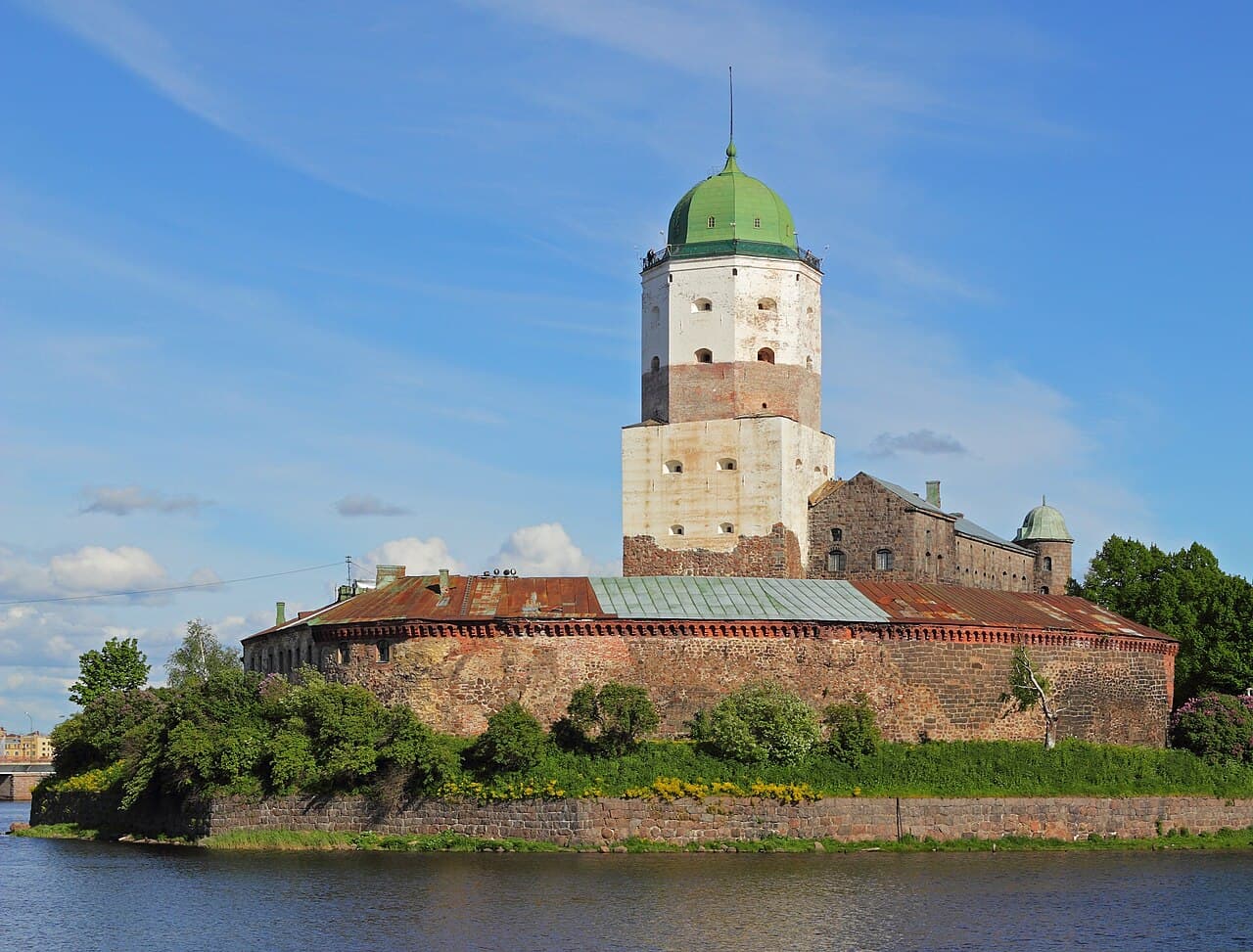
Vyborg Castle stands as a significant medieval fortress located on a small island in the Gulf of Finland, within the Republic of Karelia, Russian Federation. Founded in 1293 by Swedish forces under the command of Torkel Knutsson, the castle was established as the easternmost outpost of the Kingdom of Sweden during the High Medieval period. Its strategic position on the Karelian Isthmus allowed control over the vital Bay of Vyborg, a longstanding commercial hub, and access to inland waterways connecting to several districts, lakes, and ultimately to the rivers flowing to Lake Ladoga.
Early history and strategic importance
Originally constructed as a hill castle on a small island, Vyborg Castle replaced an earlier fortified Karelian settlement destroyed by Swedish crusaders during the so-called Third Finnish Crusade against the Novgorod Republic. The fortress was designed to serve as a defensive bastion against Russian advances and to secure Swedish territorial claims in Karelia. Throughout the 14th century, the castle withstood multiple sieges by Novgorod forces, notably in 1294 and 1322, maintaining Swedish control. The 1323 Treaty of Nöteborg formally established the border between Sweden and Novgorod along the Sestra River, confirming Vyborg as Swedish territory.
Architectural evolution and fortifications
The castle's layout is centered on a raised area called the upper ward, enclosed by thick stone walls forming an irregular four-cornered plan. The dominant feature is the St. Olaf's Tower, originally a massive square keep with walls approximately four meters thick. In the 16th century, under King Gustav Vasa, the tower was heightened to seven stories and topped with an octagonal upper section featuring embrasures for cannon fire, marking a significant advancement in military architecture and the first use of brick masonry in the tower's construction.
Surrounding the main castle is the lower courtyard, fortified by a perimeter defensive wall and several square towers including the Fire Tower, Watch Tower, New Tower, and Shoemaker's Tower. These fortifications were incrementally expanded throughout the 15th and late 15th centuries, reflecting the castle's growing military importance. Additional defensive works included stone-faced earthworks replacing earlier wooden palisades and battlements atop walls providing cover for defenders on wooden galleries.
Interior structures and amenities
Within the castle complex, various functional buildings supported its military and administrative roles. These included arsenals, a wine cellar, a smithy courtyard, a prison, and barracks constructed along the northwest outer wall in the 17th century. Living quarters were enhanced with tiled stoves for heating and wooden paneling inside St. Olaf's Tower, while the upper courtyard was paved with stone to improve durability and comfort. Landscaping efforts added several ponds, one featuring a fountain designed by architect Wevel, adding aesthetic value to the fortress grounds.
Historical significance and notable figures
Vyborg Castle served as a critical military stronghold and administrative center for the Swedish realm in Karelia. It was one of the three major Finnish castle fiefs alongside Turku and Hämeenlinna until the 1360s. The castle's fief, known as the margraviate of Viborg, became a virtually autonomous principality governed by powerful nobles such as Bo Jonsson Grip, Christer Nilsson Vasa, Karl Knutsson Bonde (later King of Sweden), Eric Axelsson Tott, Knut Posse, and Sten Sture the Elder.
The castle was repeatedly besieged during conflicts with Russia, most famously during the Russo-Swedish War of 1495-1497. Governor Knut Posse led the defense during the 1495 siege, which ended dramatically with the mysterious Viborg blast—an explosion that reportedly frightened the Russian besiegers with an apparition of a St. Andrew's cross in the sky, forcing their retreat.
Later history and restoration
In the 17th century, as the Russian threat diminished and the border moved eastward, the castle gradually fell into disrepair. It was captured by Russian forces in 1710 during the Great Northern War but was returned to Finnish control in 1812 when Old Finland was incorporated into the autonomous Grand Duchy of Finland. Extensive restorations in the 1890s by Russian military engineers preserved the castle's exterior while modifying the interior, replacing medieval stone vaults with wooden ceilings and adding new windows and staircases.
Throughout the 20th century, Vyborg Castle saw military use by the Russian Empire until 1918 and was part of independent Finland between 1917–1940 and 1941–1944. After World War II, it was annexed by the Soviet Union in 1944. The castle sustained minor damage during wartime and has since functioned as a museum, officially designated the State Museum "Vyborg Castle" since 1999. Ongoing restoration and archaeological research have revealed earlier Karelian fortifications beneath the castle and artifacts such as a 16th-century brick repurposed as a game board.
Architectural legacy and present day
Today, Vyborg Castle is one of the best-preserved examples of medieval Western European military architecture within Russian territory. Its thick defensive walls, imposing towers, and layered fortifications illustrate the evolution of castle design from the High Medieval period through the Renaissance. The castle's location on a small island with natural water defenses, combined with its robust construction, made it a formidable stronghold for centuries.
Visitors can explore the castle's St. Olaf's Tower, the surrounding defensive walls, and the various historic buildings within the complex. The castle's museum offers insights into its rich history, military significance, and architectural development. The panoramic views from the tower provide a striking perspective over the Gulf of Finland and the town of Vyborg, highlighting the castle's enduring strategic importance.
Frequently asked questions (FAQ)
- How do I get to Vyborg Castle?
- Vyborg Castle is accessible by various means of transportation. Visitors can take a train or bus from Saint Petersburg, which takes about 2-3 hours. Once in Vyborg, the castle is within walking distance from the city center.
- What is the historical significance of Vyborg Castle?
- Vyborg Castle, founded in the 13th century, is one of the most important medieval fortifications in Russia. It served as a strategic military stronghold and a center of power for various rulers, including the Swedes and the Russians. Today, it stands as a symbol of the city's rich history and cultural heritage.
- When was Vyborg Castle built?
- Construction of Vyborg Castle began in 1293 and was completed in the following decades. The castle has undergone numerous renovations and expansions over the centuries, reflecting different architectural styles and historical periods. Its current structure mainly dates back to the late Middle Ages.
- Can I visit Vyborg Castle year-round?
- Yes, Vyborg Castle is open to visitors year-round, although opening hours may vary by season. It is advisable to check the official website for the latest information on visiting hours and any potential closures due to events or renovations. The castle offers guided tours to enhance your experience.
- Why is Vyborg Castle a popular tourist attraction?
- Vyborg Castle attracts visitors due to its impressive medieval architecture and stunning views of the surrounding area. The castle hosts various cultural events, exhibitions, and festivals throughout the year, making it a vibrant part of Vyborg’s community. Its historical significance and picturesque setting also make it a must-see for history buffs and photographers.
- Is it possible to take guided tours at Vyborg Castle?
- Yes, guided tours are available at Vyborg Castle, providing visitors with in-depth knowledge about its history and architecture. Tours are typically offered in multiple languages, catering to a diverse audience. It's recommended to book in advance during peak tourist seasons to ensure availability.
- What are the ticket prices for Vyborg Castle?
- Ticket prices for Vyborg Castle are quite reasonable, with discounts available for students, seniors, and children. Prices may vary based on the type of tour you choose, such as general admission or guided tours. Check the castle's official website for the most up-to-date pricing information.
- When is the best time to visit Vyborg Castle?
- The best time to visit Vyborg Castle is during the late spring and summer months when the weather is mild and pleasant. This period also coincides with numerous cultural events and festivals held at the castle. Fall can also be a beautiful time to visit, with vibrant autumn colors enhancing the experience.
- Are there any nearby attractions to visit after Vyborg Castle?
- Yes, there are several attractions near Vyborg Castle that visitors can explore. The charming Old Town of Vyborg, the Vyborg Market Square, and the Monrepo Park are all within walking distance. Each of these sites provides a unique glimpse into the history and culture of the region.
Photo gallery

Information
Website
Visit websiteSources & official resources
Verify the information above using these authoritative references.
Loading map...
Visitor reviews
No reviews yet. Been here? Write the first review and help other travelers!
Write the first reviewVisited this castle? Share your experience
Your review helps other travelers and adds first-hand knowledge to our encyclopedia.