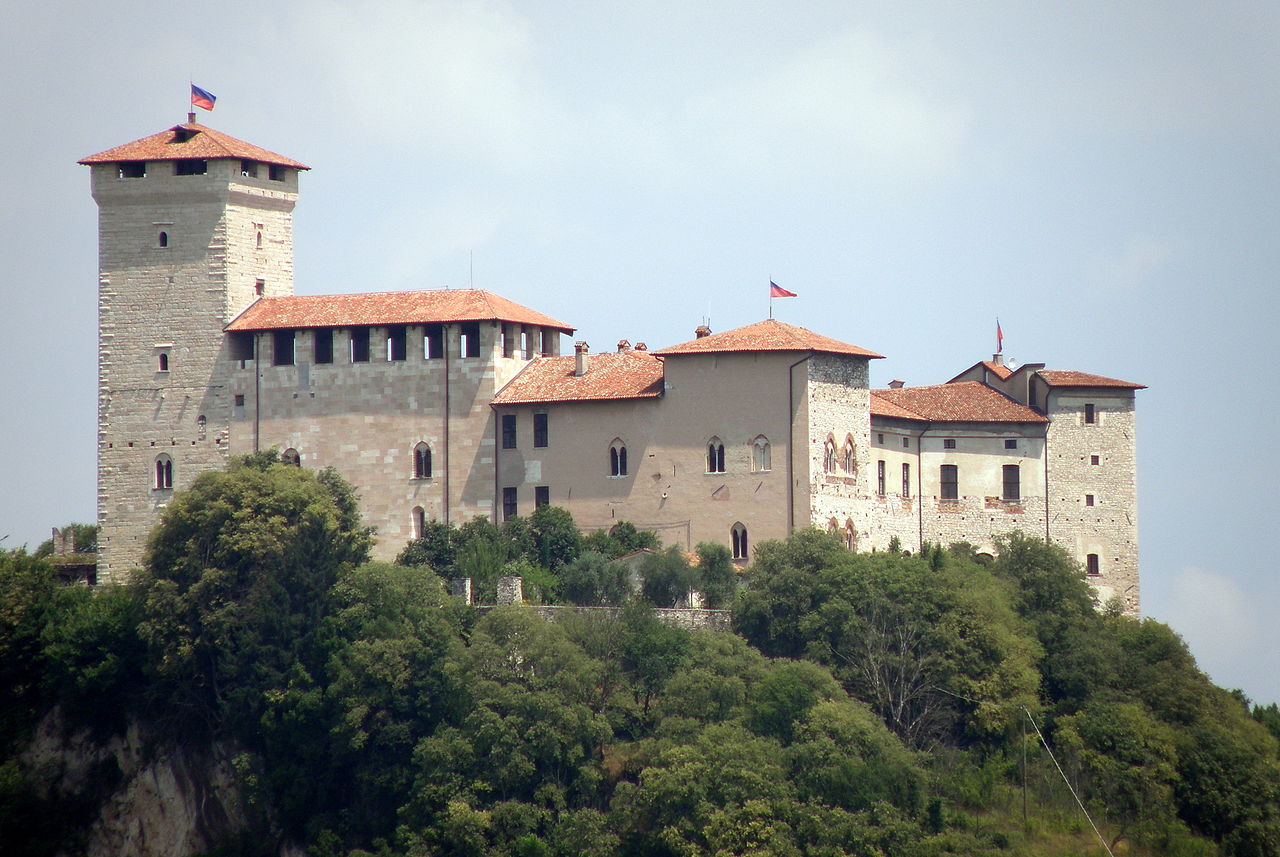
Visconti di San Vito Castle

Visconti di San Vito Castle in Somma Lombardo, Italy
Somma Lombardo, Italy
High Medieval (11th–13th c.)
Partially Preserved

Visconti di San Vito Castle, also known locally as Castello di Visconti di San Vito, is situated in the heart of Somma Lombardo, within the Varese province of the Lombardy region in Italy. This historic fortress occupies a strategic position near the Ticino river, a crucial defensive line historically connecting Milan and Lake Maggiore.

The site where the castle stands has origins tracing back to the 9th century, with early buildings documented from that period. However, the main fortress as it appears today largely dates from the 13th century, around 1250, constructed as part of a broader defensive network protecting the region. The castle's architecture reflects its evolution over centuries, incorporating multiple adjoining residences and structures that were once encircled by a single moat, enhancing its defensive capabilities.

Historical significance and ownership

The castle became closely associated with the powerful Visconti family, specifically the San Vito branch, who held lordship over Somma Lombardo for an extended period. In 1448, brothers Francesco and Guido Visconti sought refuge within the castle to escape the turmoil following the death of Filippo Maria Visconti, the last Duke of Milan from the Visconti dynasty. This event marked the end of Visconti rule over Milan and the rise of the Golden Ambrosian Republic, against which the brothers were in conflict.

Following their refuge, the brothers divided the castle and surrounding lands between themselves. Francesco took control of the newer sections of the castle, from which the Visconti di San Vito lineage descends, while Guido inherited the older, lower parts, leading to the Visconti di Modrone branch. This division contributed to the castle's complex layout, a blend of various architectural phases and residential additions.

Architectural features and artistic heritage

The castle's structure is a composite of medieval fortifications and residential buildings, unified historically by a protective moat. Its walls and towers exhibit characteristics typical of medieval defensive architecture, including battlements and fortified gates. Over time, the castle's interiors were embellished with significant artworks, reflecting Renaissance influences.

Notably, the castle houses frescoes attributed to the school of Camillo Procaccini, an important figure in late Renaissance painting. Additionally, it contains an altarpiece by Cerano, adding to its cultural and artistic value. The castle also preserves an extensive collection of barber plates, which are historical artifacts related to local traditions.

Modern use and public access

Ownership of the castle remained with the Visconti family until 1997, when it was bequeathed to the Visconti di San Vito Foundation. The foundation is responsible for the castle's maintenance and has opened parts of the property to the public. Visitors can explore the castle through guided tours, which provide insights into its layered history and architectural evolution.

While some sections of the castle are reserved for private events, the public areas offer a glimpse into the castle's past and its artistic treasures. The castle's complex layout, combining defensive and residential elements, alongside its rich collection of artworks, makes it a significant heritage site in Lombardy.

Location and surroundings

Located at Piazza Scipione Publio Cornelio 2, the castle is centrally positioned in Somma Lombardo, making it accessible for visitors interested in medieval architecture and Italian history. Its proximity to the Ticino river highlights its historical role in regional defense and control.

Visitors to Visconti di San Vito Castle can appreciate not only its architectural and historical importance but also its setting within the Lombardy region, known for its rich cultural landscape and numerous historic sites.

Frequently asked questions (FAQ)

When was Visconti di San Vito Castle originally built?
The earliest buildings on the site date back to the 9th century, but the main fortress was constructed around the 13th century, circa 1250.
Who were the Visconti brothers who took refuge in the castle?
Francesco and Guido Visconti were brothers who sought refuge in the castle in 1448 following conflicts after the death of Filippo Maria Visconti, the Duke of Milan.
Can visitors tour the castle today?
Yes, parts of Visconti di San Vito Castle are open for guided tours, although some sections are used for private events.
What notable artworks are found inside the castle?
The castle contains frescoes attributed to the school of Camillo Procaccini and an altarpiece by Cerano, reflecting its Renaissance artistic heritage.
How is the castle architecturally classified?
Visconti di San Vito Castle is a hill castle featuring a mix of medieval fortifications and residential buildings, historically surrounded by a moat.

Information

Hill Castle

Ticket prices

Fee required

Current owner

Visconti di San Vito Foundation

Address

Piazza Scipione Publio Cornelio 2, Italy

Loading map...

Visitor reviews

No reviews yet. Been here? Write the first review and help other travelers!

Write the first review

Visited this castle? Share your experience

Your review helps other travelers and adds first-hand knowledge to our encyclopedia.

Write a review

(5/5)

0/2000 characters

Your review will be visible after admin approval

Nearby castles

6.3 km

Cassino Scanasio Castle

Gallarate, Italy

The Visconti Castle of Crenna stands as a significant medieval fortress located on the summit of Crenna hill overlooking the Arno valley near Gallarate, Italy. Its strategic position, open toward the Milan plain, was crucial for territorial control, marking the site as an early settlement and fortification hub. The castle first appears in historical records in 1160, situating it firmly within the High Medieval period. Early history and visconti family connections The castle is closely associated with the Visconti family, a powerful dynasty that played a central role in the history of Milan and Lombardy. In the late 13th century, Pietro Visconti inherited the castle along with nearby fortifications such as Besnate, Orago, and Jerago, dividing these properties among family members. Pietro's son, Lodrisio Visconti, became a prominent figure who expanded the castle significantly. Lodrisio's life was marked by conflict and reconciliation with his cousin Matteo Visconti, the Lord of Milan, reflecting the turbulent political landscape of the time. Conflicts and expansions in the 14th century During the 14th century, the castle underwent phases of expansion and destruction tied to Lodrisio's fortunes. After the death of Matteo Visconti in 1322, Lodrisio clashed with his sons and was eventually forced out of Crenna, leading to the castle's partial destruction. Lodrisio later formed the Compagnia di San Giorgio, a mercenary company, and was defeated in the Battle of Parabiago in 1339 by forces loyal to Azzone Visconti, Matteo's grandson. Following this defeat, Lodrisio reconciled with his cousins, and the castle was restored, becoming the seat of the Visconti di Crenna branch. Architectural features and later modifications The castle's original medieval structure included defensive walls, a prominent tower, and fortifications adapted to the hilltop terrain. Over the centuries, the castle's architecture evolved, especially during the 16th and 17th centuries when it was modified to suit changing residential and defensive needs amid family divisions. The late 19th and early 20th centuries saw significant transformations, including the addition of revival-style elements that altered its medieval character. Current condition and visibility Today, only parts of the ancient castle remain, including a notable tower and some revival-style constructions visible from the center of Crenna. The castle area is partly surrounded by modern buildings, but it remains a recognizable landmark atop the hill, visible from a distance. Its preservation status can be considered partially preserved due to these surviving structures and ongoing recognition of its historical significance. Historical significance and legacy The Visconti Castle of Crenna exemplifies the complex feudal and familial dynamics of medieval Lombardy. It reflects the military and political struggles of the Visconti family, who shaped the region's history. The castle's location and architecture illustrate the strategic importance of hilltop fortifications in controlling territory and defending against rival factions during the High Medieval period. Despite changes and partial destruction, the castle's legacy endures in the local landscape and heritage. It offers insight into medieval fortification techniques, noble family power struggles, and the evolution of castle architecture through the Renaissance and into modern times.

High Medieval (11th–13th c.)
Details
12.9 km

Castelseprio

Castelseprio, Italy

Castelseprio, located in northern Italy, is a significant early medieval archaeological site that originated as a Roman fort commanding a strategic crossroads. This site later evolved into a fortified Lombard town during the early Middle Ages, reflecting the complex history of northern Italy between the 4th and 13th centuries. Although the original fortifications and structures were destroyed in 1287, the site today preserves remarkable ruins and exceptional early medieval frescoes that offer insight into Lombard art and architecture. The Roman origins and Lombard transformation Castelseprio began as a Roman military fortification built in the 4th century AD, designed to control vital routes in the region. Its location was strategically chosen to oversee important crossroads, facilitating military and commercial control. With the decline of Roman authority, the site was occupied and transformed by the Lombards, a Germanic people who ruled parts of Italy during the early Middle Ages. The Lombards fortified the Roman remains, converting the site into a small fortified town or citadel that served both defensive and administrative functions. Lombard political and economic significance During Lombard rule, Castelseprio gained prominence, evidenced by the minting of coins at the site, an indication of its economic and political importance. The fortified town included defensive walls and several religious buildings, reflecting the integration of military and ecclesiastical power. The Lombard occupation marked a period of cultural and architectural transition, blending Roman military engineering with early medieval fortification techniques. Architectural and religious structures at Castelseprio The archaeological zone of Castelseprio encompasses the remains of several key structures, including defensive walls, religious buildings, and ancillary constructions. Among the most notable are three churches and a baptistry that illustrate the evolution of ecclesiastical architecture from the 5th to the 12th centuries. Church of Santa Maria foris portas Located just outside the fortified walls, the Church of Santa Maria foris portas (Latin for "outside the gates") is renowned for its Byzantinesque frescoes. These frescoes, uncovered in 1944 beneath later plaster layers, are exceptionally rare examples of early medieval art in northern Italy. The fresco cycle shows strong Byzantine influence, with sophisticated iconography and stylistic features that have sparked scholarly debate regarding their precise dating and the origins of their artists. Current research suggests a date in the first half of the 9th century. Basilica of San Giovanni Evangelista Within the citadel lie the remains of the three-aisled Basilica of San Giovanni Evangelista, dating from the 5th century. This basilica represents early Christian architectural forms, with its longitudinal plan and multiple aisles designed to accommodate congregations and liturgical functions. The basilica's ruins provide valuable evidence of early medieval religious life and architectural continuity from the Roman period. Baptistry of St. John the Baptist The baptistry, dating between the 5th and 7th centuries, features an octagonal plan with a small eastern apse. It contains two baptismal fonts, which may have been used for different rites or liturgical purposes. This baptistry is a significant example of early medieval Christian architecture and ritual practice, illustrating the importance of baptism in the religious life of the community. Church of San Paolo The Church of San Paolo has a central hexagonal plan and was constructed between the 6th and 12th centuries. This building reflects evolving architectural styles and religious functions over several centuries, highlighting the site's continuous occupation and adaptation during the early and high medieval periods. Destruction and decline in the late 13th century In 1287, Ottone Visconti, Archbishop of Milan, captured Castelseprio and ordered its complete destruction to prevent its use by rival factions. This event marked the end of Castelseprio as a fortified town and led to its abandonment. The destruction was thorough, leaving only ruins and archaeological traces of the once-thriving Lombard settlement. Rediscovery and archaeological significance Archaeological investigations began in 1934, with major discoveries occurring in 1944 when the Byzantinesque frescoes in the Church of Santa Maria foris portas were uncovered. These frescoes have since been recognized as some of the most important examples of early medieval art in Europe, shedding light on the cultural exchanges between the Lombards and the Byzantine world. The site today is preserved as an archaeological park, featuring the remains of the walls, churches, baptistry, and other structures. Nearby stands the Torba Tower, a large tower once used as a convent, which is part of the broader complex protected under the UNESCO World Heritage designation. UNESCO World Heritage status and cultural importance In 2011, Castelseprio, including the Church of Santa Maria foris portas and the Torba Tower, was inscribed as a UNESCO World Heritage Site. It is part of the group "Longobards in Italy, Places of Power (568-774 A.D.)", which recognizes sites associated with the Lombard presence in Italy. This designation highlights Castelseprio's significance as a cultural and historical monument, preserving invaluable evidence of early medieval Lombard civilization and its artistic achievements.

Early Medieval (5th–10th c.)
Details
14.3 km
Rocca Borromeo di Angera — Italy castle

Rocca Borromeo di Angera

Angera, Italy

The Rocca Borromeo di Angera, also known as Rocca d'Angera or Borromeo Castle, is a prominent hill castle situated above the town of Angera in the Province of Varese, northern Italy. Perched strategically on a rocky promontory overlooking the southern shores of Lago Maggiore, the fortress offers commanding views across the lake and the surrounding landscape. It has a rich history dating back to the medieval period, reflecting the military and residential architecture of northern Italy through several centuries. The castle originally belonged to the Archbishop of Milan, an indication of its importance in the ecclesiastical and political landscape of the region during the Middle Ages. Subsequently, control passed to the powerful Visconti family, rulers of Milan, who enhanced its fortifications and residential quarters. In the late medieval period, the castle came into the possession of the Borromeo family, one of the most influential noble families in Lombardy, who have maintained ownership to the present day, preserving the castle as a cultural and historical monument. Architectural layout and defensive features The Rocca Borromeo di Angera is composed of four main sections constructed during different periods, which together form a cohesive defensive complex around a central internal courtyard. The castle's design exemplifies the evolution of medieval military architecture, combining robust fortifications with residential spaces. On the northeastern side, a fortified wall extends beyond the main structure, featuring corner turrets that enhance the castle's defensive capabilities. This wall curves toward the lake, terminating at the edge of a cliff where it encloses a garden. The garden area provides a rare blend of military and leisure functions within the fortress, reflecting the transition of castles from purely defensive strongholds to noble residences. Historical significance and ownership The castle's history is closely intertwined with the political dynamics of northern Italy. Initially under the Archbishopric of Milan, the fortress served as a strategic point of control over the southern shores of Lago Maggiore. The transfer to the Visconti family marked a period of expansion and fortification, as the Visconti sought to consolidate their power in the region. From the late 14th century onward, the Borromeo family took possession of the castle. The Borromeos were instrumental in maintaining and restoring the fortress, adapting it to changing military technologies and residential needs. Their stewardship ensured the castle's preservation through turbulent periods, including wars and political upheaval in Lombardy. Relationship with rocca di arona The Rocca Borromeo di Angera is prominently visible from across Lago Maggiore, particularly from the town of Arona. There, the ruins of the Rocca di Arona stand, another fortress historically linked to the same lineage of ownership, passing through the archbishopric, Visconti, and Borromeo families. This geographical and historical connection underscores the strategic importance of controlling both shores of the lake for defense and regional influence. Cultural heritage and current status Today, the Rocca Borromeo di Angera remains under the ownership of the Borromeo family and functions as a cultural landmark. The castle is well preserved, allowing visitors to explore its medieval architecture, including the towers, walls, and courtyards. It hosts exhibitions, cultural events, and offers panoramic views of Lago Maggiore, making it an important tourist destination. The castle's preservation reflects the ongoing commitment to maintaining Italy's medieval heritage and provides insight into the architectural and social history of the region. Its combination of military and residential features illustrates the multifaceted role of castles in northern Italy during the Middle Ages and Renaissance.

Details