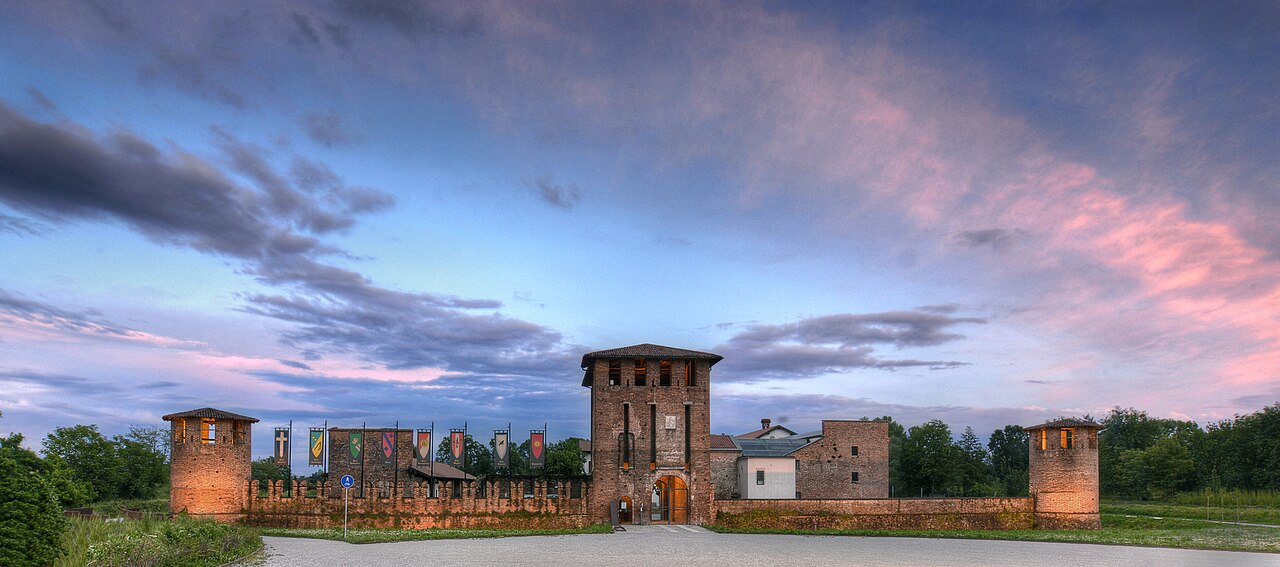
Cassino Scanasio Castle

Visconti castle of crenna in gallarate, italy
Gallarate, Italy
High Medieval (11th–13th c.)
Partially Preserved

The Visconti Castle of Crenna stands as a significant medieval fortress located on the summit of Crenna hill overlooking the Arno valley near Gallarate, Italy. Its strategic position, open toward the Milan plain, was crucial for territorial control, marking the site as an early settlement and fortification hub. The castle first appears in historical records in 1160, situating it firmly within the High Medieval period.

Early history and visconti family connections

The castle is closely associated with the Visconti family, a powerful dynasty that played a central role in the history of Milan and Lombardy. In the late 13th century, Pietro Visconti inherited the castle along with nearby fortifications such as Besnate, Orago, and Jerago, dividing these properties among family members. Pietro's son, Lodrisio Visconti, became a prominent figure who expanded the castle significantly. Lodrisio's life was marked by conflict and reconciliation with his cousin Matteo Visconti, the Lord of Milan, reflecting the turbulent political landscape of the time.

Conflicts and expansions in the 14th century

During the 14th century, the castle underwent phases of expansion and destruction tied to Lodrisio's fortunes. After the death of Matteo Visconti in 1322, Lodrisio clashed with his sons and was eventually forced out of Crenna, leading to the castle's partial destruction. Lodrisio later formed the Compagnia di San Giorgio, a mercenary company, and was defeated in the Battle of Parabiago in 1339 by forces loyal to Azzone Visconti, Matteo's grandson. Following this defeat, Lodrisio reconciled with his cousins, and the castle was restored, becoming the seat of the Visconti di Crenna branch.

Architectural features and later modifications

The castle's original medieval structure included defensive walls, a prominent tower, and fortifications adapted to the hilltop terrain. Over the centuries, the castle's architecture evolved, especially during the 16th and 17th centuries when it was modified to suit changing residential and defensive needs amid family divisions. The late 19th and early 20th centuries saw significant transformations, including the addition of revival-style elements that altered its medieval character.

Current condition and visibility

Today, only parts of the ancient castle remain, including a notable tower and some revival-style constructions visible from the center of Crenna. The castle area is partly surrounded by modern buildings, but it remains a recognizable landmark atop the hill, visible from a distance. Its preservation status can be considered partially preserved due to these surviving structures and ongoing recognition of its historical significance.

Historical significance and legacy

The Visconti Castle of Crenna exemplifies the complex feudal and familial dynamics of medieval Lombardy. It reflects the military and political struggles of the Visconti family, who shaped the region's history. The castle's location and architecture illustrate the strategic importance of hilltop fortifications in controlling territory and defending against rival factions during the High Medieval period.

Despite changes and partial destruction, the castle's legacy endures in the local landscape and heritage. It offers insight into medieval fortification techniques, noble family power struggles, and the evolution of castle architecture through the Renaissance and into modern times.

Frequently asked questions (FAQ)

What is the historical significance of Cassino Scanasio Castle?
Cassino Scanasio Castle, located in Gallarate, Italy, dates back to the 13th century and played a crucial role in the region's defense and governance. Its strategic position allowed it to oversee important trade routes, making it a key fortification during medieval times. Today, it stands as a testament to the architectural styles and historical events that shaped the area.
When was Cassino Scanasio Castle built?
The construction of Cassino Scanasio Castle began in the 13th century, specifically around the year 1245. Over the centuries, it has undergone various renovations and restorations, reflecting the architectural trends of different periods. This makes the castle a fascinating study for those interested in medieval architecture and history.
What are the opening hours for visitors?
Cassino Scanasio Castle is open to visitors from Tuesday to Sunday, from 10 AM to 5 PM. It is recommended to check the official website or contact the castle directly for any seasonal changes to these hours. Guided tours may also be available, enhancing your experience of the castle's rich history.
Is it possible to access Cassino Scanasio Castle with a disability?
Yes, Cassino Scanasio Castle is committed to being accessible to all visitors. While some areas may have historical limitations due to the castle's architecture, staff are available to assist with access where possible. It's advisable to contact the castle in advance to discuss specific accessibility needs.
Can I take photographs inside the castle?
Yes, visitors are encouraged to take photographs inside Cassino Scanasio Castle, as it offers numerous picturesque spots and stunning architectural details. However, it is important to be respectful of the site and other visitors while doing so. Some areas may have restrictions, so be sure to check for any signage regarding photography.
What is the best time to visit Cassino Scanasio Castle?
The best time to visit Cassino Scanasio Castle is during the spring and early autumn months when the weather is mild and pleasant. These seasons often see fewer crowds, allowing for a more enjoyable experience as you explore the grounds and take in the stunning views. Additionally, special events may be held during these times, enhancing your visit.
Are there any nearby attractions to visit?
Yes, there are several nearby attractions to explore after visiting Cassino Scanasio Castle. The city of Gallarate offers charming streets, local shops, and dining options, while the nearby Parco della Magana provides a beautiful natural setting for a leisurely walk. Additionally, the historic city of Varese is just a short drive away, featuring its own stunning landmarks.
How much do tickets cost for entry to the castle?
Tickets for Cassino Scanasio Castle are priced at €8 for adults, with discounts available for students and seniors. Children under 12 can enter for free when accompanied by an adult. Special family packages may also be available, making it an affordable outing for visitors of all ages.

Information

Hill Castle

Loading map...

Visitor reviews

No reviews yet. Been here? Write the first review and help other travelers!

Write the first review

Visited this castle? Share your experience

Your review helps other travelers and adds first-hand knowledge to our encyclopedia.

Write a review

(5/5)

0/2000 characters

Your review will be visible after admin approval

Nearby castles

6.3 km

Visconti di San Vito Castle

Somma Lombardo, Italy

Visconti di San Vito Castle, also known locally as Castello di Visconti di San Vito, is situated in the heart of Somma Lombardo, within the Varese province of the Lombardy region in Italy. This historic fortress occupies a strategic position near the Ticino river, a crucial defensive line historically connecting Milan and Lake Maggiore. The site where the castle stands has origins tracing back to the 9th century, with early buildings documented from that period. However, the main fortress as it appears today largely dates from the 13th century, around 1250, constructed as part of a broader defensive network protecting the region. The castle's architecture reflects its evolution over centuries, incorporating multiple adjoining residences and structures that were once encircled by a single moat, enhancing its defensive capabilities. Historical significance and ownership The castle became closely associated with the powerful Visconti family, specifically the San Vito branch, who held lordship over Somma Lombardo for an extended period. In 1448, brothers Francesco and Guido Visconti sought refuge within the castle to escape the turmoil following the death of Filippo Maria Visconti, the last Duke of Milan from the Visconti dynasty. This event marked the end of Visconti rule over Milan and the rise of the Golden Ambrosian Republic, against which the brothers were in conflict. Following their refuge, the brothers divided the castle and surrounding lands between themselves. Francesco took control of the newer sections of the castle, from which the Visconti di San Vito lineage descends, while Guido inherited the older, lower parts, leading to the Visconti di Modrone branch. This division contributed to the castle's complex layout, a blend of various architectural phases and residential additions. Architectural features and artistic heritage The castle's structure is a composite of medieval fortifications and residential buildings, unified historically by a protective moat. Its walls and towers exhibit characteristics typical of medieval defensive architecture, including battlements and fortified gates. Over time, the castle's interiors were embellished with significant artworks, reflecting Renaissance influences. Notably, the castle houses frescoes attributed to the school of Camillo Procaccini, an important figure in late Renaissance painting. Additionally, it contains an altarpiece by Cerano, adding to its cultural and artistic value. The castle also preserves an extensive collection of barber plates, which are historical artifacts related to local traditions. Modern use and public access Ownership of the castle remained with the Visconti family until 1997, when it was bequeathed to the Visconti di San Vito Foundation. The foundation is responsible for the castle's maintenance and has opened parts of the property to the public. Visitors can explore the castle through guided tours, which provide insights into its layered history and architectural evolution. While some sections of the castle are reserved for private events, the public areas offer a glimpse into the castle's past and its artistic treasures. The castle's complex layout, combining defensive and residential elements, alongside its rich collection of artworks, makes it a significant heritage site in Lombardy. Location and surroundings Located at Piazza Scipione Publio Cornelio 2, the castle is centrally positioned in Somma Lombardo, making it accessible for visitors interested in medieval architecture and Italian history. Its proximity to the Ticino river highlights its historical role in regional defense and control. Visitors to Visconti di San Vito Castle can appreciate not only its architectural and historical importance but also its setting within the Lombardy region, known for its rich cultural landscape and numerous historic sites.

High Medieval (11th–13th c.)
Details
8.6 km

Castelseprio

Castelseprio, Italy

Castelseprio, located in northern Italy, is a significant early medieval archaeological site that originated as a Roman fort commanding a strategic crossroads. This site later evolved into a fortified Lombard town during the early Middle Ages, reflecting the complex history of northern Italy between the 4th and 13th centuries. Although the original fortifications and structures were destroyed in 1287, the site today preserves remarkable ruins and exceptional early medieval frescoes that offer insight into Lombard art and architecture. The Roman origins and Lombard transformation Castelseprio began as a Roman military fortification built in the 4th century AD, designed to control vital routes in the region. Its location was strategically chosen to oversee important crossroads, facilitating military and commercial control. With the decline of Roman authority, the site was occupied and transformed by the Lombards, a Germanic people who ruled parts of Italy during the early Middle Ages. The Lombards fortified the Roman remains, converting the site into a small fortified town or citadel that served both defensive and administrative functions. Lombard political and economic significance During Lombard rule, Castelseprio gained prominence, evidenced by the minting of coins at the site, an indication of its economic and political importance. The fortified town included defensive walls and several religious buildings, reflecting the integration of military and ecclesiastical power. The Lombard occupation marked a period of cultural and architectural transition, blending Roman military engineering with early medieval fortification techniques. Architectural and religious structures at Castelseprio The archaeological zone of Castelseprio encompasses the remains of several key structures, including defensive walls, religious buildings, and ancillary constructions. Among the most notable are three churches and a baptistry that illustrate the evolution of ecclesiastical architecture from the 5th to the 12th centuries. Church of Santa Maria foris portas Located just outside the fortified walls, the Church of Santa Maria foris portas (Latin for "outside the gates") is renowned for its Byzantinesque frescoes. These frescoes, uncovered in 1944 beneath later plaster layers, are exceptionally rare examples of early medieval art in northern Italy. The fresco cycle shows strong Byzantine influence, with sophisticated iconography and stylistic features that have sparked scholarly debate regarding their precise dating and the origins of their artists. Current research suggests a date in the first half of the 9th century. Basilica of San Giovanni Evangelista Within the citadel lie the remains of the three-aisled Basilica of San Giovanni Evangelista, dating from the 5th century. This basilica represents early Christian architectural forms, with its longitudinal plan and multiple aisles designed to accommodate congregations and liturgical functions. The basilica's ruins provide valuable evidence of early medieval religious life and architectural continuity from the Roman period. Baptistry of St. John the Baptist The baptistry, dating between the 5th and 7th centuries, features an octagonal plan with a small eastern apse. It contains two baptismal fonts, which may have been used for different rites or liturgical purposes. This baptistry is a significant example of early medieval Christian architecture and ritual practice, illustrating the importance of baptism in the religious life of the community. Church of San Paolo The Church of San Paolo has a central hexagonal plan and was constructed between the 6th and 12th centuries. This building reflects evolving architectural styles and religious functions over several centuries, highlighting the site's continuous occupation and adaptation during the early and high medieval periods. Destruction and decline in the late 13th century In 1287, Ottone Visconti, Archbishop of Milan, captured Castelseprio and ordered its complete destruction to prevent its use by rival factions. This event marked the end of Castelseprio as a fortified town and led to its abandonment. The destruction was thorough, leaving only ruins and archaeological traces of the once-thriving Lombard settlement. Rediscovery and archaeological significance Archaeological investigations began in 1934, with major discoveries occurring in 1944 when the Byzantinesque frescoes in the Church of Santa Maria foris portas were uncovered. These frescoes have since been recognized as some of the most important examples of early medieval art in Europe, shedding light on the cultural exchanges between the Lombards and the Byzantine world. The site today is preserved as an archaeological park, featuring the remains of the walls, churches, baptistry, and other structures. Nearby stands the Torba Tower, a large tower once used as a convent, which is part of the broader complex protected under the UNESCO World Heritage designation. UNESCO World Heritage status and cultural importance In 2011, Castelseprio, including the Church of Santa Maria foris portas and the Torba Tower, was inscribed as a UNESCO World Heritage Site. It is part of the group "Longobards in Italy, Places of Power (568-774 A.D.)", which recognizes sites associated with the Lombard presence in Italy. This designation highlights Castelseprio's significance as a cultural and historical monument, preserving invaluable evidence of early medieval Lombard civilization and its artistic achievements.

Early Medieval (5th–10th c.)
Details
14.5 km
Legnano Castle — Italy castle

Legnano Castle

Legnano, Italy

Legnano Castle, also known as Castello Visconteo di Legnano or Castello di San Giorgio, is a remarkable example of a medieval hill castle located in the town of Legnano, within the Milan province of the Lombardy region in Italy. This castle stands on a natural island formed by the Olona River, a strategic position that has shaped its history and architectural evolution since the early 13th century. The castle’s origins trace back to an Augustinian monastery dedicated to Saint George, first documented in 1231, with earlier foundations possibly dating to 789. The monastery was situated on an island in the Olona River, a location coveted by noble families due to its strategic importance along the ancient Via Severiana Augusta, a key communication route between Milan and Lake Maggiore. The monks faced frequent harassment from local nobility and in 1261 exchanged the monastery with the powerful Della Torre family for lands near Limito. The motives behind this exchange remain unclear, whether voluntary or forced. Between 1261 and 1273, the Della Torre family transformed the original monastery watchtower into a fortified castle by expanding the structure with two large wings, incorporating parts of the convent’s church and buildings. This transformation marked the castle’s emergence as a prestigious noble residence. A testament to its significance is the visit in April 1273 of Edward I of England and Eleanor of Castile, returning from the Crusades. However, after the Della Torre family’s defeat at the Battle of Desio in 1277, control of the castle passed to the Visconti family. Ottone Visconti, Lord and Archbishop of Milan, made the castle his residence for a period, valuing its defensive advantages. Medieval military and noble significance During the 14th century, the castle played a role in regional conflicts, including the 1339 Battle of Parabiago, involving Lodrisio Visconti. The Visconti family maintained control until 1437, when the castle was gifted to Oldrado II Lampugnani. Under the Lampugnani family, the castle underwent significant fortification upgrades and served both military and residential purposes. Oldrado II notably constructed the main keep, a rectangular tower standing 16.5 meters tall with a base of 9.2 by 14 meters, featuring a prominent Candoglia marble coat of arms displaying the Lampugnani family symbols. The castle’s defenses were enhanced with a floodable moat connected to the Olona River, a drawbridge, and a portcullis (now removed). The brick perimeter walls, originally enclosing a larger area, are substantial, measuring 1 to 2 meters thick and 5.2 meters high from the moat’s bottom. Six cylindrical towers, approximately 12.5 meters tall with flared bases, stand along the walls, four at the corners and two midway along the longer sides. These towers featured embrasures and battlements for defense, though two southern towers were demolished in the 17th century by the Cornaggia family. Architectural features and interior details The castle’s core is the medieval watchtower dating from around 1231, with a square footprint of 7.5 meters per side. It has distinctive bricked-up arched windows and entrances framed by brick and white marble arches. The original western entrance was marked by a broad brick arch with marble detailing. The tower once rose higher and included battlements, but 15th-century renovations lowered the floors. Renaissance frescoes remain preserved on the upper floor, while evidence of its agricultural use includes stone channels for grape must drainage and holes used for scaffolding. The two wings built by the Della Torre family extend from the tower: the northern wing (20 by 7.5 meters) runs parallel to the river, and the southern wing (7.5 by 30 meters) was expanded in the early 16th century by Oldrado III Lampugnani. He added Baroque-style white plaster and frescoes with marble inlay designs painted by Gian Giacomo Lampugnani. This wing also features coffered ceilings, rustic fireplaces, and an early heating system circulating warm air through terracotta pipes and grills. The castle grounds include a small church dedicated to Saint George, dating to 1440, likely on the site of the original convent chapel. Renovated in the 19th century by the Cornaggia family, it served as a private oratory and family burial place. Its modest interior contains tomb inscriptions and an early 19th-century painting of Saint George. Later history and restoration In 1798, the castle was acquired by the Cornaggia family, wealthy cotton merchants who restored it and used it as a summer residence until the late 19th century. During this period, the castle’s battlements were largely removed, and some southern towers were demolished. Agricultural buildings such as barns and stables were added, and much of the castle’s original decorative elements were lost or relocated. The castle was later rented out as a farm, leading to further decline. The municipality of Legnano purchased the castle in the 1970s and undertook extensive restoration work, completed in 2005. The castle now serves as a cultural venue hosting exhibitions and events, with the surrounding area converted into a public park, preserving this historic landmark for the community and visitors. Architectural and defensive innovations Among the castle’s notable features is a system of underground tunnels connecting the fortress to nearby towns such as San Vittore Olona. These tunnels, used primarily in the 14th and 15th centuries, functioned as concealed escape routes or secret access points during conflicts. Several entrances have been identified, including one inside the underground icehouse or "caneva," located about eight meters below the walls. The castle’s interior courtyard was transformed in the 16th century by Oldrado III Lampugnani, who added decorative panels illustrating weapons and rural motifs, as well as architectural details like cornices, chimney pots, and balcony railings characteristic of the 17th century. The spacious reception hall features a vaulted ceiling supported by ribs and pendentives, a fireplace, and an adjacent study that housed the heating system’s apparatus. The upper floor contains oak-paneled rooms with floral ceiling decorations. Despite losses during its agricultural phase, Legnano Castle retains significant architectural and artistic evidence of its complex history, reflecting its evolution from a religious convent to a fortified castle, noble residence, and agricultural estate. Its preservation and adaptive reuse underscore its cultural and historical importance in the Lombardy region.

High Medieval (11th–13th c.)
Details