Burg Vischering
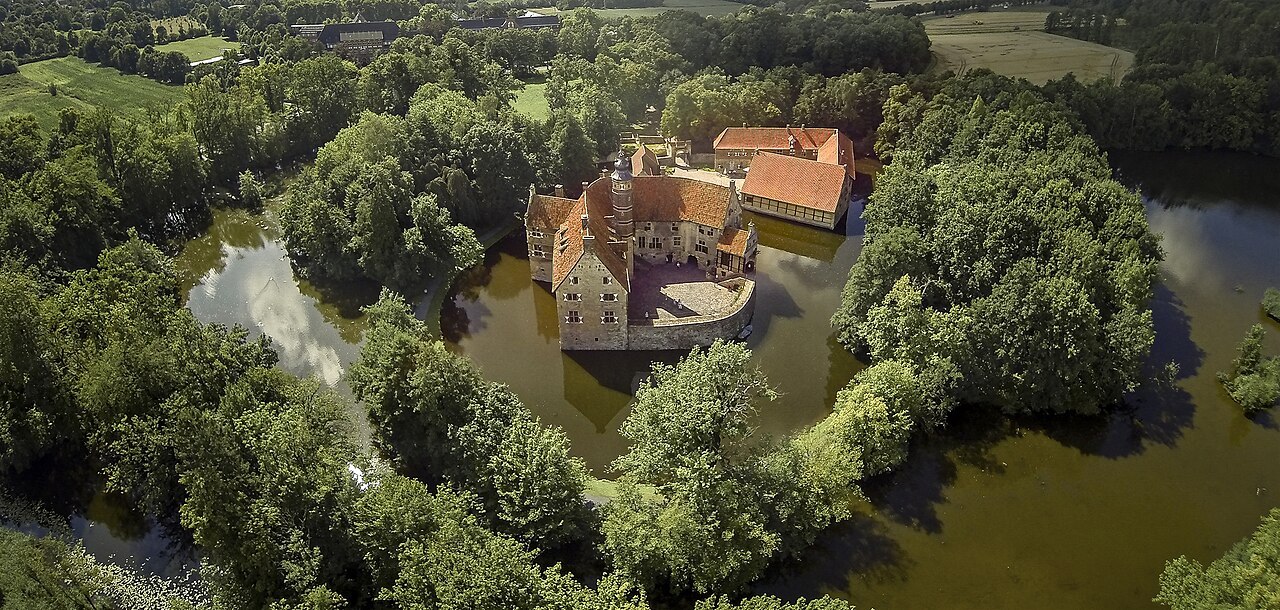
Burg Vischering stands as a quintessential example of a moated castle in the Münsterland region of North Rhine-Westphalia, Germany. Renowned for its harmonious integration with the surrounding water, the castle’s round main building is set dramatically amidst a reflective moat, creating a striking architectural monument celebrated widely as a popular destination and photographic subject.
The castle’s name, Vischering, first appears in historical records in the 14th century, yet the earliest documentary evidence dates back to 1271. At that time, Bishop Gerhard von der Mark of Münster entrusted the castle to knight Albert von Wulfheim, who was charged with defending it alongside a small troop. This strategic move was part of a broader conflict involving the von Lüdinghausen brothers, Hermann and Bernhard, who controlled nearby castles at Lüdinghausen and Wolfsberg. The brothers sought dominion over the wealthy imperial abbey of Werden, challenging the bishop’s authority.
The bishop viewed the construction of Wolfsberg Castle as an infringement on his sovereign rights. In response, he conquered the town of Lüdinghausen and destroyed Wolfsberg Castle. To maintain control over his adversaries, he granted Albert von Wulfheim the fortification that would later become known as Burg Vischering. A facsimile of the 1271 confiscation document is displayed in the castle’s museum, underscoring its historical significance.
Location and architectural evolution
Situated on the plain of the River Stever, Burg Vischering benefits from natural water defenses, enhanced by a man-made stream that surrounds the castle. While the precise timeline of its architectural development is complex, recent research suggests the presence of an earlier structure, possibly dating from the 12th century, on the site of the current main castle.
By 1271, a formidable medieval tower-house had been constructed on what is now the castle courtyard. Over the centuries, the castle underwent significant restructuring. The original walls were partially dismantled, but subsequent construction was often built atop these foundations, preserving the castle’s compact and fortified appearance.
Transformation into a residential castle
Between 1519 and 1622, Burg Vischering evolved from a primarily defensive stronghold into a more comfortable residential castle. This period saw the addition of a new guardhouse within the main building. Following a devastating fire in 1521, the castle was renewed with the construction of higher living quarters and a distinctive stair tower. A notable architectural feature from this era is the bay window that extends over the castle’s pond, adding both aesthetic charm and functional space.
Unlike many castles of its time, Burg Vischering did not undergo a Baroque transformation. This may be attributed to its diminished role as the primary residence of its owning family by the end of the 17th century. Nonetheless, the castle remained in continuous use and retained symbolic importance for the house of Droste zu Vischering.
Modern history and preservation
In the 20th century, Burg Vischering faced significant challenges. During World War II, the castle suffered severe damage from bombing in 1944. Reconstruction efforts began promptly after the war, restoring much of its historic fabric.
The castle’s cultural role expanded with the opening of the Münsterland Museum in 1972, which was further enlarged in 1984. A major redesign in 2018, part of the regional project WasserBurgenWelt (the world of moated castles), revitalized the permanent exhibition. Today, Burg Vischering serves as the "Portal of the Castles and Palaces of Münsterland", offering visitors comprehensive information about the area's rich heritage and tourist attractions.
Architectural features and defensive elements
Burg Vischering’s defining characteristic is its moat, which envelops the castle and enhances its defensive capabilities while contributing to its picturesque setting. The castle’s round main building is strategically positioned in the center of the water, creating a natural barrier against potential attackers.
The castle walls, built on earlier medieval foundations, exhibit a robust construction that reflects the castle’s dual role as a fortress and later as a noble residence. The stair tower added in the early 16th century is a prominent vertical element, providing access to the upper floors and serving as a lookout point.
Another distinctive feature is the bay window projecting over the pond, an architectural flourish uncommon in purely defensive castles but typical of the transition to residential comfort during the Renaissance period.
Interior and museum exhibits
The interior of Burg Vischering houses a museum that showcases the castle’s history, the Droste zu Vischering family heritage, and the broader cultural context of the Münsterland region. Exhibits include medieval artifacts, historical documents, and detailed models illustrating the castle’s architectural evolution.
Historical significance and cultural heritage
Burg Vischering is not only an architectural landmark but also a symbol of the complex feudal and political dynamics of medieval Westphalia. Its history reflects the tensions between the bishopric of Münster and local noble families, as well as the strategic importance of controlling key territories and religious institutions such as the imperial abbey of Werden.
The castle’s endurance through centuries of conflict, fire, and war underscores its resilience and the importance placed on it by successive owners. Today, it stands as a testament to the rich heritage of the Münsterland region and continues to attract visitors interested in medieval architecture, history, and moated castles.
Visitor experience and tourism
Visitors to Burg Vischering can explore the castle’s well-preserved exterior, enjoy the scenic views of the moat and surrounding landscape, and tour the museum’s engaging exhibits. The castle’s role as a cultural hub is enhanced by its participation in regional tourism initiatives, making it a key attraction within the network of castles and palaces in Münsterland.
Its picturesque setting and historical ambiance make Burg Vischering a favored location for photography, educational tours, and cultural events, further cementing its status as a cherished heritage site.
Frequently asked questions (FAQ)
- When was Burg Vischering first documented?
- Burg Vischering was first documented in the year 1271 when Bishop Gerhard von der Mark entrusted it to knight Albert von Wulfheim.
- What architectural style characterizes Burg Vischering?
- Burg Vischering features a mixed architectural style with medieval defensive elements and later Renaissance residential modifications.
- How did the castle's role change over time?
- Originally a defensive fortress, Burg Vischering transformed into a residential castle between 1519 and 1622, reflecting changes in its function and architecture.
- Is Burg Vischering accessible to visitors today?
- Yes, Burg Vischering is open to visitors and features a museum with exhibitions on its history and the Münsterland region.
- What happened to Burg Vischering during World War II?
- The castle suffered severe damage from bombing in 1944 but was promptly reconstructed after the war to preserve its historical integrity.
Loading map...
Visitor reviews
No reviews yet. Been here? Write the first review and help other travelers!
Write the first reviewVisited this castle? Share your experience
Your review helps other travelers and adds first-hand knowledge to our encyclopedia.