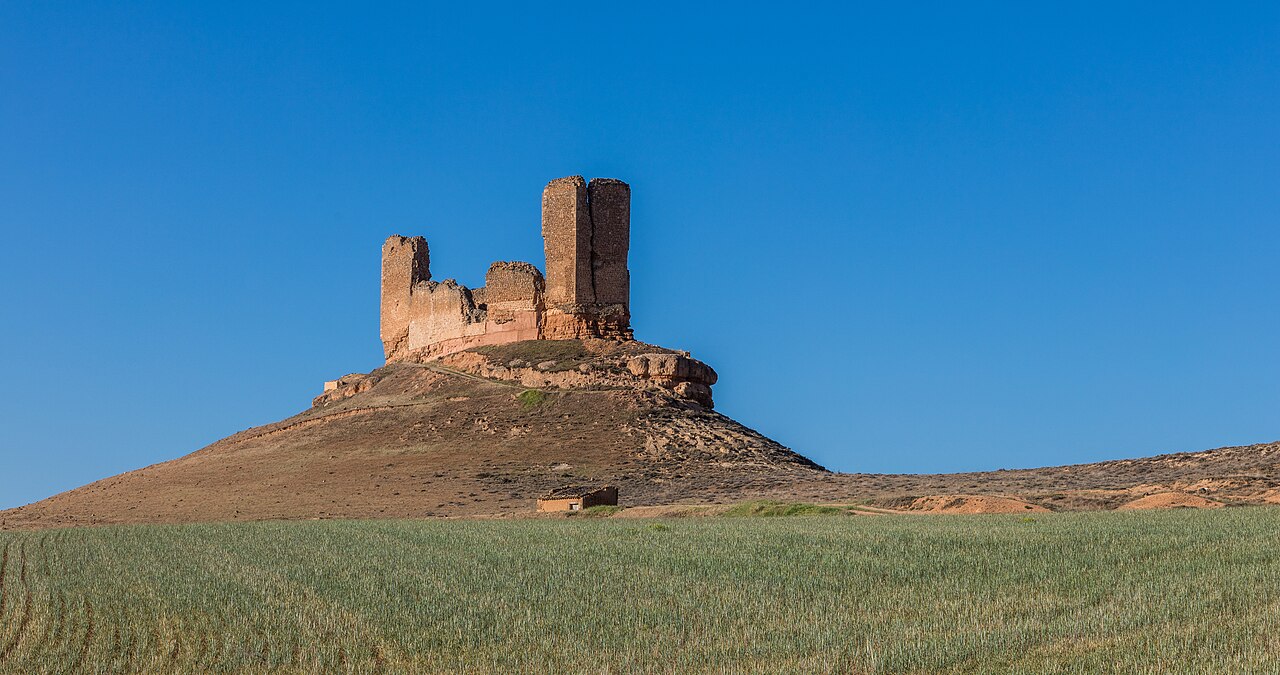
Villel Castle
Villel Castle is a historic fortress located in the village of Villel del Mesa, nestled within the northern part of the Senorio de Molina in the province of Guadalajara, Spain. This castle stands prominently on a large rock formation at the heart of the village, showcasing a design that closely follows the natural contours of the terrain. The castle's strategic location atop this rock provided a commanding view of the surrounding valley and the river Mesa, an important natural feature that shaped the region's geography and history.
The approach to Villel del Mesa involves traversing winding roads through the narrow river Mesa valley, a landscape marked by a striking contrast of fertile green lands near the riverbanks and the arid red rocks and soil that dominate the higher ground. This diverse environment not only offered natural defenses but also abundant resources such as fishing grounds, which contributed to the settlement's sustainability over centuries.
Historical context and origins
Archaeological investigations reveal that the site of Villel Castle has been inhabited since several centuries before Christ, indicating its long-standing significance as a human settlement. The current castle structure is believed to have been constructed in the 12th century, during the High Medieval period, following the Christian Reconquest of the Iberian Peninsula. It is traditionally attributed to Don Manrique de Lara, a notable nobleman involved in the military and political efforts to consolidate Christian control over the region.
Throughout its history, Villel Castle played a key role in the power dynamics of the area. In 1299, the influential De los Funes family, originally from the Kingdom of Navarre, seized control of the castle along with surrounding villages and fortifications. This acquisition was achieved without conflict, reflecting the family's growing prominence and strategic acumen.
Following this, Villel Castle remained in the hands of the De los Funes lineage for centuries. The family’s allegiance shifted at times between the Kingdom of Aragon and the Kingdom of Castile, reflecting the complex political landscape of medieval Spain. In 1680, a descendant of the family was ennobled with the title Marquess of Villel, cementing their noble status and the castle’s importance as a symbol of their heritage.
Architectural features and layout
Villel Castle is classified as a hill castle, given its elevated position on a natural rock outcrop. The castle's design is notably adapted to the irregular shape of the rock, which dictated the layout and defensive structures. This integration with the natural topography is a hallmark of medieval military architecture, maximizing defensive advantages while minimizing construction challenges.
The most prominent feature of the castle is its keep, located at the northern point of the rock. This keep served dual purposes, functioning both as the living quarters for the lord and as the gatehouse controlling access to the fortress. The keep’s position allowed defenders to monitor and control the approach routes effectively.
Although today Villel Castle exists as a small ruin, its remaining walls and foundations provide insight into its original structure. The castle likely included typical medieval defensive elements such as battlements, curtain walls, and possibly a courtyard within the rock’s confines. The adaptation to the rock’s contours would have made the castle difficult to assault, with natural cliffs supplementing man-made fortifications.
The castle’s role in regional history
Villel Castle was part of a network of fortifications that secured the northern frontier of the Senorio de Molina, a key territorial lordship during the Middle Ages. Its location allowed control over the valley and the river Mesa, which were vital for trade, communication, and military movements.
The castle’s history reflects the shifting allegiances and territorial disputes that characterized medieval Spain. The De los Funes family’s control over Villel Castle and the surrounding lands illustrates the fluid nature of noble power, as families balanced loyalties between the competing crowns of Aragon and Castile.
Later history and current status
By the late 17th century, the castle’s military importance had diminished, coinciding with broader changes in warfare and political structures. The grant of the Marquess of Villel title in 1680 signaled a transition from a fortress to a noble residence and symbol of aristocratic status.
Today, Villel Castle stands as a partially preserved ruin, offering visitors a glimpse into its medieval past. The surrounding landscape, including the scenic drive through the river Mesa canyons, enhances the experience of visiting the site. Despite its modest size, the castle’s integration with the natural rock and its historical associations make it a noteworthy example of High Medieval military architecture in the Guadalajara region.
Visiting Villel Castle
Visitors to Villel Castle can enjoy the combination of natural beauty and historical intrigue. The winding roads through the river Mesa valley provide a picturesque approach, with opportunities to observe the region’s diverse ecosystems and geological formations.
While the castle itself is a ruin, its location on the rock formation offers panoramic views of the village and valley below. The site is accessible to those interested in medieval history, architecture, and the cultural heritage of Castilla-La Mancha.
Frequently asked questions (FAQ)
- How do I get to Villel Castle?
- Villel Castle is located in Villel del Mesa, accessible via winding roads through the river Mesa valley. The drive offers scenic views of fertile lands and red rock formations.
- When was Villel Castle built?
- Villel Castle was likely built in the 12th century during the High Medieval period, attributed to Don Manrique de Lara following the Reconquest.
- What is the architectural style of Villel Castle?
- Villel Castle is a hill castle adapted to the natural rock formation, typical of High Medieval military architecture, though specific stylistic details are limited due to its ruinous condition.
- Is Villel Castle open to visitors?
- Yes, Villel Castle is accessible to visitors as a partially preserved ruin. While there are no formal opening hours or ticket requirements, visitors can explore the site and enjoy views of the surrounding valley.
- What historical families were associated with Villel Castle?
- The De los Funes family, originally from the Kingdom of Navarre, controlled Villel Castle from 1299 and maintained it through shifting allegiances between the Kingdoms of Aragon and Castile.
Information
Address
Calle Rivas, Villel del Mesa, Guadalajara, Spain
Loading map...
Visitor reviews
No reviews yet. Been here? Write the first review and help other travelers!
Write the first reviewVisited this castle? Share your experience
Your review helps other travelers and adds first-hand knowledge to our encyclopedia.