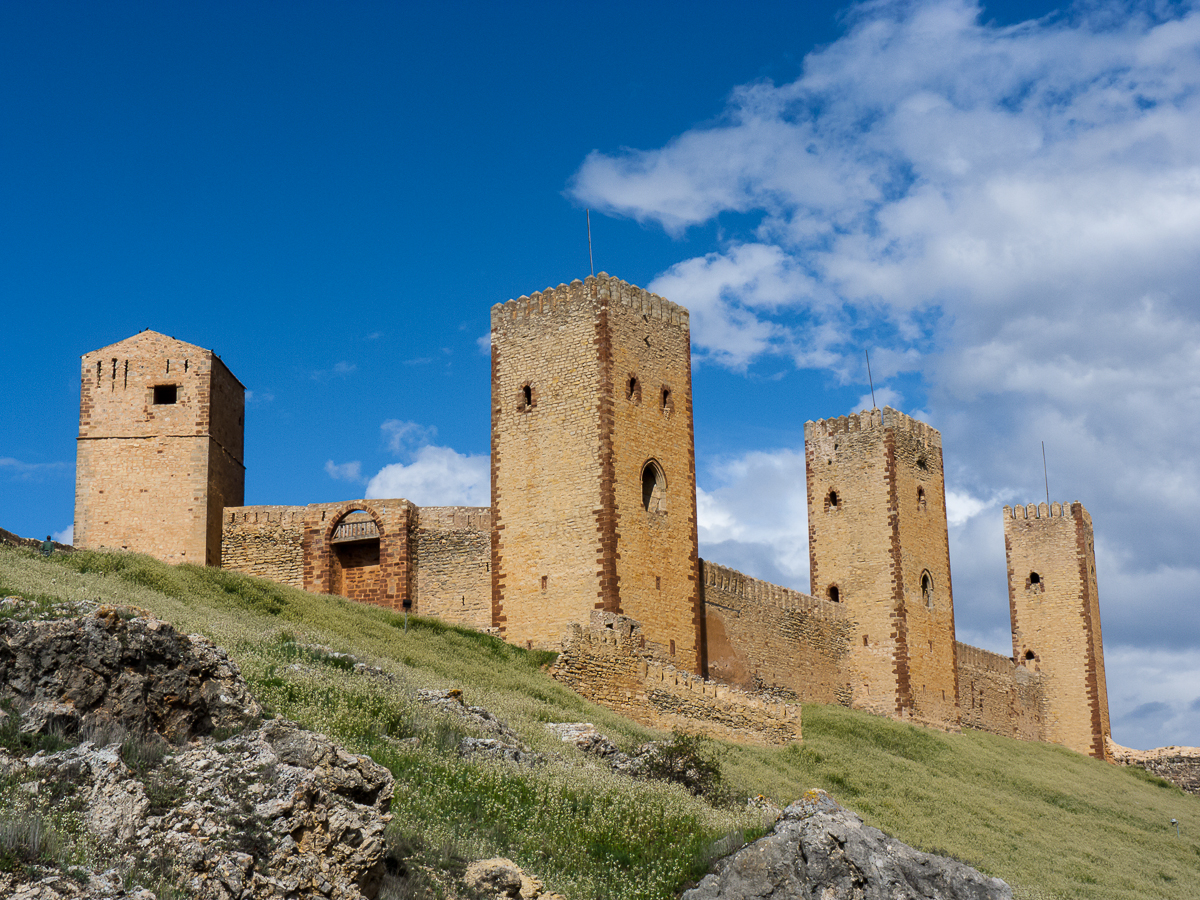
Establés Castle
Establés Castle is a significant high medieval fortress located in the quiet countryside village of Establés, within the province of Guadalajara, Spain. Positioned at the northern end of the Señorío de Molina, the castle occupies a strategic location in a narrow valley that channels water from the Aragoncillo Mountain to the river Mesa. This natural route historically connected Aragon with the heart of the Señorío de Molina, lending the castle considerable military and political importance during the Middle Ages.
Historical background and strategic significance
The origins of Establés Castle date back to the 12th century, coinciding with the early phases of the Christian repopulation of the territory. Initially, a watchtower was constructed on a hill overlooking the valley to monitor and control this critical route. Over time, a small village developed at the foot of the hill, gradually growing in population and importance. The castle and village were integral parts of the Señorío de Molina, a feudal lordship that frequently clashed with the neighboring Duchy of Medinaceli.
Throughout its history, Establés Castle witnessed numerous battles and territorial disputes between these two political entities. In 1432, Don Álvaro de Luna, the Chancellor of King Juan II of Castile, ordered repairs to the castle's exterior fortifications, reflecting its ongoing military relevance during the late medieval period.
Conflict and ownership disputes in the 15th and 16th centuries
The 15th century marked a turbulent period for Establés Castle and its village. In a violent conquest, Don Gastón de la Cerda, acting on behalf of the Dukes of Medinaceli, seized control of the castle and surrounding settlements. The Señorío de Molina persistently sought to reclaim these lands, prompting intervention by the Catholic Monarchs, Ferdinand and Isabella, who ordered the restitution of Establés Castle and village to the Señorío. However, the castle's lord at the time, Don Pedro de Zurita, a supporter of Medinaceli, defied the royal decree, resulting in only the village being returned initially.
Further skirmishes ensued, notably in 1541, when troops loyal to the Señorío de Molina, commanded by Don Luis Fernández de Alcover, engaged forces led by Sancho Díaz de Zurita, the castle's lord. These conflicts culminated in the castle definitively returning to the Señorío de Molina's possession, where it remained thereafter.
Architectural features and construction details
The castle as it stands today was constructed around 1450 under the orders of the Dukes of Medinaceli. The builder, Gabriel de Ureña, reportedly employed harsh methods to procure building materials at low cost, earning the fortress the local nickname "Castle of the Black Shadow". This epithet reflects the harshness associated with its construction rather than any architectural characteristic.
Establés Castle exemplifies a typical high medieval fortification with a square plan defined by robust curtain walls and defensive corner towers. The main entrance is located on the northeast side, protected by a prominent gate tower and an adjoining turret that would have served as vantage points for guards and archers. The castle's design emphasizes defense and control of the surrounding valley and routes.
Currently, Establés Castle is privately owned and not open to the public. Observations reveal a modern structure within the castle walls, likely intended to adapt the fortress for residential use. However, restoration or habitation efforts appear to have been paused indefinitely.
Geographical and cultural context
The village of Establés remains nestled in the valley beneath the castle, maintaining its rural and tranquil character. The castle's location within the Señorío de Molina places it in a region rich with medieval history and feudal conflicts. Its proximity to the Duchy of Medinaceli meant that Establés was often at the frontier of political and military tensions during the Middle Ages.
Though not accessible to visitors, Establés Castle stands as a testament to the complex feudal dynamics of medieval Spain and the strategic importance of controlling natural routes through mountainous terrain. Its architecture and history provide valuable insights into the military and political landscape of the Guadalajara province during the 12th to 16th centuries.
Preservation and current condition
The castle is classified as well preserved in terms of its external fortifications, with the main walls and towers remaining intact. However, the interior has been altered by modern constructions, and no public access is allowed. The castle's preservation reflects both its durable medieval construction and the limited modern interventions that have taken place.
Frequently asked questions (FAQ)
- When was Establés Castle originally built?
- Establés Castle was originally constructed in the 12th century as a watchtower during the early Christian repopulation of the area.
- What architectural style is Establés Castle?
- The castle exhibits typical high medieval Gothic architectural features, including strong square walls and corner towers.
- Is Establés Castle open to the public?
- No, Establés Castle is privately owned and currently not open for public visits.
- What historical conflicts involved Establés Castle?
- The castle was involved in numerous battles between the Señorío de Molina and the Duchy of Medinaceli, including violent conquests and skirmishes in the 15th and 16th centuries.
- Why is Establés Castle nicknamed the 'Castle of the Black Shadow'?
- The nickname arose due to the harsh methods used by the builder Gabriel de Ureña to acquire building materials cheaply during the castle's construction around 1450.
Information
Current owner
Private owner
Address
Calle Baja del Castillo, Establés, Guadalajara, Spain
Loading map...
Visitor reviews
No reviews yet. Been here? Write the first review and help other travelers!
Write the first reviewVisited this castle? Share your experience
Your review helps other travelers and adds first-hand knowledge to our encyclopedia.