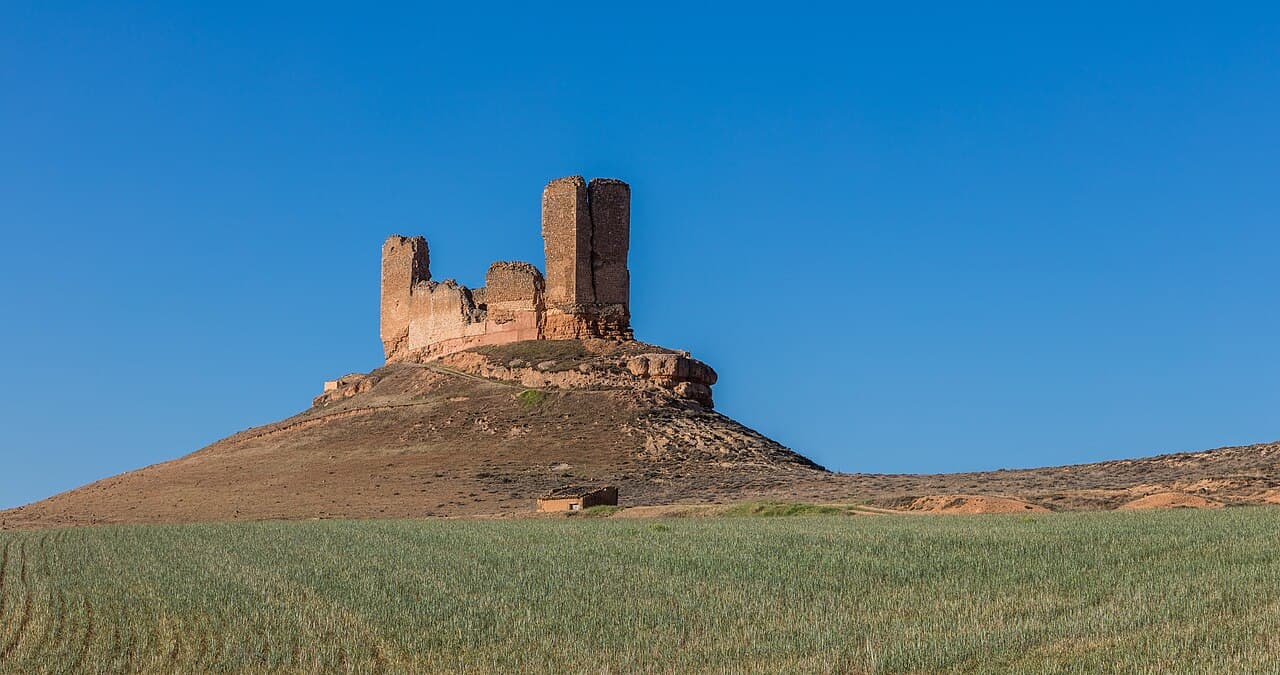
Montuenga Castle — Spain castle

Montuenga Castle

Montuenga Castle in Soria, Spain
Montuenga de Soria, Spain
High Medieval (11th–13th c.)
Ruins

Montuenga Castle is a notable high medieval hill castle located in Montuenga de Soria, within the province of Soria, Spain. Strategically positioned on a steep and elongated hill, the castle overlooks the village and commands the natural passage between the central plateau of Spain and the strategic basin of the Ebro River. This location made it a critical defensive stronghold controlling access between the historic kingdoms of Castile and Aragon.

Historical significance and strategic role

Montuenga Castle formed part of a defensive line along the Jalón River, a vital natural corridor in the region. Its placement allowed control over movements along this route, which was essential during periods of conflict such as the Castilian Civil War. The castle's dominance over the surrounding landscape provided military advantage in monitoring and defending against incursions.

The castle's history is deeply intertwined with the turbulent medieval politics of the Iberian Peninsula, particularly the disputes between the kingdoms of Castile and Aragon. Its location near the border region meant that it was frequently contested and played a role in the broader conflicts shaping medieval Spain.

Architectural features and remains

The surviving structure of Montuenga Castle consists primarily of two polygonal towers situated at opposite ends of the hilltop, connected by curtain walls. These walls and towers reflect typical high medieval military architecture designed for both defense and surveillance.

The castle's elongated layout follows the natural shape of the hill, maximizing the use of the terrain for defensive purposes. The steep slopes surrounding the castle add to its defensibility, making direct assault difficult.

Although largely in ruins today, the castle's remains provide valuable insight into medieval fortification techniques and the strategic importance of hilltop castles in Spain.

Geographical context and access

Montuenga de Soria lies approximately 105 kilometers from Madrid and is part of the municipality of Arcos de Jalón, with the town of Arcos de Jalón about 5 kilometers away. The castle's elevated position offers commanding views of the surrounding landscape, including the Jalón River valley and the routes leading toward both Castile and Aragon.

The location was chosen specifically for its natural defensive advantages and its control over the important communication and trade routes between these historic regions.

Preservation and current condition

Today, Montuenga Castle is classified as a ruined hill castle. The remains, while fragmentary, are significant for understanding the military architecture of the high medieval period in this part of Spain. Conservation efforts focus on stabilizing the existing structures to prevent further deterioration.

Visitors to the site can explore the ruins and appreciate the castle's commanding position and historical importance, although facilities and detailed interpretive materials may be limited due to its remote location and condition.

Architectural style and construction period

The castle's construction dates broadly to the high medieval period, reflecting the typical fortification methods of the time. Its polygonal towers and connecting walls are characteristic of military architecture designed to adapt to the natural topography, emphasizing defense and visibility.

The style is primarily utilitarian, focusing on functionality rather than ornamental features, which is common for castles built in strategic border regions during the Middle Ages.

Frequently asked questions (FAQ)

How do I get to Montuenga Castle from Madrid?
Montuenga Castle is approximately 105 kilometers from Madrid. Visitors can reach the village of Montuenga de Soria by car via regional roads, typically taking around 1.5 to 2 hours. Public transportation options are limited, so driving is recommended.
What is the historical significance of Montuenga Castle?
Montuenga Castle played a strategic role in controlling access between the kingdoms of Castile and Aragon during the high medieval period. It was part of the defensive line along the Jalón River and was involved in conflicts like the Castilian Civil War.
Can I visit the interior of Montuenga Castle?
The castle is largely in ruins with two polygonal towers and connecting walls remaining. Visitors can explore the exterior ruins and enjoy panoramic views, but interior access is limited due to the condition of the structures.
When is the best time to visit Montuenga Castle?
The best time to visit Montuenga Castle is during the spring and autumn months when the weather is mild. Summers can be hot and winters cold, which may affect accessibility and comfort.
Is Montuenga Castle accessible for people with mobility issues?
Due to its hilltop location and ruined condition, Montuenga Castle is not easily accessible for visitors with mobility issues. The terrain is steep and uneven, and there are no specialized facilities for accessibility.

Photo gallery

Montuenga Castle
Click to view

Photo by Diego Delso•CC BY-SA 4.0

1 photo • Click any image to view in full screen

Information

Hill Castle

Loading map...

Visitor reviews

No reviews yet. Been here? Write the first review and help other travelers!

Write the first review

Visited this castle? Share your experience

Your review helps other travelers and adds first-hand knowledge to our encyclopedia.

Write a review

(5/5)

0/2000 characters

Your review will be visible after admin approval

Nearby castles

5.6 km

Arcos de Jalón Castle

Arcos de Jalón, Spain

Arcos de Jalón Castle is a late medieval fortress located in the town of Arcos de Jalón, Spain. Dating from the 14th century, this castle was built on the site of an earlier Arab fortress, reflecting the turbulent history of the region during the Reconquista and the power struggles within the Kingdom of Castile. The castle is notable for its strategic position atop a high and narrow hill that physically divides the town into two parts, providing a commanding view of the surrounding landscape and natural defense advantages.The castle's rectangular floor plan is somewhat irregular, adapting to the rugged topography of the hill. Its thick stone walls incorporate horizontal rows of brick and finely cut ashlar stones, with visible stonecutter’s marks on the corners, demonstrating the skilled craftsmanship of its builders. A robust keep is attached directly to the castle walls, serving as the last defensive refuge and symbol of feudal authority.Historical significance and conflictsArcos de Jalón Castle played a role in the political conflicts of the 14th century. It was besieged during the civil war between supporters of King Pedro I of Castile and the rebel forces led by Fernán Gómez de Albornoz, who supported Pedro's half-brother, Enrique de Trastamara. This siege highlights the castle's military importance in the power struggles that shaped medieval Spain.Architectural features and construction techniquesWall structure and materialsThe castle's walls are remarkable for their double-lined brick construction, a technique primarily intended for structural stability but which also creates striking reddish lines contrasting with the stonework. This method is characteristic of Mudejar architecture, reflecting the influence of the Muslim artisans and builders who lived in the region during the Middle Ages. The presence of Mudejar elements in a military fortress is unusual and adds to the castle's architectural interest.Keep and defensive elementsThe keep attached to the walls was originally taller than the current remains suggest. Inside, traces of the internal structures that divided the tower into multiple floors can still be seen. The castle has only one entrance, positioned high above ground level for defensive purposes, along with two loophole windows designed for archers to defend the fortress while minimizing exposure.Layout and fortificationsAlong the perimeter of the fortress, the foundations of walls and several towers that once reinforced the castle's defenses are visible. These towers would have provided vantage points for surveillance and defense against attackers. The irregular shape of the castle allowed it to conform closely to the contours of the hill, maximizing the natural defenses provided by the terrain.Mudejar influence and cultural contextThe castle's construction technique, especially the use of brick lining within stone walls, is a clear indication of Mudejar influence. This style developed from the coexistence of Christian and Muslim cultures in medieval Spain, particularly in regions like Aragon where a significant Muslim population remained after the Reconquista. The castle stands as a testament to this cultural blending, combining traditional military architecture with decorative and structural elements derived from Islamic art and building methods.Current condition and visitor experienceToday, Arcos de Jalón Castle is classified as partially preserved. While much of the original structure remains in ruins, key features such as the keep, walls, and foundations can still be explored. Visitors can appreciate the castle's unique architectural details and its dramatic setting overlooking the town. The site offers insight into the military and cultural history of the region during the late medieval period.Access to the castle involves navigating the steep hill on which it stands, which adds to the sense of its historical defensive purpose. Interpretive signage and guided tours may be available locally to enhance understanding of the castle's historical context and architectural significance.

Late Medieval (14th–15th c.)
Details
16.1 km

Monteagudo de las Vicarías Castle

Monteagudo de las Vicarías, Spain

Monteagudo de las Vicarías Castle is a significant example of late medieval military architecture situated in the heart of Monteagudo de las Vicarías, Spain. Constructed primarily during the 15th century by the influential Hurtado de Mendoza family, the castle served both as a defensive fortress and a noble residence. Its strategic location within the town's defensive walls emphasizes its role in local security and governance during a period marked by territorial conflicts and social upheaval. Architectural features and layout The castle is characterized by its robust stone walls and corner towers reinforced with buttresses, which provided enhanced stability and defense against siege warfare. A defining feature of the castle is its octagonal keep, a rare architectural element that offered a panoramic vantage point for surveillance and defense. The keep's shape not only increased its structural strength but also allowed defenders to cover all approaches effectively. Within the castle, a large indoor courtyard served as a central space for daily activities, gatherings, and military drills. Surrounding the courtyard, an arcaded gallery provided sheltered walkways and connected various parts of the castle. The presence of battlement hexes and arches along the walls and galleries reflects the castle's blend of functional military design with aesthetic considerations typical of the period. Historical context and significance The castle's construction during the 15th and early 16th centuries coincided with the late medieval period in Spain, a time of consolidation of noble power and frequent skirmishes between rival factions. The Hurtado de Mendoza family, prominent nobles of the region, commissioned the castle to assert their dominance and protect their estates. The castle's integration within the town walls highlights its dual purpose as a military stronghold and a symbol of feudal authority. Over the centuries, Monteagudo de las Vicarías Castle witnessed various historical events that shaped the region's political landscape. Its fortifications were adapted to evolving military technologies, including the introduction of artillery, which influenced the design of its defensive structures. Recent restorations and preservation In recent years, efforts have been made to restore and preserve key architectural elements of the castle. Restoration work has focused on the battlement hexes, which are distinctive crenellated parapets that provided cover for archers and defenders. The arches and the arcaded gallery have also been carefully restored to maintain their structural integrity and historical authenticity. These conservation projects aim to protect the castle from further deterioration while allowing visitors to appreciate its architectural and historical value. The castle remains a prominent landmark within Monteagudo de las Vicarías, reflecting the town's medieval heritage and cultural identity. Architectural style and classification Monteagudo de las Vicarías Castle exemplifies the late medieval style of fortress construction prevalent in Spain during the 15th century. Its design incorporates elements typical of military Gothic architecture, including pointed arches and fortified towers. The castle's classification falls under a hill castle type, given its elevated position relative to the surrounding terrain, which enhanced its defensive capabilities.

Late Medieval (14th–15th c.)
Details
18.3 km

Castillo de Sisamón

Sisamón, Spain

The Castillo de Sisamón is a medieval fortress located in the municipality of Sisamón, within the autonomous community of Aragón, Spain. Perched strategically on a hill, this hill castle played a pivotal role in the complex political and military landscape of the Iberian Peninsula during the Middle Ages. Its position near the border between the kingdoms of Aragón and Castilla made it a critical stronghold in controlling access to the Jalón valley, a vital corridor for movement and trade. Constructed during the high medieval period, the castle's origins are closely tied to the Señorío de Molina, an independent lordship that existed between Aragón and Castilla. This lordship was a buffer zone where shifting allegiances and territorial disputes were common. The castle itself was a manifestation of the need for fortified defense in this volatile frontier region. Historical context and political significance Throughout the 14th century, the area surrounding Sisamón was the stage for significant political realignments. In 1321, the Señorío de Molina was absorbed into the Kingdom of Castilla, yet Sisamón remained under the control of Aragón, highlighting the fragmented nature of territorial control in medieval Spain. This division resulted in Sisamón becoming a frontier fortress of Aragón, which was frequently threatened by Castilian ambitions. The castle's military importance is documented during the War of the Two Peters (1356–1369), a protracted conflict between Aragón and Castilla. In 1356, the fortress was commanded by Rodrigo González de Ayoza, who received royal funding amounting to 2000 libras jaquesas to reinforce the castle's defenses. These funds were crucial for maintaining the stronghold's capability to secure the Jalón valley entrance against Castilian incursions. In 1357, the castle endured a siege by Castilian forces, underscoring its strategic value. Shortly thereafter, King Pedro IV of Aragón transferred control of Sisamón and its castle to Sancho González de Heredia. This transfer linked the castle to the influential Fernández de Heredia family, who would govern the region for centuries. The marriage of Sancho González to Donosa Fernández de Heredia further cemented this familial stewardship. Noble rivalries and social dynamics in the 15th century Despite formal peace treaties, the 15th century remained turbulent due to unresolved feuds among local nobility. The Fernández de Heredia family, lords of Sisamón, were embroiled in a bitter rivalry with the Liñán family of nearby Cetina. This feud culminated in a notable duel in 1452 between Juan Fernández de Heredia and Alfonso de Liñán, an event significant enough to require royal intervention to restore order. The conflict between these noble houses was finally resolved through marriage in 1509, when Juan Fernández de Heredia wed Jerónima de Liñán. This union merged the two families, pacifying the region and paving the way for the creation of the County of Contamina. Following this consolidation, the military importance of the castle diminished as the region stabilized. Architectural features and defensive design Today, the Castillo de Sisamón remains in a state of notable ruin but still conveys important aspects of its medieval defensive architecture. The surviving structures include two battlemented walls that originally formed part of the main tower. These walls feature crenellations, which allowed defenders to shield themselves while observing or attacking enemies. This design reflects the castle's primary function as a military fortress during periods of conflict. Fragments of the chemin de ronde, a raised protected walkway along the walls, are also visible. This feature enabled guards and soldiers to patrol the castle's perimeter efficiently, providing a vantage point for surveillance and rapid response to threats. A distinctive heraldic shield bearing the emblem of the Fernández de Heredia family is displayed on one of the walls. This crest not only signifies the noble lineage that controlled Sisamón but also serves as a tangible link to the castle's historical narrative and the family's enduring influence. Beneath the ruins lies a subterranean chamber, likely used as a storage room. Its underground location would have offered a stable environment for preserving essential supplies during sieges, highlighting the castle's preparedness for prolonged defense. Surrounding the main tower and internal buildings, remnants of an outer defensive wall can still be discerned. This additional barrier created a layered defense system, enhancing the fortress's resilience against attackers and illustrating sophisticated medieval military engineering. Castillo de sisamón in the context of spanish medieval fortifications The Castillo de Sisamón exemplifies the characteristics of a hill castle designed to control strategic routes and borderlands during the high medieval period. Its location on elevated terrain provided natural defensive advantages, while its architectural elements reflect the military necessities of the time, including protection against siege warfare and territorial disputes. As a frontier fortress, it played a crucial role in the defense system of the Kingdom of Aragón, particularly during the turbulent 14th and 15th centuries marked by conflicts such as the War of the Two Peters and noble feuds. The castle's history is intertwined with the broader narrative of medieval Spain's political fragmentation and the gradual consolidation of regional powers. Present condition and cultural significance Currently, the ruins of Castillo de Sisamón stand as a testament to the region's medieval past. Though partially collapsed, the remaining walls, battlements, and defensive features offer valuable insights into the castle's original structure and function. The site is an important cultural heritage landmark within Aragón, attracting historians, archaeologists, and visitors interested in medieval military architecture and Spanish history. Preservation efforts focus on maintaining the integrity of the remaining structures and promoting awareness of the castle's historical significance. The heraldic symbols and architectural remnants continue to evoke the legacy of the noble families who shaped the region's history.

High Medieval (11th–13th c.)
Details
