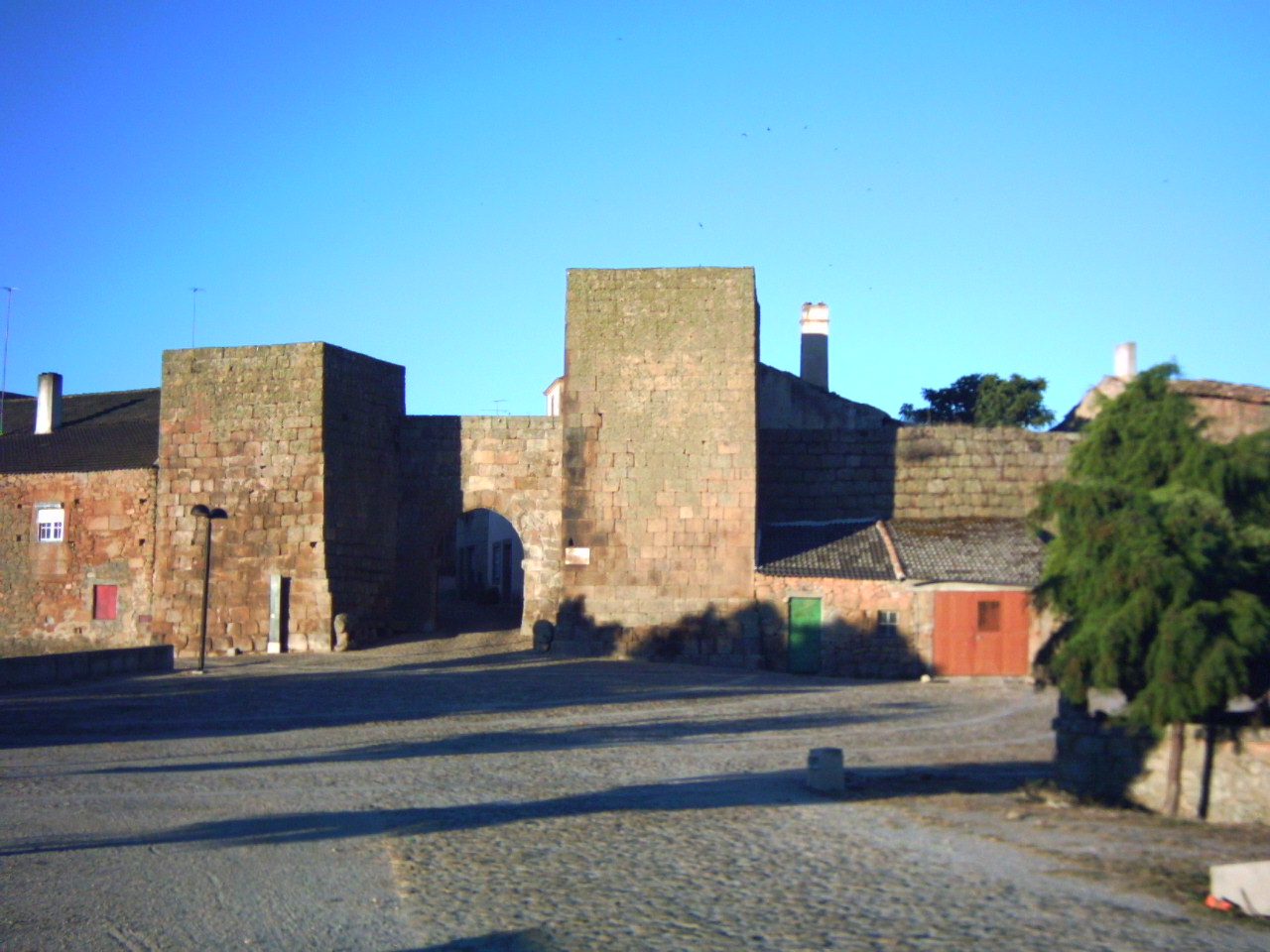
Vilar Maior Castle
Vilar Maior Castle, known locally as Castelo de Vila Maior, is a striking medieval fortress perched on a rocky plateau overlooking the valley of the Rio Cesarão in the Beiras e Serra da Estrela region of Portugal. Situated just 10 kilometers from the Spanish border, this hill castle commands a strategic position that has shaped its long and complex history. The site’s origins trace back to pre-Roman times, with archaeological evidence indicating a fortified castro settlement predating Roman occupation around 60 A.D. The Romans later fortified the site, recognizing its defensive potential along the frontier.
The castle’s medieval history is closely tied to the turbulent border conflicts between Christian and Muslim forces during the Reconquista. The first documented fortification on this hill was a Muslim fortress mentioned in the mid-11th century. In 1139, troops from the Kingdom of León captured the castle, marking a shift in control that would see the fortress change hands multiple times between León and the nascent Portuguese kingdom throughout the 12th and 13th centuries. The Treaty of Alcanices in 1297 finally secured Vilar Maior as Portuguese territory, after which King Denis of Portugal undertook significant reconstruction efforts to reinforce the castle and other border fortresses in the region.
Historical evolution and political significance
The castle’s history reflects the broader geopolitical struggles of the Iberian Peninsula during the Middle Ages. Initially a Muslim stronghold, its capture by Leonese forces in 1139 was part of a larger campaign to reclaim territory from Moorish control. The early 13th century saw the castle contested repeatedly, with León and Portugal vying for dominance. King Alfonso IX of León ordered reconstruction and resettlement in 1232, but Portuguese forces reclaimed the site shortly afterward. The final transfer to Portuguese control was formalized by the Treaty of Alcanices in 1297, a landmark agreement that established the modern border between Portugal and Castile-León.
Under King Denis of Portugal, who reigned from 1279 to 1325, Vilar Maior Castle was rebuilt and fortified as part of a broader effort to secure Portugal’s eastern frontier. This period saw the construction of robust defensive walls and the enhancement of the castle’s keep, integrating Romanesque and early Gothic architectural elements. Subsequent monarchs, including King Fernando (1367–1383), John I (1385–1433), and Manuel I (early 16th century), continued to maintain and upgrade the fortress, adding features such as a double line of walls and a barbican to strengthen its defenses against evolving military threats.
Architectural features and fortifications
Layout and defensive structures
The castle’s plan is an irregular oval, adapted to the natural contours of the rocky plateau. Its defensive system originally included a double curtain wall, providing two concentric layers of fortification. Remnants of a third wall survive near the old town hall and along adjacent streets, indicating the extensive nature of the defensive perimeter that once enclosed not only the castle but also the surrounding settlement.
The curtain walls are crowned with distinctive rounded battlements, designed to provide cover for archers and defenders. A barbican fortified the main entrance, adding an extra layer of protection. The main gate features a broken barrel vault and monumental hinges, while a secondary postern gate includes both a pointed arch and a rounded arch, with ornate stone hinges preserved. These architectural details reflect the castle’s evolution over several centuries and its adaptation to changing defensive needs.
The keep and internal structures
Dominating the fortress is a large rectangular keep tower rising approximately 35 meters over three levels. The keep is roofless today but retains its original narrow arrow slits on the northern face and embrasures with gun ports framed by projecting stone on the eastern side, reflecting adaptations for both archery and early gunpowder weapons. The southern facade includes a pointed, broken arch doorway on the second floor, accessible via a series of five staircases connecting the keep to the battlements.
Inside the castle courtyard lies a remarkable open circular cistern, 35 meters in diameter, essential for water storage during sieges. Foundations of various buildings and the remains of defensive scaffolding around the keep—similar to machicolations—highlight the castle’s strategic design to repel attackers by allowing defenders to fire arrows or drop projectiles vertically.
Later history and decline
By the 17th century, Vilar Maior Castle had lost much of its strategic importance due to changes in military technology and border stability. Its fortifications were no longer maintained as a primary defense, and the castle gradually fell into disuse. Accounts from the mid-18th century describe the castle as largely in ruins, though it survived the devastating 1755 Lisbon earthquake unscathed.
The 19th century brought renewed turmoil during the Peninsular War when Napoleonic troops invaded and pillaged the region, including the town and castle. Later, the Liberal Wars further impacted the area, leading to the dissolution of the municipality of Vilar Maior in 1855 and its incorporation into Sabugal. Today, the castle stands as a well-preserved ruin, freely accessible to visitors who can explore its walls and towers, though caution is advised due to the loss of interior floors and partial structural decay.
Cultural significance and preservation
Vilar Maior Castle is a testament to the region’s rich medieval heritage and the complex history of the Portuguese-Spanish borderlands. Its architectural features, including Romanesque and Gothic elements, provide valuable insights into medieval military construction and frontier defense strategies. The castle’s extensive ruins, including the keep, curtain walls, gates, cistern, and remnants of town fortifications, contribute to its status as an important cultural landmark.
Today, the castle is managed as a historical monument, with parts incorporated into the Museum of Vilar Maior, which preserves artifacts and educates visitors about the site’s history. The castle’s accessibility and dramatic setting make it a popular destination for those interested in medieval architecture, military history, and Portuguese cultural heritage.
Visitors are encouraged to explore the castle’s walls, climb the keep with care, and appreciate the strategic ingenuity of its design. The inscriptions on the gates and stones bearing Knights Templar symbols add layers of historical intrigue, connecting the fortress to broader medieval narratives of chivalry and conflict.
Frequently asked questions (FAQ)
- How do I get to Vilar Maior Castle?
- Vilar Maior Castle is located in the village of Vilar Maior, Sabugal municipality, in the Beiras e Serra da Estrela region of Portugal. It is accessible by road, with parking available nearby.
- What are the opening hours for visiting Vilar Maior Castle?
- The castle is freely accessible to the public at all times, as it is an open ruin without staffed entry points or ticketed access.
- Is there an entrance fee to visit Vilar Maior Castle?
- No, visiting Vilar Maior Castle is free of charge since it is an open historical ruin.
- Can I climb the keep at Vilar Maior Castle?
- Visitors can climb the castle walls and the keep, but should exercise caution due to the loss of interior floors and partial structural decay.
- What is the historical significance of Vilar Maior Castle?
- Vilar Maior Castle played a key role in the medieval border conflicts between Portugal and the Kingdom of León, exemplifying frontier defense during the Reconquista and later Portuguese consolidation.
- Are there any guided tours available at Vilar Maior Castle?
- Currently, there are no official guided tours at Vilar Maior Castle, but visitors can explore the site independently and find informational materials at the nearby Museum of Vilar Maior.
Information
Sources & official resources
Verify the information above using these authoritative references.
Loading map...
Visitor reviews
No reviews yet. Been here? Write the first review and help other travelers!
Write the first reviewVisited this castle? Share your experience
Your review helps other travelers and adds first-hand knowledge to our encyclopedia.