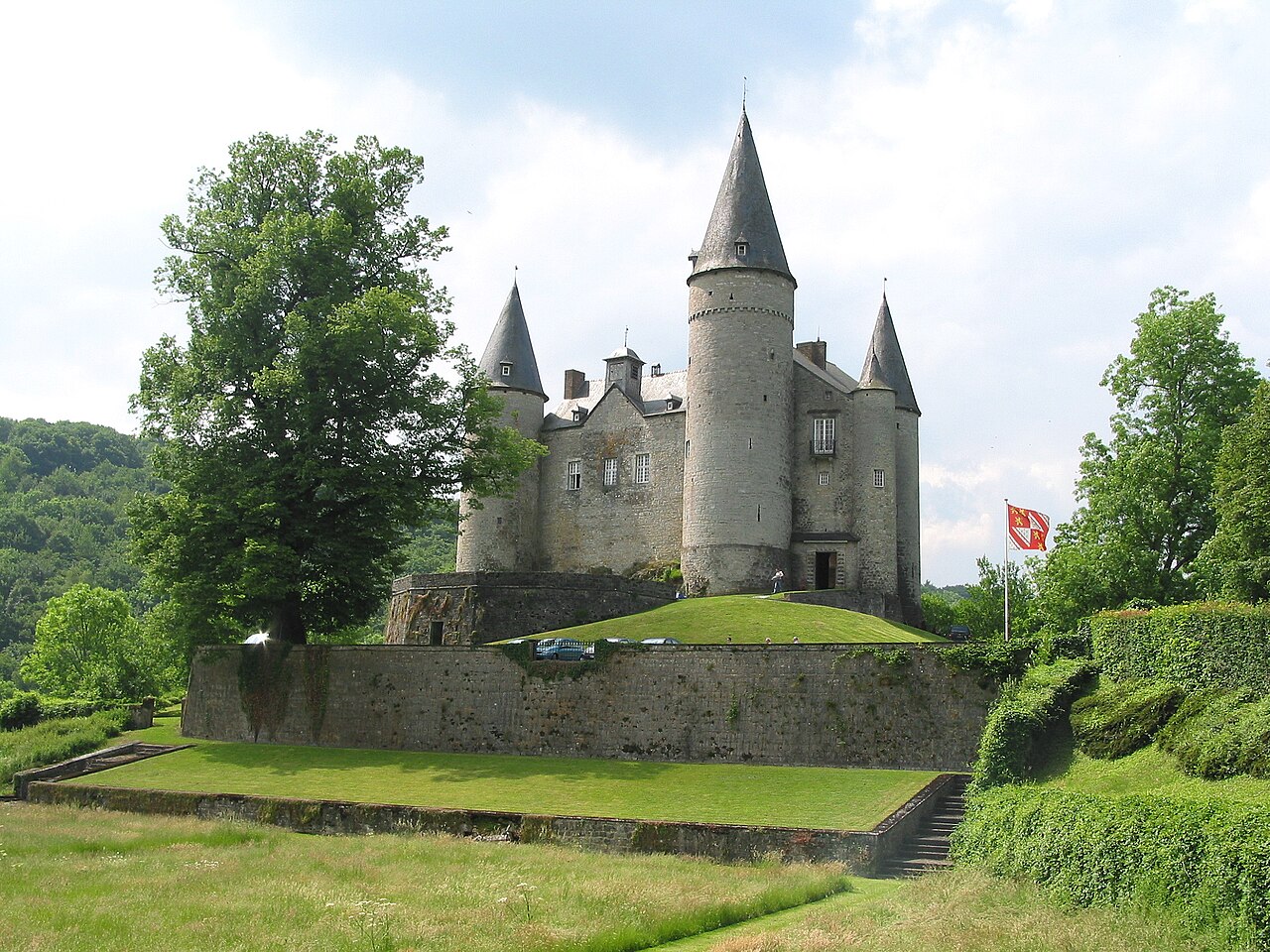
Vêves Castle

Vêves castle: a remarkable medieval hill castle in belgium
Celles, Belgium
High Medieval (11th–13th c.)
Restored

Vêves Castle, also known as Château de Vêves, is a stunning example of medieval military architecture located near the village of Celles in the province of Namur, in the Wallonia region of Belgium. This hill castle sits prominently on a rocky outcrop overlooking a valley that historically formed part of the old route between Dinant and Rochefort. The strategic location of the castle has made it an important defensive site since at least the early 8th century.

The origins of Vêves Castle trace back to the early medieval period, with tradition attributing its first construction to Pepin de Herstal (c. 670–714), a powerful Frankish statesman and grandfather of Charlemagne. Although little remains of this earliest fortress, the site's significance grew over the centuries, eventually coming under the control of the noble Beaufort family in the 12th century through marriage. The Beauforts were a prominent lineage known for their participation in the Crusades, with family members such as Théodore de Celles taking part in the Third Crusade.

Early history and medieval significance

The original castle was destroyed by fire in 1200 but was rebuilt by 1230, marking the foundation of the present castle's oldest surviving structures. The castle endured multiple sieges and battles, notably during the War of the Cow (1275–1277), where the Beaufort lords sided with the Counts of Luxembourg and Namur. Members of the family also distinguished themselves in the Battle of the Golden Spurs (1302) and the Battle of Pevelenberg (1304), key conflicts in Flemish history.

In 1466, the castle was again set ablaze during the siege of Dinant by the forces of Charles the Bold, Duke of Burgundy. It was subsequently rebuilt, reflecting the resilience and ongoing strategic importance of the fortress. Throughout the late medieval period, Vêves Castle maintained its military role, with architectural features adapted to the evolving demands of defense.

Architectural features and renovations

The castle's layout is distinctive, forming an irregular triangle or pentagon shape, surrounded by six round towers of varying sizes, including four large and two smaller towers. The most prominent of these is the 13th-century keep, standing 36 meters tall with walls up to 3 meters thick at the base and an 8-meter diameter. This keep served as the primary stronghold and residence within the castle complex.

Originally, the castle's walls and towers were equipped with crenelations and a wall walk for defense, but these features were removed or altered during renovations in the 15th century. The castle underwent significant changes during the Renaissance period and later in the 18th century under the reign of Louis XV. These renovations focused on interior refinements, including elegant timberwork, alcoves, and window walls, as well as the addition of a distinctive half-timbered gallery lining one side of the inner courtyard.

The northern facade of the castle features a small cupola housing a clock, a later addition that blends functional and decorative elements. The castle's walls also received a red brick facade in the Louis XV style, reflecting the aesthetic tastes of the period while preserving the medieval structure beneath.

The beaufort family and noble heritage

From the 12th century onward, the history of Vêves Castle is closely intertwined with the Beaufort family and their descendants, the Counts of Liedekerke Beaufort de Celles. The Beauforts expanded their influence through strategic marriages, such as Wauthier de Beaufort's union with Ode de Bretagne, which introduced the Breton ermine into their coat of arms.

The family played notable roles in regional and European history. For example, Louis de Beaufort took part in the siege of Dinant in 1466, and his descendants were involved in French, Belgian, and Dutch politics throughout the 18th and 19th centuries. The family's legacy includes connections to significant historical figures, such as the Marquise de la Tour du Pin Gouvernet, Lady of Honour to Marie-Antoinette, and the last War Minister under Louis XVI, Jean-Frédéric de la Tour du Pin, who was executed during the French Revolution.

In the 20th century, Count Hadelin de Liedekerke de Beaufort sought to preserve and open the castle to the public. He established a foundation that undertook extensive restoration work under the guidance of his son, Count Christian de Liedekerke Beaufort, between 1969 and 1979, with support from the Belgian state. The castle remains under the stewardship of the family foundation, which continues to maintain this important heritage site.

Visiting vêves castle today

Today, Vêves Castle is open to visitors for a modest entrance fee. Guests can freely explore most of the castle's rooms, many of which are furnished with authentic 18th-century furniture, offering a glimpse into the lifestyle of the noble families who once inhabited the fortress.

The castle's well-preserved state and rich history make it a unique destination for those interested in medieval architecture, military history, and European nobility. The combination of its impressive keep, defensive towers, and elegant Renaissance and Louis XV period interiors provides a comprehensive experience of centuries of architectural evolution and aristocratic heritage.

Visitors can also appreciate the castle's picturesque setting in the Belgian countryside, with views over the valley and surrounding landscape that underscore the strategic importance of its location.

Faqs about vêves castle

  • What is the historical significance of Vêves Castle? Vêves Castle is a prime example of medieval military architecture in Belgium, with origins dating back to the early 8th century and strong ties to the Beaufort family and regional history.
  • When was Vêves Castle built? The current castle's oldest parts date from around 1230, following a fire that destroyed an earlier fortress in 1200.
  • Can visitors explore the interior of the castle? Yes, visitors can freely roam most rooms, many furnished with 18th-century period pieces, providing insight into noble life.
  • Is the castle accessible year-round? The castle is generally open to the public with specific visiting hours; checking the official website or local tourist information is recommended for current times.
  • What architectural styles are represented at Vêves Castle? The castle features primarily medieval military architecture with Renaissance and Louis XV period interior renovations.
  • Why is the castle located on a hill? The hilltop location provided strategic defensive advantages, overseeing important medieval routes and the surrounding valley.
  • Are there any notable events associated with the castle? The castle was involved in regional conflicts such as the War of the Cow and the siege of Dinant, reflecting its military importance.

Frequently asked questions (FAQ)

How do I get to Vêves Castle?
Vêves Castle is located in Celles, Belgium, and can be reached by car or public transport. The nearest major city is Dinant, which is about 20 minutes away by car. There is also parking available on-site for visitors.
What is the historical significance of Vêves Castle?
Vêves Castle dates back to the 14th century and is an excellent example of medieval architecture in Belgium. It has served various roles throughout history, including a stronghold during conflicts and a residence for nobility. Today, it stands as a testament to the region's rich history and architectural heritage.
When was Vêves Castle built?
Construction of Vêves Castle began in the 14th century, with significant modifications and expansions occurring in the following centuries. The castle showcases a mix of architectural styles that reflect its long history. Visitors can see influences from both medieval and Renaissance periods in its structure.
Can I take guided tours of Vêves Castle?
Yes, guided tours are available for visitors interested in learning more about the castle's history and architecture. These tours are conducted in multiple languages and provide in-depth insights into the castle's past. It's recommended to check the schedule in advance as tours may vary seasonally.
Why is Vêves Castle a popular tourist attraction?
Vêves Castle is renowned for its stunning architecture and picturesque setting, making it a favorite among tourists and photographers. The castle's well-preserved interiors and beautiful gardens offer a glimpse into medieval life. Additionally, its location near the Meuse River provides scenic views, enhancing the overall visitor experience.
Is it possible to host events at Vêves Castle?
Yes, Vêves Castle offers facilities for hosting special events such as weddings, corporate gatherings, and private parties. The enchanting surroundings and historical ambiance make it a unique venue. It's advisable to contact the castle administration for details regarding availability and booking.
What are the opening hours for Vêves Castle?
Vêves Castle is typically open to visitors from April to October, with varying hours depending on the month. During peak season, the castle may have extended hours to accommodate more guests. Always check the official website for the most current opening times before your visit.
What are the ticket prices for Vêves Castle?
Ticket prices for Vêves Castle vary for adults, children, and families, with discounts often available for students and seniors. A typical adult ticket grants access to both the castle and the gardens. It's advisable to purchase tickets online in advance, especially during peak tourist seasons, to ensure availability.
What is the best time to visit Vêves Castle?
The best time to visit Vêves Castle is during the spring and summer months when the gardens are in full bloom and the weather is pleasant for outdoor exploration. Visiting during weekdays can help avoid larger crowds, allowing for a more enjoyable experience. Additionally, special events and exhibitions may take place during these seasons, enhancing your visit.
Are there any nearby attractions to visit after Vêves Castle?
Yes, there are several nearby attractions worth exploring after visiting Vêves Castle, including the scenic Meuse River and the charming village of Celles. The Dinant Citadel and the historic town of Dinant are also just a short drive away, offering additional cultural and historical experiences. Visitors can easily plan a full day of exploration in the area.

Information

Hill Castle

Address

Rue de Furfooz 3, Belgium

Sources & official resources

Verify the information above using these authoritative references.

Loading map...

Visitor reviews

No reviews yet. Been here? Write the first review and help other travelers!

Write the first review

Visited this castle? Share your experience

Your review helps other travelers and adds first-hand knowledge to our encyclopedia.

Write a review

(5/5)

0/2000 characters

Your review will be visible after admin approval

Nearby castles

0.6 km

Miranda Castle

Wallonia, Belgium

Miranda Castle, also known as Castle Noisy Miranda or the Home of Noisy, is a striking yet tragically dilapidated castle located in the Walloon Region of Belgium. This castle's history and architecture reflect a fascinating evolution from an 18th-century farmstead to a grand summer residence for the noble Liedekerke Beaufort family. Despite its current state of severe decay, Miranda Castle remains a significant cultural and architectural landmark in Wallonia. Origins and historical background The origins of Miranda Castle trace back to the 18th century, when the Count Liedekerke Beaufort was displaced from his ancestral home, the Vêves Castle. Seeking refuge near the village of Celles, the count acquired a farm which he transformed into a residence befitting his status. This initial transformation laid the foundation for what would become Miranda Castle. The castle's development accelerated in the early 20th century when the estate underwent significant architectural enhancements. Between 1903 and 1907, the central tower was constructed, designed by the English landscape architect Edward Milner and further influenced by the French architect Pelchner. These additions gave the castle its distinctive silhouette and grandeur, marking its transition into a summer residence for the Liedekerke Beaufort family. Architectural features and style Miranda Castle is an example of a hill castle perched strategically to overlook the surrounding landscape. Its architecture combines elements typical of the late 19th and early 20th centuries, with a romantic, eclectic style that blends medieval revival motifs with modern construction techniques of its time. The castle's most notable feature is its central tower, which dominates the structure and was built as a focal point during the early 1900s renovations. The building includes multiple floors with large halls and chambers designed for residential comfort and social functions. The use of stone masonry was prevalent, but unfortunately, this has suffered greatly due to environmental and human factors. Structural challenges and decay Over the past decades, Miranda Castle has suffered from serious structural issues, primarily caused by dry rot fungus. This fungal attack has compromised the integrity of the stone, making it friable and prone to collapse. Frequent collapses have rendered many of the castle's floors unsafe and inaccessible to visitors. The looting of interior floors has exacerbated the problem by allowing rainwater to penetrate deeply into the building, weakening the wooden structures and accelerating deterioration. By the early 21st century, the castle was already considered extremely dangerous, with ongoing collapses threatening its survival. Use and social history in the 20th century Following the upheavals of the Second World War, Miranda Castle's role shifted dramatically. It ceased to be a noble residence and was repurposed as a holiday center. Some accounts suggest it also functioned as a boarding school during this period. In 1950, the castle became a holiday center for children of employees of the SNCB (Société Nationale des Chemins de fer Belges), the Belgian national railway company. This phase in the castle's history is remembered with mixed emotions; while some former residents recall joyful experiences, others have recounted difficult memories. Current condition and conservation concerns Today, Miranda Castle stands in a state of ruinous decay. The combined effects of natural decay, fungal infestation, water damage, and human neglect have left the castle vulnerable and unstable. Many parts of the structure have collapsed or are at imminent risk of collapse. Despite its perilous condition, Miranda Castle remains a poignant symbol of Wallonia's rich heritage. Efforts to secure or restore the castle have been limited, and its future remains uncertain. The site attracts the interest of historians, architects, and heritage conservationists who recognize its cultural value and the urgent need for preservation. Visitor access and safety Due to its dangerous condition, most floors of Miranda Castle are not accessible to the public. Safety concerns have restricted visitor access to prevent accidents from structural failures. Anyone wishing to visit should seek updated information on accessibility and guided tours, if available. Miranda Castle in cultural memory Miranda Castle holds a unique place in local folklore and cultural memory, often associated with its haunting appearance and tragic decline. It has inspired stories and legends, contributing to its mystique as a historic ruin. The castle's story reflects broader themes of aristocratic displacement, architectural ambition, and the challenges of heritage preservation in the modern era. Its evocative ruins continue to attract photographers, historians, and tourists drawn to its dramatic setting and history.

Late Medieval (14th–15th c.)
Details
2 km
Castle of Veves — Belgium castle

Castle of Veves

Celles, Belgium

The Castle of Veves is a remarkable example of medieval fortification and noble residence located on a rocky platform just outside the village of Celles in the Namur region of Belgium. With origins tracing back to the late 7th century, this hill castle occupies a strategic position overlooking the Lesse River valley, near the historic road connecting Dinant and Rochefort. The castle’s location was originally chosen for its defensive advantages and proximity to the hermitage of Saint Hadelin, underscoring its early religious and military significance. The site’s history begins with the establishment of a Frankish villa by Pepin of Herstal in the late 7th century. This villa was fortified in the 9th century by Pepin’s successors, transforming it into a small fortress designed to control the surrounding territory. Though this early fortification was destroyed around the year 1200, it was soon rebuilt in the early 13th century by the powerful Beaufort family, who held the lordship of Celles-Vêves from the 12th century onward. The Beauforts’ influence was consolidated through marriage alliances, notably when Wauthier of Beaufort married Ode of Brittany, securing their lineage and territorial control. Medieval construction and fortifications The present castle largely dates from around 1410, following a destructive attack by the Dinantais in the early 15th century. The castle’s irregular pentagonal layout is shaped by the natural rocky outcrop on which it stands, with six round towers of varying sizes strategically placed around the perimeter. These towers and the thick stone walls were designed to withstand sieges and provide defensive strongpoints. The main tower, one of the oldest and most prominent features, stands approximately 36 meters tall and measures about 8 meters in diameter, anchoring the castle’s medieval fortifications. Originally, the castle was equipped with battlements and narrow arrow slits, which were essential for defense during the Middle Ages. However, as military technology and residential needs evolved, these features were modified. The battlements were removed, and arrow slits were enlarged into windows to allow more light into the interior, reflecting a shift from purely defensive purposes to greater comfort and habitability. Renaissance and later modifications During the Renaissance and the subsequent Louis XV period, the castle underwent significant remodeling to adapt to changing tastes and functions. Two levels of timber-framed galleries were added in the 16th century, connecting the medieval residential section to a newer wing built at that time. Opposite these galleries, a wing with a red brick façade was constructed in the 18th century, showcasing the influence of Louis XV style and reflecting the castle’s evolution from a fortress to a noble residence. Inside, the castle contains a rich collection of furnishings from the 18th century, including pieces from Countess Athénaïs de Mortemart’s collection, such as period furniture, paintings, and porcelain. The restored armory is notable for its original features, including a large fireplace, a paneled ceiling, and a sandstone floor mosaic decorated with various coats of arms, highlighting the castle’s heraldic heritage. Religious significance and pilgrimage A unique aspect of the castle’s history is its religious importance. In 1609, a terracotta statue of the Virgin Mary was discovered on the castle grounds, which attracted pilgrims and led to the construction of the nearby Église Notre-Dame de Foy. This event linked the castle to local religious traditions and added a spiritual dimension to its historical narrative. Modern preservation and public access The Liedekerke de Beaufort family, descendants of the original Beaufort owners, maintained the castle through the centuries. The last family member to live there was Count Hadelin de Liedekerke Beaufort. In the 20th century, a nonprofit association was established to preserve the castle and open it to the public. Major restoration efforts took place between 1969 and 1979 under the leadership of Christian de Liedekerke de Beaufort. Since 1986, the castle has operated as a museum, receiving the prestigious “preferred heritage” prize of Wallonia in 2018. Today, the castle is well preserved, showcasing a blend of medieval fortifications and Renaissance architectural elements. Visitors can explore the robust medieval kitchens, the elegant living quarters furnished with historic artifacts, and the imposing towers that offer panoramic views of the surrounding landscape. The castle’s adaptation to the natural topography and its architectural evolution reflect its continuous occupation and the changing needs of its inhabitants over nearly a millennium. Architectural features and layout The castle’s irregular triangular plan is dictated by the rocky promontory on which it stands. The six round towers vary in size, with the four larger towers providing strong defensive positions and the two smaller towers serving supplementary roles. The walls are constructed from heavy stone, typical of high medieval military architecture, and have been modified over time to enhance both defense and residential comfort. The interior courtyard is enclosed and features two levels of timber-framed galleries from the Renaissance period, illustrating the castle’s transition from fortress to stately home. The juxtaposition of the medieval stonework with the lighter timber framing and the red brick façade creates a visually striking architectural ensemble. The main tower’s height and diameter make it a dominant feature of the castle’s silhouette, symbolizing its original military purpose. The castle’s kitchens are notably large, designed for preparing food for a substantial household or garrison. The armory’s preserved elements, including the mosaic floor with coats of arms, provide insight into the castle’s noble lineage and martial history. Historical context and regional significance The Castle of Veves played a significant role in the defense and administration of the region during the high medieval period. Its strategic location allowed control over important trade and military routes along the Lesse River. The Beaufort family’s long tenure and the castle’s resilience through attacks, such as the 1410 assault by the Dinantais, highlight its importance as a regional stronghold. Throughout its history, the castle has witnessed the shifting political and social landscape of Belgium, from Frankish rule through the Middle Ages, the Renaissance, and into modern times. Its preservation and continued public accessibility make it a valuable cultural heritage site, offering insights into medieval architecture, noble life, and regional history.

High Medieval (11th–13th c.)
Details
2.6 km

Halte Royal d'Ardenne

Houyet, Belgium

The Halte Royal d'Ardenne, also known as the Royal Train Stop of the Ardennes, is a unique historical site located in Houyet, Belgium. This private train stop was originally constructed to serve King Leopold II of Belgium and his royal entourage, providing direct access to the nearby Château royal d'Ardenne, the royal family's summer residence. The construction of this opulent train stop and residence was overseen by the distinguished court architect Alphonse Balat, who completed the project in 1891. Balat's design reflected the luxurious tastes of the Belgian monarchy during the late 19th century, combining functionality with elegant architectural detailing. The Château royal d'Ardenne itself was set within extensive and meticulously designed gardens, crafted by the renowned Paris-based landscape architect Elie Lainé. These gardens complemented the grandeur of the estate, enhancing the experience for royal visitors arriving by train. The private train stop was not merely a transit point but an integral part of the royal estate, symbolizing the prestige and exclusivity of the Belgian monarchy during this period. Transformation into a luxury hotel Within a few years of its completion, King Leopold II made the strategic decision to repurpose the residence adjoining the train stop into a luxury hotel. This transformation opened the doors of the estate to wealthy guests from Belgium, France, and England, who traveled via the private train stop to enjoy the luxurious accommodations. The hotel was outfitted with state-of-the-art amenities for the time, including running water, private bathrooms, electrical lighting, and telephone services. These modern conveniences underscored the hotel's status as a premier destination for elite visitors seeking comfort and exclusivity in the Ardennes region. Architectural features and design elements The architectural style of the Halte Royal d'Ardenne reflects the late 19th-century eclecticism favored by King Leopold II and his court. The building exhibits a blend of historicist elements that emphasize grandeur and sophistication. Its design includes ornate facades, decorative ironwork, and spacious reception areas to accommodate the needs of royal guests and dignitaries arriving by train. The integration of the train stop with the hotel and the château was a testament to the careful planning and vision of Alphonse Balat, who was also responsible for other significant royal projects in Belgium. Impact of world war i and subsequent history During World War I, both the train station and the hotel suffered damage and were subsequently closed. The conflict disrupted the aristocratic lifestyle that the estate had catered to, and the site fell into a period of decline. Despite this, the Halte Royal d'Ardenne remains an important cultural and historical landmark, representing the era of Belgian royal opulence and the innovative integration of transportation and hospitality in the late 19th century. Legacy and cultural significance Today, the Halte Royal d'Ardenne stands as a remarkable example of royal leisure architecture and the unique role of private train stops in European aristocratic travel. Its connection to King Leopold II and the Château royal d'Ardenne highlights the ways in which transportation infrastructure was adapted to serve elite social functions. The site's architectural and historical significance continues to attract interest from historians, architects, and visitors who seek to understand the lifestyle and innovations of the Belgian monarchy during the late 19th and early 20th centuries. While the site is no longer operational as a hotel or train stop, its preservation offers valuable insights into the luxurious travel and hospitality practices of European royalty. The Halte Royal d'Ardenne remains a testament to the vision of King Leopold II and his court architect, Alphonse Balat, showcasing an era when rail travel was synonymous with prestige and exclusivity.

Post-Renaissance (17th–18th c.)
Details