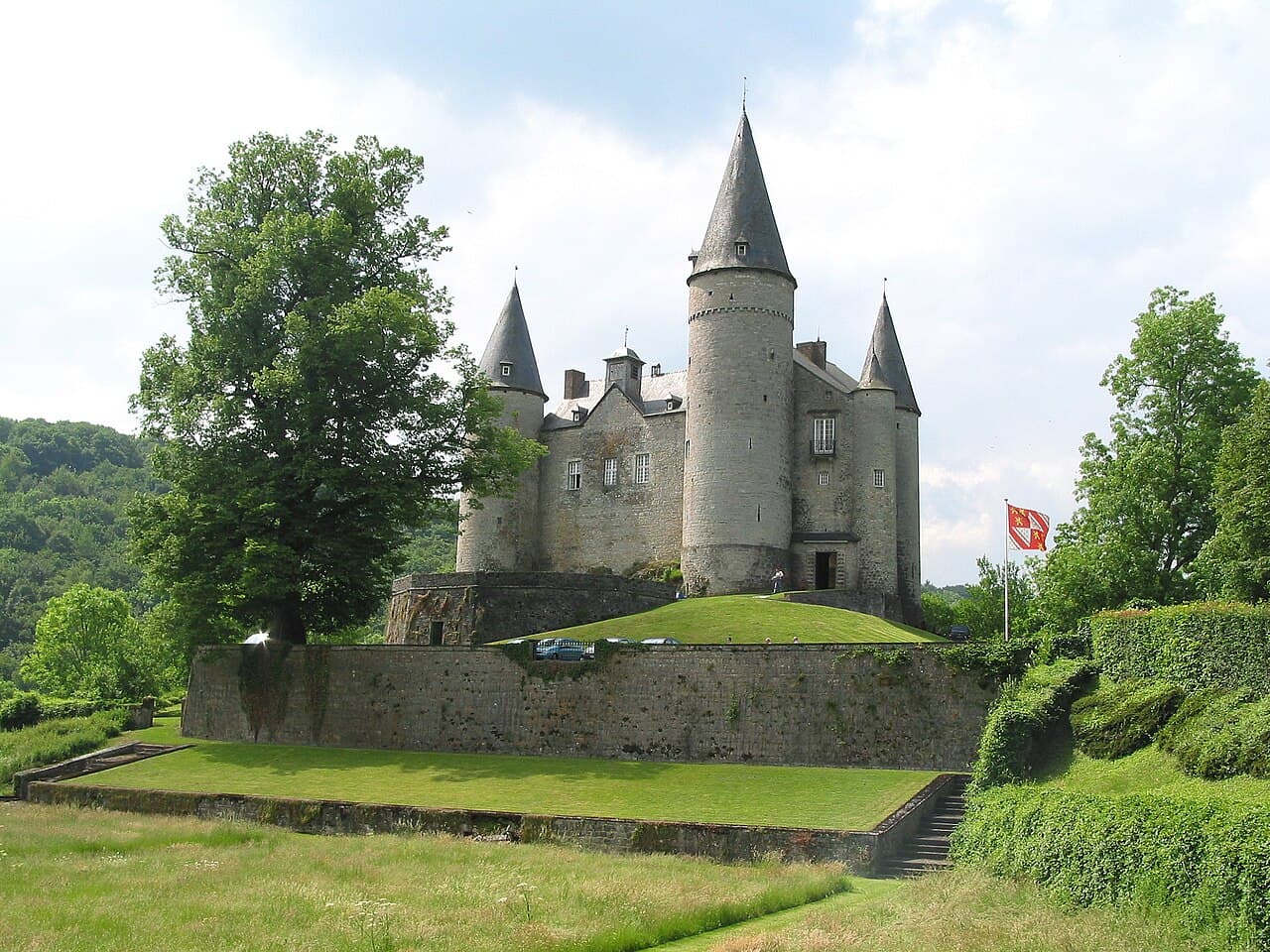
Castle of Veves
The Castle of Veves is a remarkable example of medieval fortification and noble residence located on a rocky platform just outside the village of Celles in the Namur region of Belgium. With origins tracing back to the late 7th century, this hill castle occupies a strategic position overlooking the Lesse River valley, near the historic road connecting Dinant and Rochefort. The castle’s location was originally chosen for its defensive advantages and proximity to the hermitage of Saint Hadelin, underscoring its early religious and military significance.
The site’s history begins with the establishment of a Frankish villa by Pepin of Herstal in the late 7th century. This villa was fortified in the 9th century by Pepin’s successors, transforming it into a small fortress designed to control the surrounding territory. Though this early fortification was destroyed around the year 1200, it was soon rebuilt in the early 13th century by the powerful Beaufort family, who held the lordship of Celles-Vêves from the 12th century onward. The Beauforts’ influence was consolidated through marriage alliances, notably when Wauthier of Beaufort married Ode of Brittany, securing their lineage and territorial control.
Medieval construction and fortifications
The present castle largely dates from around 1410, following a destructive attack by the Dinantais in the early 15th century. The castle’s irregular pentagonal layout is shaped by the natural rocky outcrop on which it stands, with six round towers of varying sizes strategically placed around the perimeter. These towers and the thick stone walls were designed to withstand sieges and provide defensive strongpoints. The main tower, one of the oldest and most prominent features, stands approximately 36 meters tall and measures about 8 meters in diameter, anchoring the castle’s medieval fortifications.
Originally, the castle was equipped with battlements and narrow arrow slits, which were essential for defense during the Middle Ages. However, as military technology and residential needs evolved, these features were modified. The battlements were removed, and arrow slits were enlarged into windows to allow more light into the interior, reflecting a shift from purely defensive purposes to greater comfort and habitability.
Renaissance and later modifications
During the Renaissance and the subsequent Louis XV period, the castle underwent significant remodeling to adapt to changing tastes and functions. Two levels of timber-framed galleries were added in the 16th century, connecting the medieval residential section to a newer wing built at that time. Opposite these galleries, a wing with a red brick façade was constructed in the 18th century, showcasing the influence of Louis XV style and reflecting the castle’s evolution from a fortress to a noble residence.
Inside, the castle contains a rich collection of furnishings from the 18th century, including pieces from Countess Athénaïs de Mortemart’s collection, such as period furniture, paintings, and porcelain. The restored armory is notable for its original features, including a large fireplace, a paneled ceiling, and a sandstone floor mosaic decorated with various coats of arms, highlighting the castle’s heraldic heritage.
Religious significance and pilgrimage
A unique aspect of the castle’s history is its religious importance. In 1609, a terracotta statue of the Virgin Mary was discovered on the castle grounds, which attracted pilgrims and led to the construction of the nearby Église Notre-Dame de Foy. This event linked the castle to local religious traditions and added a spiritual dimension to its historical narrative.
Modern preservation and public access
The Liedekerke de Beaufort family, descendants of the original Beaufort owners, maintained the castle through the centuries. The last family member to live there was Count Hadelin de Liedekerke Beaufort. In the 20th century, a nonprofit association was established to preserve the castle and open it to the public. Major restoration efforts took place between 1969 and 1979 under the leadership of Christian de Liedekerke de Beaufort. Since 1986, the castle has operated as a museum, receiving the prestigious “preferred heritage” prize of Wallonia in 2018.
Today, the castle is well preserved, showcasing a blend of medieval fortifications and Renaissance architectural elements. Visitors can explore the robust medieval kitchens, the elegant living quarters furnished with historic artifacts, and the imposing towers that offer panoramic views of the surrounding landscape. The castle’s adaptation to the natural topography and its architectural evolution reflect its continuous occupation and the changing needs of its inhabitants over nearly a millennium.
Architectural features and layout
The castle’s irregular triangular plan is dictated by the rocky promontory on which it stands. The six round towers vary in size, with the four larger towers providing strong defensive positions and the two smaller towers serving supplementary roles. The walls are constructed from heavy stone, typical of high medieval military architecture, and have been modified over time to enhance both defense and residential comfort.
The interior courtyard is enclosed and features two levels of timber-framed galleries from the Renaissance period, illustrating the castle’s transition from fortress to stately home. The juxtaposition of the medieval stonework with the lighter timber framing and the red brick façade creates a visually striking architectural ensemble.
The main tower’s height and diameter make it a dominant feature of the castle’s silhouette, symbolizing its original military purpose. The castle’s kitchens are notably large, designed for preparing food for a substantial household or garrison. The armory’s preserved elements, including the mosaic floor with coats of arms, provide insight into the castle’s noble lineage and martial history.
Historical context and regional significance
The Castle of Veves played a significant role in the defense and administration of the region during the high medieval period. Its strategic location allowed control over important trade and military routes along the Lesse River. The Beaufort family’s long tenure and the castle’s resilience through attacks, such as the 1410 assault by the Dinantais, highlight its importance as a regional stronghold.
Throughout its history, the castle has witnessed the shifting political and social landscape of Belgium, from Frankish rule through the Middle Ages, the Renaissance, and into modern times. Its preservation and continued public accessibility make it a valuable cultural heritage site, offering insights into medieval architecture, noble life, and regional history.
Frequently asked questions (FAQ)
- How do I get to the Castle of Veves?
- The Castle of Veves is located in Celles, Belgium, and can be easily accessed by car or public transportation. If traveling by car, there is parking available nearby. For those using public transport, the nearest train station is in the town of Celles, from where you can take a short taxi ride to the castle.
- What is the historical significance of the Castle of Veves?
- The Castle of Veves dates back to the 15th century and is an excellent example of medieval architecture in Belgium. It has played a crucial role in the region's history, serving as a noble residence and a strategic stronghold. The castle's rich history and well-preserved structure make it a popular attraction for history enthusiasts.
- When was the Castle of Veves built?
- The construction of the Castle of Veves began in the 15th century, specifically around 1450. It was built in the Gothic style and has undergone several renovations over the centuries, preserving its historical charm. Today, it stands as a testament to the architectural styles of its time.
- Can I take photos inside the Castle of Veves?
- Yes, visitors are welcome to take photos inside the Castle of Veves, but be sure to respect any signage regarding photography restrictions. Capturing the beautiful architecture and decor is encouraged, as it helps to preserve the memories of your visit. Just remember to be courteous to other visitors.
- Why is the Castle of Veves considered a must-visit attraction?
- The Castle of Veves is considered a must-visit due to its stunning architecture, rich history, and picturesque surroundings. It offers visitors a glimpse into medieval life and the opportunity to explore beautifully landscaped gardens. Additionally, the castle hosts various events and exhibitions that enhance the visitor experience.
- Is it possible to tour the Castle of Veves?
- Yes, guided tours are available at the Castle of Veves, providing an in-depth look at its history and architecture. Tours are conducted in multiple languages, making it accessible for international visitors. It’s recommended to check the schedule in advance, as times may vary seasonally.
- What are the opening hours for the Castle of Veves?
- The Castle of Veves is typically open to visitors from March to November, with varied hours depending on the month. During peak season, the castle opens daily, while in the off-season, it may be closed on weekdays. It's best to check the official website for the most current opening hours before planning your visit.
- What are the ticket prices for the Castle of Veves?
- Ticket prices for the Castle of Veves are generally affordable, with discounts available for students and seniors. Admission includes access to the castle and its gardens, as well as guided tours. Check the official website for any special events or promotional rates that may apply during your visit.
- When is the best time to visit the Castle of Veves?
- The best time to visit the Castle of Veves is during the spring and summer months when the gardens are in full bloom. Additionally, the weather is more favorable for exploring the outdoor areas. However, visiting during the fall can also provide stunning views of the foliage surrounding the castle.
- Are there any nearby attractions to the Castle of Veves?
- Yes, there are several nearby attractions worth exploring, including the picturesque village of Celles and other historical sites in the region. Visitors may also enjoy hiking in the scenic Ardennes area, which offers beautiful landscapes and outdoor activities. Plan a full day to enjoy both the castle and its surrounding natural beauty.
Photo gallery

Information
Website
Visit websiteSources & official resources
Verify the information above using these authoritative references.
Loading map...
Visitor reviews
No reviews yet. Been here? Write the first review and help other travelers!
Write the first reviewVisited this castle? Share your experience
Your review helps other travelers and adds first-hand knowledge to our encyclopedia.



