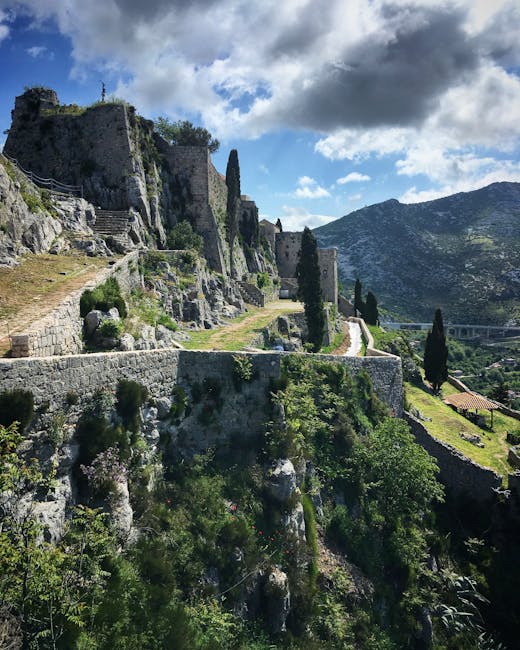
Venetian Castle
The Venetian Castle in Split, Croatia, is a significant example of late medieval military architecture in the Dalmatian region. Constructed in 1441 during the period of Venetian rule, the castle was strategically positioned just south-west of the renowned Diocletian's Palace, along the Adriatic shoreline. Its location was chosen to strengthen the city's coastal defenses and assert Venetian dominance in this important maritime hub.
The castle was built on the site of a demolished monastery, reflecting the common practice of repurposing land for military needs during times of conflict. It originally featured an irregular pentagonal layout, a design that maximized defensive capabilities by reducing blind spots and allowing for comprehensive surveillance of the surrounding area. The fortress included three towers facing north, oriented towards the city to oversee and protect the urban center. These towers were integral to the castle's defensive function, providing elevated positions for lookouts and artillery.
Historical context and construction
The decision to construct the Venetian Castle was made in 1424, during a period of heightened tension and military threats in the Adriatic. However, actual construction did not commence until 1441, indicating a period of planning and resource allocation. The castle's establishment was part of a broader Venetian strategy to fortify key coastal cities against Ottoman expansion and piracy, which were significant threats in the 15th century.
By the early 16th century, the castle had fallen into disrepair, a common fate for many fortifications as military technology and political circumstances evolved. It was not until the first half of the 17th century that significant restoration and strengthening efforts were undertaken. These improvements likely included reinforcing walls, repairing towers, and updating defensive features to adapt to the changing nature of warfare, particularly the increasing use of gunpowder artillery.
Architectural features and design
The castle's irregular pentagonal shape was a distinctive feature that combined both functional and strategic elements. This form allowed defenders to cover all approaches with overlapping fields of fire, minimizing vulnerable angles. The three northern towers were crucial for monitoring the city and controlling access routes.
Constructed predominantly from local stone, the castle's walls were thick and robust, designed to withstand bombardment and sieges. The presence of a large central tower served as a keep or donjon, providing a last line of defense and a vantage point for surveillance. The smaller eastern tower and connecting walls formed a defensive perimeter that enclosed the castle's interior spaces.
Decline and partial demolition
By the early 19th century, the Venetian Castle had lost its military significance due to changes in warfare and political control. During the Napoleonic Wars, the southern walls were demolished between 1806 and 1807 under the orders of Auguste de Marmont, a French marshal overseeing the region. This demolition reflected a strategic decision to prevent the fortress from being used by enemy forces or to adapt urban development needs.
Today, the remaining structures include the large central tower, the smaller eastern tower, and the connecting walls, all situated on Radić Brothers Square (Trg braće Radić). These remnants provide valuable insight into the castle's original layout and defensive capabilities.
Legacy and cultural significance
The Venetian Castle stands as a testament to the complex history of Split and the Dalmatian coast, reflecting centuries of Venetian influence and military architecture. Its proximity to Diocletian's Palace links it to one of the most important Roman monuments in the region, creating a layered historical landscape.
Although only partially preserved, the castle remains a point of interest for visitors and scholars interested in medieval fortifications, Venetian maritime power, and Croatian heritage. Its ruins contribute to the character of Radić Brothers Square, integrating historical architecture into the modern urban fabric of Split.
Information
Loading map...
Visitor reviews
No reviews yet. Been here? Write the first review and help other travelers!
Write the first reviewVisited this castle? Share your experience
Your review helps other travelers and adds first-hand knowledge to our encyclopedia.