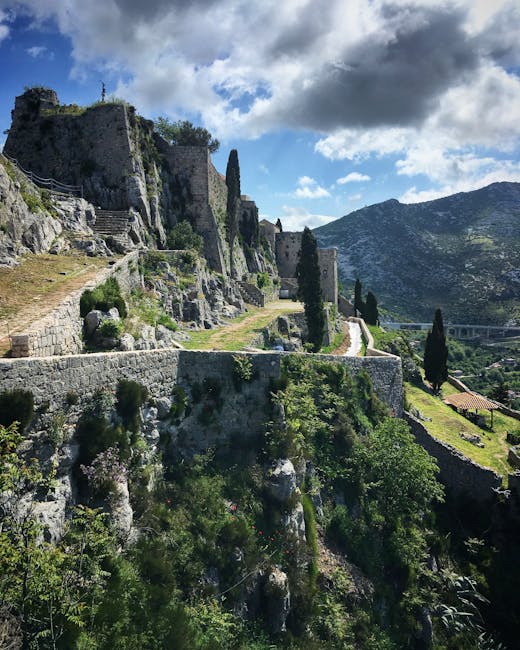
Solin Castle
Solin Castle, locally known as Gradina, is situated in the town of Solin within the Split-Dalmatia County of Croatia. The name "Gradina" is a common Croatian term for "castle," but to distinguish it from other similarly named sites, it is widely referred to as Solin Castle. This fortress occupies a strategic location near the Jadro River, close to the ruins of the ancient Roman city of Salona.
The castle's origins are primarily linked to the Ottoman Empire, which constructed it in the first half of the 16th century, most likely in 1531. The Ottomans ingeniously incorporated remnants of the ancient city walls of Salona into the castle's eastern curtain wall, demonstrating a practical reuse of existing fortifications. Additionally, the northern curtain wall incorporates the north wall of a 9th-century church, which had been converted into a mosque during Ottoman rule. Remarkably, historical accounts suggest that the castle was erected in as little as 15 days, underscoring the strategic urgency of its construction.
Historical background and strategic importance
Although the Ottoman construction is the most documented, some sources suggest that a fortification existed on this site earlier, possibly built in the second half of the 14th century by Archbishop Hugolin de Mala Branca of Split. However, the Ottoman fortress is the structure that has left the most significant archaeological and historical imprint.
The primary military purpose of Solin Castle was to serve as a forward base for the Ottomans during their campaigns against the nearby Klis Castle, a key stronghold resisting Ottoman expansion. By controlling Solin Castle, the Ottomans aimed to disrupt the logistical and military support lines to Klis, weakening its defenders. This threat was recognized by the defenders of Klis, who launched an attack in 1532 and destroyed Solin Castle.
In response, Gazi Husrev Bey, the Ottoman governor of the Sanjak of Bosnia, ordered the castle's restoration in 1536. The following year, in 1537, the Ottomans successfully captured Klis Castle, marking a significant advance in their control over the region. Initially, Solin Castle remained garrisoned by Ottoman troops, but over time its military relevance diminished as the border between the Ottoman Empire and the Republic of Venice stabilized nearby, turning the area into a no man's land by the late 16th century.
Architectural features and construction details
Solin Castle is a typical example of a Renaissance-era fortress adapted by the Ottomans to local conditions. The use of existing ancient structures, such as the Roman city walls and the 9th-century church, is a notable feature that illustrates the layering of historical periods at the site. The castle's walls are built to maximize defensive capabilities, with thick curtain walls and strategic incorporation of older masonry.
The conversion of the church into a mosque within the castle grounds is a significant architectural and cultural adaptation, reflecting the Ottoman practice of repurposing religious buildings in conquered territories. The castle's rapid construction within 15 days indicates a focus on urgent military functionality rather than elaborate design.
Layout and defensive structures
The castle's layout includes a compact courtyard enclosed by robust walls, with the eastern curtain wall integrating the ancient Roman fortifications. The northern wall, incorporating the church remains, provided both defensive strength and a symbolic assertion of Ottoman presence. Defensive features likely included battlements and firing positions suitable for the firearms and artillery of the period.
Later history and current status
After the late 16th century, as the Ottoman-Venetian border solidified, Solin Castle gradually lost its military importance and fell into ruin. During the French rule in Croatia (1806-1813), the castle ruins were repurposed to station a cavalry detachment, indicating its continued strategic location despite its dilapidated state.
In modern times, since 1979, the castle has been adapted as a cultural venue with a summer stage installed within its ruins. This transformation highlights the site's ongoing cultural relevance. An extensive archaeological excavation conducted in 2020 has further illuminated the castle's historical layers, contributing valuable insights into its construction phases and usage.
Today, Solin Castle is accessible primarily during cultural events held on site. Visitors can experience the atmospheric ruins and appreciate the castle's historical significance within the broader context of Croatian and Ottoman history.
Solin Castle in the context of Croatian heritage
Solin Castle stands as a testament to the complex history of Dalmatia, where Roman, medieval Croatian, Venetian, and Ottoman influences intersect. Its location near the ancient city of Salona connects it to one of the most important Roman urban centers in the region, adding archaeological significance to its military and cultural history.
The castle's layered architecture and historical narrative reflect the region's turbulent past and the shifting borders of empires. As a partially preserved Renaissance fortress with Ottoman modifications, Solin Castle offers valuable insights into military architecture and cultural adaptation during a critical period of European history.
Frequently asked questions (FAQ)
- How do I get to Solin Castle?
- Solin Castle is easily accessible by car and public transportation from nearby cities like Split. If you're traveling by bus, there are regular services that connect Solin with major Croatian cities. Once in Solin, the castle is a short walk from the bus stop.
- What is the historical significance of Solin Castle?
- Solin Castle, built during the medieval period, holds great historical importance as it was a strategic fortress that protected the region from invasions. It is situated near the ancient Roman city of Salona, which adds to its historical allure. Visitors can explore the remnants of this castle and learn about its role in the region's turbulent history.
- When was Solin Castle constructed?
- Solin Castle was constructed in the late 15th century, primarily as a response to the Ottoman threat in the region. The castle showcases the architectural styles and defensive strategies of its time. Although much of it has been preserved, the site still reflects its historical context.
- Can I take guided tours of Solin Castle?
- Yes, guided tours are available at Solin Castle, providing visitors with in-depth knowledge about its history and architecture. These tours often include access to areas that may not be open to the public during self-guided visits. Check the castle's official website for tour schedules and availability.
- Why is Solin Castle a popular tourist attraction?
- Solin Castle is popular due to its stunning views of the surrounding landscape and its proximity to historical sites, including the ruins of Salona. The castle’s rich history and well-preserved architecture attract history enthusiasts and tourists alike. Additionally, the tranquil setting makes it a perfect spot for photography and exploration.
- Is it possible to visit Solin Castle year-round?
- Yes, Solin Castle is open to visitors year-round, although the best time to visit is during the spring and fall when the weather is mild. However, some services may be limited during the winter months. It's advisable to check the castle's official website for any seasonal changes in opening hours.
- What are the ticket prices for Solin Castle?
- Ticket prices for Solin Castle are quite affordable, with discounts available for students and seniors. Children under a certain age often enter for free. It's best to check the official website for the most current pricing information and any special offers.
- What are the opening hours for Solin Castle?
- Solin Castle typically opens at 9 AM and closes at 7 PM during the summer months, while winter hours may vary. It's recommended to arrive earlier in the day to fully enjoy the site without feeling rushed. Always check the official website for the latest updates regarding opening hours.
- Are there any nearby attractions to visit after Solin Castle?
- Yes, after visiting Solin Castle, you can explore the ruins of ancient Salona, which is just a short distance away. Additionally, the city of Split, with its UNESCO World Heritage sites, is also nearby and offers a wealth of cultural experiences. Enjoying both the castle and surrounding attractions makes for a full day of exploration.
Information
Loading map...
Visitor reviews
No reviews yet. Been here? Write the first review and help other travelers!
Write the first reviewVisited this castle? Share your experience
Your review helps other travelers and adds first-hand knowledge to our encyclopedia.