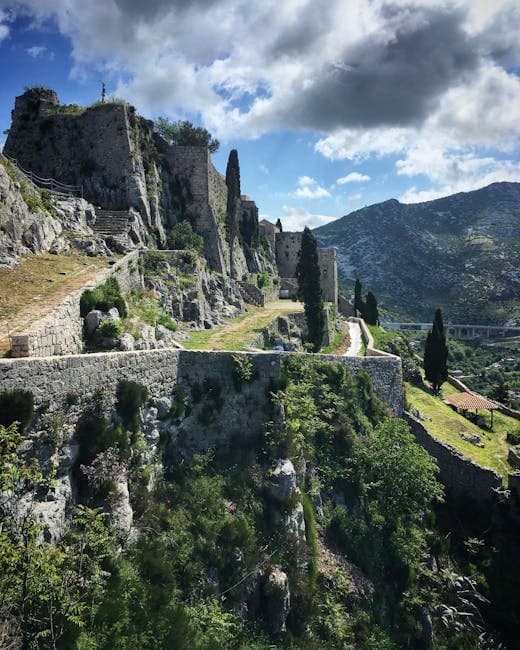
Klis Fortress
Klis Fortress is a monumental medieval stronghold perched on a rocky spur above the village of Klis, near Split, Croatia. Its strategic location on the pass between the Mosor and Kozjak mountains has made it a pivotal military and political site throughout history. The fortress overlooks the ancient Roman settlement of Salona and commands views of the city of Split, Solin, Kaštela, Trogir, and the central Dalmatian islands, underscoring its importance in controlling access between the Mediterranean coast and the Balkan hinterland.
The origins of Klis Fortress trace back to the Illyrian tribe of the Dalmatae, who initially established a small stronghold on this naturally defensible rocky outcrop. The Romans later fortified the site, naming it "Andetrium" or "Clausura," and it gained early military prominence during the Illyrian revolt, notably resisting a siege by Emperor Augustus. Following the fall of the Roman Empire, Klis passed through the hands of various rulers including the Ostrogoths and Byzantines, with its fortifications mentioned in the 10th century by Emperor Constantine VII in his work De Administrando Imperio.
Early medieval significance and royal seat
From the 7th century onward, Klis Fortress emerged as a central stronghold for the early Croatian state. Duke Mislav made it his seat in the mid-9th century, establishing Klis as a political and military center. His successor, Duke Trpimir I, founder of the Croatian royal House of Trpimirović, significantly expanded the fortress and promoted Christianity by founding a church and the first Benedictine monastery in the valley below at Rižinice. A Latin charter dated 852 confirms Klis as Trpimir's property and seat.
King Tomislav, Croatia's first king, used Klis alongside Biograd na Moru as his main residences in the early 10th century, highlighting the fortress's role as a royal seat. During this period, Klis not only served as a military bastion but also as a symbol of Croatian sovereignty and statehood.
Medieval fortifications and noble rule
In the early 13th century, control of Klis was granted by King Andrew II of Hungary to the Knights Templar, who appointed Pontius de Cruce as regent of Croatia and Dalmatia. Although the Templars soon lost Klis, this period underscores the fortress's strategic importance in regional power struggles. In 1242, Klis famously withstood a siege by Tatars under Kadan, part of the Mongol army pursuing King Béla IV of Hungary. The fortress's defenders successfully repelled the attack, forcing the Mongols to retreat.
From the late 13th century, the noble House of Šubić governed Klis, with Paul I Šubić of Bribir becoming Ban of Croatia and Dalmatia and Lord of Bosnia. The Šubić family controlled much of modern Croatia and Bosnia, and Klis served as a key administrative and military center during their rule. The fortress also has dynastic significance through Jelena Šubić, mother of the first Bosnian king Tvrtko I, who was married at Klis.

Photo by Minestrone • CC BY-SA 3.0
Defense against the ottoman empire
The early 16th century marked a critical chapter in Klis's history during the Ottoman expansion into Europe. Croatian captain Petar Kružić led the fortress's defense against a prolonged Ottoman siege lasting over 25 years. Kružić and his Uskoks, an elite Croatian militant faction formed during this period, resisted fiercely despite limited external support.
Despite their valiant efforts, the defenders were ultimately overcome in 1537, and Klis fell under Ottoman control. The Ottomans transformed the fortress into a sanjak center within the Bosnia Eyalet, adapting its structures to suit their administrative and military needs. Notably, they constructed a stone mosque on the site of an earlier Croatian Catholic chapel, symbolizing the cultural and religious shifts during Ottoman rule.
In 1596, local nobles and Uskoks briefly recaptured Klis but soon lost it again to the Ottomans, who maintained control until the late 17th century.
Venetian and austrian periods
The Republic of Venice seized Klis in 1669, shifting the border between Christian and Muslim Europe further east. The Venetians restored and expanded the fortress, converting the Ottoman mosque into the Roman Catholic Church of St. Vitus, removing the minaret and adding Baroque elements such as a stone baptismal font dated 1658.
Venetian fortifications included the construction of bastions like the Bembo bastion, the largest artillery position in the fortress’s third defensive line. These enhancements reflect the evolving military architecture of the period, adapting Klis to withstand contemporary siege warfare.
After the fall of Venice in 1797, Klis came under Austrian control. The Austrians made further modifications, including new gates and artillery barracks, although the fortress gradually lost strategic importance as borders shifted and modern warfare evolved. The last military occupation occurred during World War II under Axis forces.
Architectural features and layout
Klis Fortress exemplifies Dalmatian defensive architecture, built irregularly to conform to the rugged terrain of its rocky promontory. It comprises three elongated defensive lines formed by stone walls encircling a central stronghold known as the Položaj maggiore at the highest eastern point.
The fortress is divided into a lower western section near Mount Greben and a higher eastern section containing the Oprah tower and the commander’s quarters. The only entrance is on the western side, leading to a fortified settlement or "borgo" surrounded by double walls and numerous towers. Below Mount Greben lies the Megdan plateau, which housed lazarettos and quarantine facilities called nazanama during Ottoman times, used to isolate travelers and protect coastal cities from epidemics.
Several potable water sources are near the fortress, including the Holy Biblical Magi spring, which was vital during sieges. The fortress’s current appearance largely reflects Venetian renovations from the 17th century and Austrian modifications in the 19th century.
The fortress has three main entrances associated with different historical periods. The first, built by the Austrians in the early 19th century, features a narrow vaulted corridor called a casemate and is flanked by Venetian fortifications and the "Avanzato" position from 1648. The second entrance leads to the medieval section, near the Oprah tower, first mentioned in 1355. The third entrance opens to the early medieval section, renovated by Venetians until 1763, containing various military buildings including a powder magazine and the "House of Dux," the governor’s residence rebuilt on older Croatian royal foundations.
At the fortress’s highest point stands a "new gunpowder storage" built in the early 19th century. The oldest surviving domed building is a former Ottoman mosque, later converted into the Church of St. Vitus by the Venetians.
Cultural heritage and tourism
Today, Klis Fortress is a well-preserved monument and museum that showcases its extensive military history. Visitors can explore displays of arms, armor, and traditional uniforms, gaining insight into the fortress’s role in Croatian and regional history. Its commanding views and rugged architecture make it a popular destination for those interested in medieval fortifications and Balkan history.
Klis also holds cultural significance as a symbol of Croatian resilience and statehood, having been a royal seat, a defensive bastion against invasions, and a contested site among regional powers for over a millennium.
Frequently asked questions (FAQ)
- How do I get to Klis Fortress from Split?
- Klis Fortress is located about 15 kilometers from Split and can be reached by car or local bus. The journey takes approximately 30 minutes, with buses running regularly from Split's main bus station.
- What is the historical significance of Klis Fortress?
- Klis Fortress has been a strategic military stronghold since the Illyrian period, serving as a royal seat for Croatian rulers and a key defensive site against Ottoman invasions.
- Can I visit the interior of Klis Fortress?
- Yes, the fortress is open to visitors daily from 9:00 to 18:00. Inside, you can explore the museum exhibits featuring arms, armor, and traditional uniforms, as well as enjoy panoramic views from the battlements.
- Is Klis Fortress accessible for people with mobility issues?
- Due to its rugged terrain and historic construction, Klis Fortress has limited accessibility for visitors with mobility impairments. Some areas involve steep climbs and uneven surfaces.
- When is the best time to visit Klis Fortress?
- The best time to visit is during the spring and autumn months when the weather is mild and the site is less crowded. Summer can be hot, but the fortress offers shaded areas and stunning views.
- Are there guided tours available at Klis Fortress?
- Guided tours are available and recommended to fully appreciate the fortress's rich history and architectural details. Tours can be booked on-site or through local tour operators.
Photo gallery

Photo by Sergei Gussev

Information
Opening hours
9:00-18:00, daily
Ticket prices
€5 adult, €3 child
Current owner
Croatian government
Website
Visit websiteSources & official resources
Verify the information above using these authoritative references.
Loading map...
Visitor reviews
No reviews yet. Been here? Write the first review and help other travelers!
Write the first reviewVisited this castle? Share your experience
Your review helps other travelers and adds first-hand knowledge to our encyclopedia.



