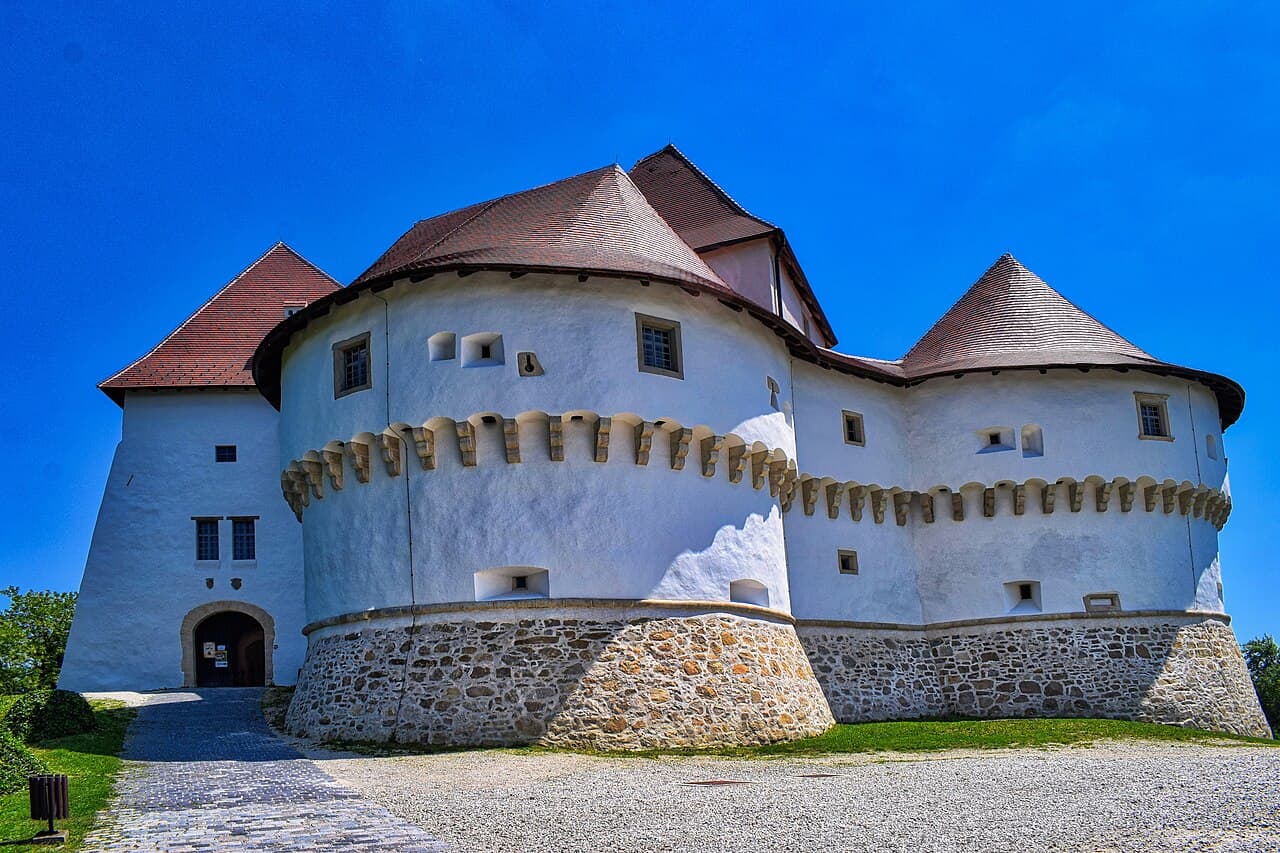
Veliki Tabor Castle
Veliki Tabor Castle stands as one of the most significant cultural and historical monuments of secular architecture in continental Croatia. This late medieval hill castle, perched atop Mount Hum Košnički at 333 meters above sea level, has dominated the Zagorje region for over 500 years. Its imposing silhouette blends harmoniously with the surrounding natural landscape, offering panoramic views over the entire Hrvatsko Zagorje area and parts of Slovenia. As a zero-category cultural monument, Veliki Tabor is not only an emblematic landmark of Hrvatsko Zagorje but also a cherished symbol of Croatian heritage.
Historical origins and construction phases
The earliest construction phase of Veliki Tabor dates back to the mid-15th century, as confirmed by recent archaeological and conservation research. While some sources previously suggested the beginning of construction around 1502, comparative architectural analysis and archaeological findings firmly establish the castle's origins in the Late Gothic period. The castle's core is a distinctive pentagonal palace that reflects the architectural style of this era.
The castle was likely founded by Fridrik II Celjski (Frederick II of Celje) (1378–1454), a prominent nobleman of the time. His successor, Ivan Vitovec (d. 1468), is credited with initiating the construction of the semi-circular Renaissance towers that surround the central pentagonal structure. These towers, built in the Renaissance style, were designed to defend the castle against firearms, evident in their slanted, expanded bases packed with soil for better resilience.
Architectural layout and defensive features
The castle's central pentagonal palace is surrounded by four semi-circular Renaissance towers connected by curtain walls and the northern entrance walls. The entire fortification complex is enclosed by an outer defensive wall extending approximately 225 meters from east to west. This outer wall includes a Renaissance bastion, two semi-circular guardhouses on the northern and southern sides, and the archaeological remains of a quadrangular entrance tower that once controlled access via the main road.
The palace itself was primarily a residential facility but incorporated fortification elements to defend against cold steel weapons. In contrast, the Renaissance towers were adapted for defense against firearms, featuring ground-level embrasures above cordon mouldings. The first-floor walls are broader and rest on triple stone consoles with drainage systems. Originally, embrasures were present on the façades of the semi-circular towers, underscoring their defensive role. However, in the 18th century, these towers were remodeled into living spaces, with embrasures closed off and larger windows installed.
On the courtyard side, the semi-circular towers connect through an arcade porch supported by slender Tuscan pillars and semi-circular Renaissance arches. A stone bridge links the first floor of the southern tower's porch to the castle entrance, adding to the architectural elegance.
The Rattkay family and the castle's golden age
In 1502, the castle came under the ownership of the Rattkay family, who ruled Veliki Tabor until 1793. This Hungarian noble family expanded their estate and significantly enhanced the castle's fortifications, reflecting their role in regional military and political affairs. The Rattkays were active participants in the battles against the Ottoman Empire during the 16th and 17th centuries, serving as commanders in the Croatian Military Border.
The family was ennobled with baronetcy in 1559, cementing their status among Croatia's most powerful aristocrats. Notable members include Juraj Rattkay (1613–1666), a canon and chronicler whose historical work "Memoriae Regum et Banorum Regnorum Dalmatiae, Croatiae et Sclavoniae" was published in 1652. Other Rattkay missionaries, such as Nikola and Ivan III Adam, extended the family's influence abroad.
Besides Veliki Tabor, the Rattkays constructed other castles like Mali Tabor and Miljana, and contributed to the building of parish churches in Vinagora, Taborsko, and Prišlin. Their tenure marked the castle's golden age, blending military utility with residential comfort and cultural patronage.
Later history and decline
After the death of Josip Ivan Rattkay in 1793 without a male heir, Veliki Tabor passed under the management of the Hungarian Chamber. Throughout the 19th century, the castle changed hands multiple times and gradually fell into disrepair. During World War I, it was repurposed as a prison. In 1919, the Croatian painter Oton Iveković purchased the castle with intentions to restore it but financial difficulties forced him to sell it in 1938.
The castle was then entrusted to the Society of Sisters of Mercy of the Third Order of St. Francis, who operated an orphanage and domestic science school. Repairs funded by the Banate were carried out between 1938 and 1943. After the nuns left in 1945, Veliki Tabor became state property and was used for various unsuitable functions, including a meat smokery and agricultural warehouse. Sporadic repairs occurred during the socialist period but comprehensive restoration was lacking.
Revitalization and modern use
In the late 1980s, local enthusiast Josip Štimac initiated cultural revitalization efforts, organizing knight tournaments, art colonies, and falconry events. In 2003, the Muzeji Hrvatskog Zagorja museums assumed management of the castle, launching archaeological research and professional restoration under the Croatian Conservation Institute's supervision.
Today, Veliki Tabor is a well-preserved castle functioning as a museum and cultural venue. Its architectural ensemble showcases a blend of Late Gothic, Renaissance, and Baroque elements, illustrating the evolution of fortification and noble residence design in Croatia. The castle is also famed for the legend of Veronika of Desinić, a tragic tale of love, accusation of witchcraft, and imprisonment that adds a rich layer of folklore to its history.
Architectural highlights and features
- The central pentagonal palace with thick defensive walls and a unique sharp triangular corner facing west.
- Four semi-circular Renaissance towers with slanted bases designed for firearm defense.
- Curtain walls connecting the towers and enclosing the castle's core.
- An outer defensive wall with a Renaissance bastion and semi-circular guardhouses.
- A chapel dedicated to Saints Peter and Paul located in the southern tower, housing a skull linked to Veronika of Desinić.
- Arcaded galleries with Tuscan pillars and semi-circular arches on the courtyard side.
- A deep well approximately 31 meters deep, essential for the castle's self-sufficiency during sieges.
- Baroque modifications including vaulted rooms, raised tower heights, and enlarged windows for residential comfort.
Legend of Veronika of Desinić
The castle's folklore is inseparable from the story of Veronika of Desinić, a local girl who fell in love with Fridrik, son of Count Hermann II of Celje. Their forbidden romance ended tragically when Hermann accused Veronika of witchcraft and had her drowned. Fridrik was imprisoned in the Celje Tower for over four years. According to legend, Veronika’s spirit still haunts Veliki Tabor, her mournful cries echoing through the castle walls. A skull believed to be hers is kept in the castle chapel, symbolizing this poignant tale.
Visiting Veliki Tabor today
Veliki Tabor Castle is open to visitors as a museum showcasing its rich history, architecture, and cultural heritage. The castle hosts the annual Tabor Film Festival since 2002, linking its medieval ambiance with contemporary arts. Visitors can explore the castle’s defensive structures, residential rooms, chapel, and exhibitions that narrate the castle’s multifaceted story from medieval times to the present.
The castle’s location offers breathtaking views and a tangible connection to Croatia’s noble and military past. Its preservation and ongoing research ensure that Veliki Tabor remains a vital cultural monument and a captivating destination for history enthusiasts and tourists alike.
Frequently asked questions (FAQ)
- What is the historical significance of Veliki Tabor Castle?
- Veliki Tabor Castle is a well-preserved medieval fortress that dates back to the 15th century. It is renowned for its role in the history of the region, particularly as a noble residence and a symbol of Croatian heritage.
- When was Veliki Tabor Castle built?
- The construction of Veliki Tabor Castle began in the 15th century, with its most significant developments occurring in the 16th century. Its architectural style reflects the transition from Gothic to Renaissance, making it an important example of medieval architecture in Croatia.
- Can I visit Veliki Tabor Castle year-round?
- Yes, Veliki Tabor Castle is open to visitors throughout the year, although the opening hours may vary by season. It is advisable to check the official website for the most current visiting hours before planning your trip.
- What are the ticket prices for Veliki Tabor Castle?
- Ticket prices for Veliki Tabor Castle are generally affordable, with discounts available for children, students, and seniors. It's best to check directly on the castle's website for the latest pricing information and any special offers.
- Is Veliki Tabor Castle accessible for visitors with disabilities?
- Veliki Tabor Castle has made efforts to improve accessibility for all visitors. However, due to the nature of the castle's historic architecture, some areas may pose challenges for those with mobility impairments.
- What is the best time to visit Veliki Tabor Castle?
- The best time to visit Veliki Tabor Castle is during the spring and early autumn months when the weather is pleasant and the surrounding landscape is particularly beautiful. Additionally, visiting during weekdays can help you avoid crowds.
- Are there any nearby attractions to visit while at Veliki Tabor Castle?
- Yes, there are several attractions near Veliki Tabor Castle, including the picturesque town of Zagore and other historical sites like the Museum of Krapina Neanderthals. Exploring the surrounding nature parks can also enhance your visit.
- What architectural features can I expect to see at Veliki Tabor Castle?
- Veliki Tabor Castle showcases a blend of Gothic and Renaissance architectural styles, with impressive defensive walls and a unique tower. Visitors will appreciate its well-preserved interiors, which include a chapel and various historical artifacts.
- How do I get to Veliki Tabor Castle?
- Veliki Tabor Castle is easily accessible by car, located approximately 4 km from the town of Desinić. Public transportation options may be limited, so it's advisable to plan your visit accordingly, possibly arranging for a taxi or guided tour.
Photo gallery

Information
Website
Visit websiteSources & official resources
Verify the information above using these authoritative references.
Loading map...
Visitor reviews
No reviews yet. Been here? Write the first review and help other travelers!
Write the first reviewVisited this castle? Share your experience
Your review helps other travelers and adds first-hand knowledge to our encyclopedia.


