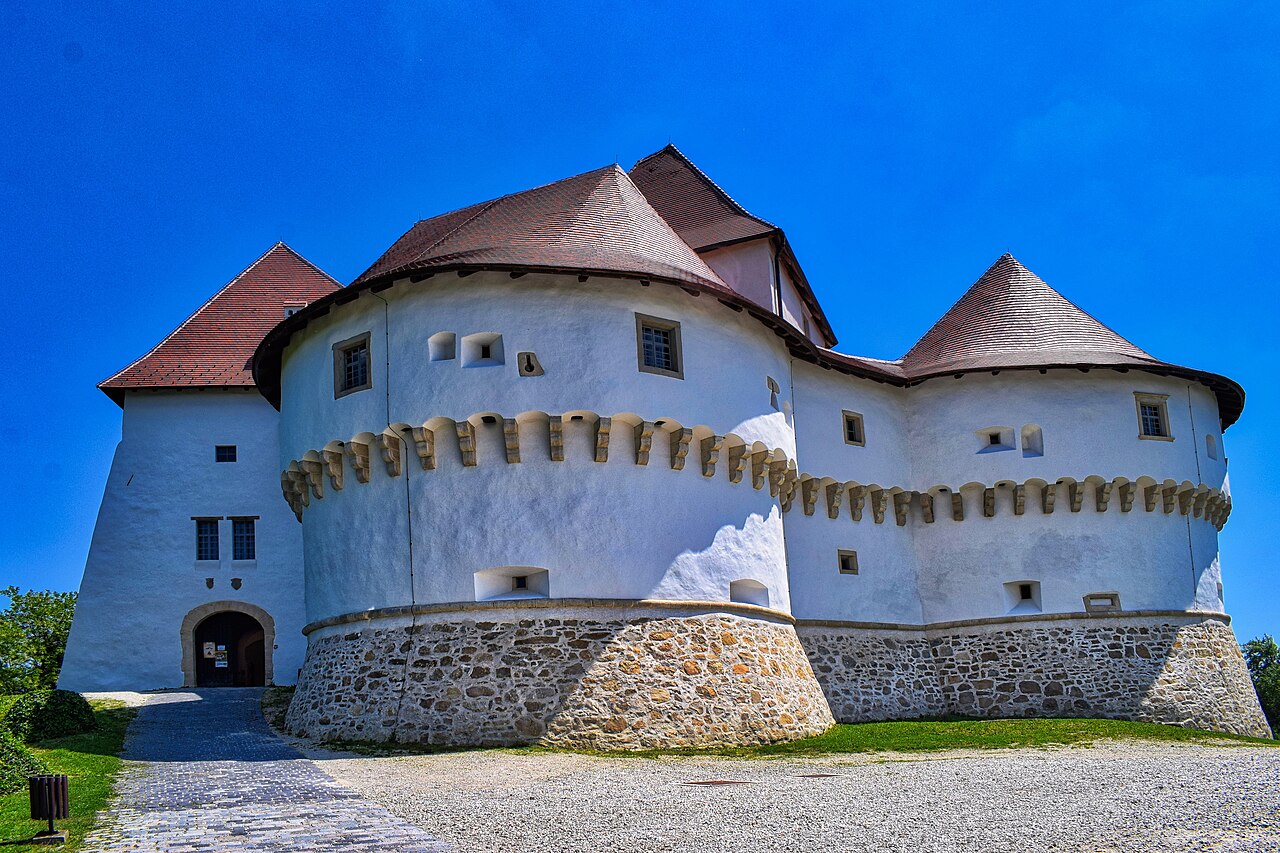
Mali Tabor Castle is a significant historical fortress located in Mali Tabor, Croatia, first mentioned in records at the end of the 15th century. While the exact builders remain unknown, the castle's early history is closely linked to the influential Ratkay family, who owned it for nearly three centuries. This castle reflects the architectural and political shifts in the region from the late medieval period through the Baroque era.
Origins and early ownership
The initial mention of Mali Tabor Castle dates back to the late 1400s. During this time, it was under the possession of the Ratkay family, a powerful Hungarian noble lineage. Between 1490 and 1504, ownership briefly passed to John Corvinus, the viceroy of Croatia-Hungary and son of King Matthias Corvinus, indicating the castle's strategic importance in the region. The Ratkay family regained possession in 1524 and maintained control until 1793, overseeing the castle through significant historical events and architectural transformations.
Architectural evolution
Medieval fortress layout
The earliest phase of Mali Tabor Castle featured a classic late medieval defensive design. The castle was originally constructed as a rectangular building surrounded by defensive walls and fortified with four semi-circular towers positioned at the corners. This layout was typical of fortifications designed to withstand sieges and provide a stronghold in turbulent times. The western wall of the castle is believed to be part of the original defensive structure, possibly predating the main construction phases.
Baroque transformation
In the 17th and 18th centuries, the castle underwent significant modifications, reflecting the changing needs and tastes of its owners. It was transformed into a one-storied Baroque palace, moving away from its purely military function to a more residential and representational role. This architectural shift included the addition of elegant facades and interior spaces suited for noble living rather than defense.
19th-century additions
Further changes occurred in 1861 when a one-storied annex was built on the eastern wing of the castle's northern side. This period also saw the demolition of the northern defensive wall, which was replaced by a new entrance portal. The portal, an important architectural feature, has been preserved and remains a visible reminder of the castle's adaptation to more peaceful times and changing architectural styles.
Later ownership and decline
After the Ratkay family's tenure, the castle passed through several hands, including the baron Joseph Wintershoffen in the early 19th century, who inherited it from Ivan Rattkay in 1793. Subsequently, it was owned by Rikard Jelačić from the Zaprešić branch until 1876, followed by the Irish baron Henry Cavanagh. These changes in ownership reflect the shifting political and social landscape of the region during the 19th century.
Today, Mali Tabor Castle stands abandoned and in a poor state of preservation. Despite its rich history and architectural significance, it has not been maintained and is currently for sale. The castle's condition reflects the challenges faced by many historic properties in maintaining their legacy amid changing times.
Architectural features and defensive elements
The castle's original defensive features included the semi-circular towers which provided vantage points for surveillance and defense. The rectangular layout allowed for efficient use of space within the walls, while the thick stone walls offered protection against attacks. The gradual removal of defensive walls and the addition of residential annexes illustrate the transition from a fortress to a noble residence.
Historical significance in the Croatian-Hungarian borderlands
Mali Tabor Castle played a role in the regional dynamics between Croatia and Hungary, especially during the turbulent late medieval and early modern periods. Its ownership by figures such as John Corvinus highlights its strategic importance. The castle also reflects the broader history of noble families in the area and their adaptations to political changes over centuries.
Current status and preservation challenges
Despite its historical and architectural value, Mali Tabor Castle has suffered from neglect in recent decades. The lack of restoration efforts has led to deterioration of its structures. Preservation of such castles is critical for cultural heritage, yet financial and logistical challenges often impede conservation. The castle remains a subject of interest for historians and preservationists who recognize its potential as a cultural landmark.
Loading map...
Visitor reviews
No reviews yet. Been here? Write the first review and help other travelers!
Write the first reviewVisited this castle? Share your experience
Your review helps other travelers and adds first-hand knowledge to our encyclopedia.