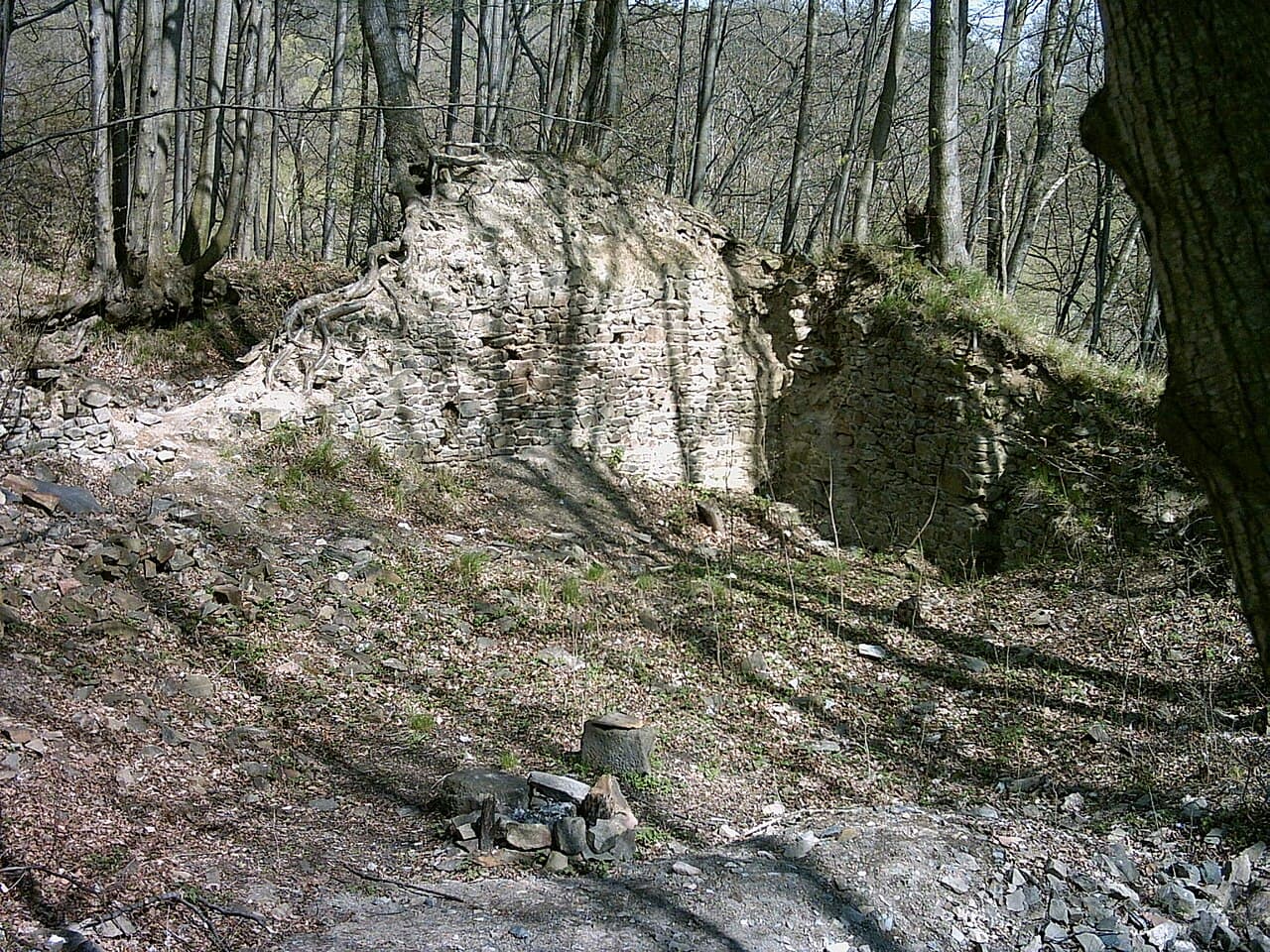
Vartnov Castle stands as a compelling historical monument in the Czech Republic, located on a small wooded hill in the village of Pocheň. The castle's origins trace back to the early 14th century, with the first documented mention appearing in 1377. Archaeological excavations have confirmed its construction around this period, linking it to the noble family of Varta who served at the court of the Opava Duke, Mikołaj II. Around 1349, the castle passed into the hands of the Moravian family from Holštejn, with notable figures such as Vok I and his son Štěpán I holding significant regional influence.
Strategic location and architectural design
Vartnov Castle was strategically built on a modest elevation with an oval ground plan. The defensive perimeter walls, remarkably thick at up to 2.5 meters, were constructed along the edge of the hill, maximizing natural defenses. The main entrance was situated on the southern side, accessible via a bridge spanning a dry moat. The gate tower, notable for being open on the courtyard side, projected outward from the main wall, enhancing its defensive capabilities.
Additional fortifications included an outer wall protecting the southern section of the castle, while the northern part of the courtyard was enclosed by another wall. Inside, the western section housed the main residential building, while a smaller internal courtyard with a well was located on the eastern side. Another residential structure was positioned along the western wall. Excavations have also revealed remains of buildings near the gate, though their precise function remains unclear.
Historical significance and ownership changes
The castle's history reflects the turbulent political landscape of medieval Moravia. In 1421, the Holštejn family sold Vartnov Castle to Jan II Železný, Duke of Opava. His sons later sold it in 1447 to Bernard Bírka of Násile. Remarkably, Vartnov survived the widespread destruction of the Hussite Wars intact.
However, in 1474, during the Hungarian-Czech war, the castle was captured and burned by the forces of King Matthias Corvinus. The allegiance of the castle's owners during this conflict remains uncertain. A 1523 inspection records the castle as ruined, indicating it was never rebuilt after the attack. In the latter half of the 17th century, the village of Pocheň was established adjacent to the castle ruins.
Current condition and archaeological remains
Today, the site of Vartnov Castle is characterized by its ruined state, with only fragments of the original walls, the gate remains, and parts of the moat visible amidst the forested hill. Among the surviving structures is a barrel-vaulted cellar room and a portal leading to another collapsed chamber, providing valuable insight into the castle's architectural layout.
The ruins offer a tangible connection to the late medieval period of Moravian history, illustrating typical defensive features such as thick curtain walls, a strategically placed gate tower, and a dry moat, all adapted to the natural topography of the hill.
Architectural features and layout
The castle's oval plan is somewhat unusual compared to more common rectangular or circular designs, reflecting adaptation to the hill's contours. The curtain walls were formidable, designed to withstand siege weaponry of the period. The gate tower served as both a defensive stronghold and a controlled entry point, with its open courtyard side allowing defenders to monitor and repel attackers effectively.
The internal division of the castle into distinct residential and service areas, including the well-equipped courtyard, highlights the dual military and domestic functions of Vartnov Castle. The presence of multiple residential buildings indicates a substantial garrison or noble household.
Visiting the site and cultural importance
Although in ruins, Vartnov Castle remains an important cultural and historical site in the Czech Republic, attracting visitors interested in medieval architecture and history. The castle's location on a forested hill provides a scenic setting that enhances the experience of exploring its remains. Interpretive signage and archaeological findings contribute to understanding the castle's role in regional history.
Its survival through significant historical conflicts and eventual decline into ruins encapsulates the story of many medieval fortifications in Central Europe. Vartnov Castle stands as a testament to the architectural ingenuity and turbulent history of the Moravian nobility during the late medieval era.
Frequently asked questions (FAQ)
- How do I get to Vartnov Castle ruins?
- Vartnov Castle ruins are located on a wooded hill near the village of Pocheň in Moravia, Czechia. Visitors can reach the site by local roads and then follow marked hiking trails leading up to the ruins.
- What remains can I see at Vartnov Castle?
- Visitors can observe fragments of the original curtain walls, the gate tower remains, parts of the dry moat, a barrel-vaulted cellar, and a portal to a collapsed chamber.
- When was Vartnov Castle built and by whom?
- Vartnov Castle was constructed in the early 14th century, likely by the noble family of Varta who served at the court of Duke Mikołaj II of Opava.
- Was Vartnov Castle involved in any historical conflicts?
- Yes, the castle survived the Hussite Wars intact but was captured and burned during the 1474 Hungarian-Czech war by King Matthias Corvinus's forces.
- Is Vartnov Castle accessible to visitors year-round?
- The ruins are accessible year-round, but visitors should be prepared for uneven terrain and forested paths. There are no formal visitor facilities on site.
Photo gallery

Information
Loading map...
Visitor reviews
No reviews yet. Been here? Write the first review and help other travelers!
Write the first reviewVisited this castle? Share your experience
Your review helps other travelers and adds first-hand knowledge to our encyclopedia.



