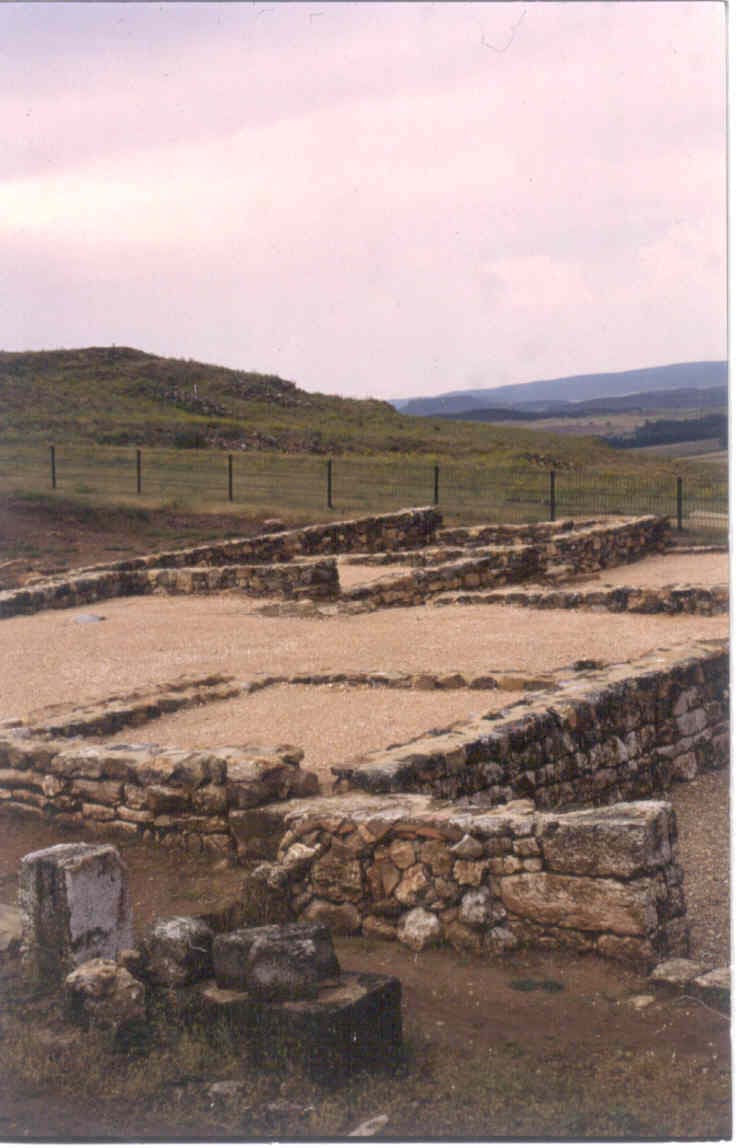
Uxama Argaela — Spain castle

Uxama Argaela

Uxama Argaela archaeological site in Soria, Spain
El Burgo de Osma, Spain
Ruins

Uxama Argaela is an archaeological site of a former Celtiberian settlement that later became a significant Roman city. It is located on El Castro hill, overlooking the modern town of El Burgo de Osma in the province of Soria, Spain. This site offers valuable insight into the pre-Roman and Roman periods in the Iberian Peninsula, reflecting the cultural and architectural evolution from a fortified Celtiberian oppidum to a Roman municipium.

The Celtiberian origins of Uxama Argaela

The earliest known phase of Uxama Argaela dates back to the Iron Age, when it was inhabited by the Celtiberians, an ancient Iberian people known for their warrior culture and hilltop settlements called oppida. The site occupies a strategic position on El Castro hill, providing natural defensive advantages with steep slopes and commanding views of the surrounding landscape. The Celtiberian inhabitants constructed fortification walls using large stone blocks, enclosing the settlement to protect against rival tribes and invaders.

Archaeological excavations have revealed remains of these fortified walls, along with domestic structures, workshops, and burial sites that illustrate the daily life and social organization of the Celtiberian community. The settlement was likely a center for trade and military activities, controlling important routes through the region.

Roman transformation and urban development

Following the Roman conquest of the Iberian Peninsula in the 2nd century BCE, Uxama Argaela underwent significant changes. It was integrated into the Roman provincial system and eventually attained the status of a municipium, a self-governing city with Roman citizenship rights for its inhabitants. This transition is evident in the architectural remains and urban layout uncovered at the site.

The Romans introduced urban planning concepts such as a grid street system, public buildings, and infrastructure improvements. Excavations have uncovered the foundations of a forum, temples, baths, and an amphitheater, indicating the city's importance as a local administrative and cultural center. The presence of Roman masonry techniques and construction materials marks a clear departure from the earlier Celtiberian styles.

Architectural features and defensive structures

The city's defensive system was enhanced during the Roman period, with the construction of stone walls and towers adapted to new military technologies. The integration of Celtiberian and Roman fortification methods resulted in a complex defensive network that protected the city from external threats.

Key architectural elements include the remains of gates that controlled access to the city, sections of the perimeter wall, and watchtowers strategically placed to monitor the surrounding territory. These features illustrate the blend of indigenous and Roman military architecture.

Archaeological significance and preservation

Today, Uxama Argaela is recognized as an important archaeological site that provides a rare glimpse into the cultural transition from Celtiberian to Roman civilization in northern Spain. The site is protected as a historical monument, and ongoing excavations continue to uncover new information about its urban development, social structure, and regional role.

Visitors to the site can explore the ruins of the ancient city, including the defensive walls, public buildings, and residential areas. Interpretive signage and guided tours help contextualize the findings within the broader history of the Iberian Peninsula.

Location and access

Uxama Argaela is situated near the modern town of El Burgo de Osma in the Soria province of Spain. The site lies on El Castro hill, which offers panoramic views of the surrounding landscape. It is accessible by road from El Burgo de Osma, making it a valuable destination for those interested in ancient history and archaeology.

Frequently asked questions (FAQ)

What is the historical significance of Uxama Argaela?
Uxama Argaela is an ancient Roman settlement that played a crucial role in the region's history. It showcases the architectural and cultural influences of the Roman Empire in Spain, making it an important site for understanding the area's past.
When was Uxama Argaela built?
Uxama Argaela was established during the Roman period, with its origins tracing back to the 1st century AD. The site has been excavated to reveal significant structures that highlight its historical importance.
How do I get to Uxama Argaela?
Uxama Argaela is located near El Burgo de Osma, easily accessible by car or public transport from major cities in Spain. The site is well-signposted, and local maps can assist visitors in finding their way.
Is it possible to access the castle grounds?
Yes, visitors can explore the castle grounds and the surrounding archaeological site. The area is open to the public, allowing guests to walk through the ruins and appreciate the historical context.
What are the opening hours for Uxama Argaela?
Uxama Argaela is typically open to visitors from 10 AM to 6 PM, but hours may vary seasonally. It is advisable to check the official website or local tourist information for the most current hours before planning your visit.
Can I take a guided tour of Uxama Argaela?
Yes, guided tours are often available, providing deeper insights into the history and architecture of Uxama Argaela. These tours are a great way to enhance your visit and learn more about the significance of the site.
What is the best time to visit Uxama Argaela?
The best time to visit Uxama Argaela is during the spring and fall when the weather is mild and pleasant. These seasons also tend to attract fewer crowds, allowing for a more enjoyable experience.
Are there any nearby attractions to Uxama Argaela?
Yes, nearby attractions include the historic town of El Burgo de Osma, known for its beautiful architecture and cultural heritage. Additionally, the surrounding natural landscapes offer opportunities for hiking and exploring the scenic countryside.
What are the ticket prices for visiting Uxama Argaela?
Ticket prices for Uxama Argaela are generally affordable, with discounts available for students and seniors. It’s best to check the official website for the latest pricing information and any special offers.

Photo gallery

Uxama Argaela
Click to view

Photo by Caligatus•Public domain

1 photo • Click any image to view in full screen

Information

Archaeological Site / Ruins

Loading map...

Visitor reviews

No reviews yet. Been here? Write the first review and help other travelers!

Write the first review

Visited this castle? Share your experience

Your review helps other travelers and adds first-hand knowledge to our encyclopedia.

Write a review

(5/5)

0/2000 characters

Your review will be visible after admin approval

Nearby castles

0.8 km

Osma Castle

El Burgo de Osma, Spain

Osma Castle is a remarkable medieval fortress situated near the town of El Burgo de Osma, in the western part of the province of Soria, Spain. Perched on a rocky hill between the rivers Ucero and Avion, the castle overlooks the historically significant town of Osma and the ancient Roman city of Uxama. This strategic location allowed the castle to control access to the valley and defend the surrounding region throughout various historical periods. The castle's origins date back to the early 10th century, with construction beginning around 912 AD. It was built primarily as a defensive stronghold during the turbulent times of the Reconquista, when Christian kingdoms sought to reclaim territory from Muslim rule. The fortress occupies a hilltop naturally suited for defense, featuring three distinct walled enclosures that adapt to the irregular terrain. Although much of the castle now lies in ruins, significant remains of the inner enclosure, including the keep, towers, and fortified walls, provide insight into its medieval military architecture. Historical background and origins Ancient and roman foundations The site of Osma Castle has a rich history predating the medieval fortress. Originally, the area was home to the Celtiberian settlement known as Uxama-Argelae, established by the Arevaci tribe long before Roman conquest. This early settlement was strategically located between two rivers, a feature that influenced later fortifications. During the 2nd century BCE, the Romans conquered the region and rebuilt Uxama, fortifying it with robust walls and infrastructure typical of Roman municipia. The city flourished under Roman rule, minting its own currency and developing advanced water management systems, including cisterns, aqueducts, and pipelines that sourced water from springs some 20 kilometers away. These Roman constructions provided building materials and foundational structures later incorporated into the medieval castle. Visigothic and muslim periods After the fall of the Roman Empire, the site remained inhabited during the Visigothic era, evidenced by archaeological finds such as burial grounds and early Christian diocesan structures dating before the 6th century. This continuity reflects the area's sustained importance and emerging religious significance. With the arrival of Muslim rule, the city was known as Waxsima. During this period, watchtowers called atalayas were constructed to enhance communication and defense across the landscape. Despite political changes, the Roman roads continued to serve as vital routes, facilitating movement and control under both Muslim and later Christian authorities. Medieval construction and military significance Castle construction and layout The medieval Osma Castle was constructed primarily in the early 10th century, with the initial building phase around 912 AD. It was established on the hilltop overlooking the valley, utilizing stone masonry techniques such as mampostería and sillarejo, which involved small squared stones. Builders reused Roman architectural elements, including finely cut blocks, cornices, and columns, especially visible in the prominent towers. The fortress is divided into three irregularly shaped enclosures. The innermost enclosure, the highest on the hill, contains the main defensive structures, including the keep or tower of homage, which served as the castle's stronghold. This enclosure also features a main gate, possibly adorned with a horseshoe-shaped arch typical of Iberian medieval military architecture, and smaller doors providing controlled access. The middle and outer enclosures provided additional layers of defense, extending down the hillside toward the riverbanks. Although much of these outer walls have deteriorated, remnants remain visible, including the notable Tower of Water (Torre del Agua) situated near the Ucero River. This tower guarded a vital bridge and water source, essential for the castle's sustainability during sieges. Military history and sieges Osma Castle played a significant role during the Reconquista, experiencing numerous sieges and conflicts. It was first conquered by King Garcia of Leon in 912, marking its entry into Christian hands. However, the castle faced repeated Moorish expeditions throughout the 10th and 11th centuries, leading to cycles of destruction and rebuilding. In 1088, the castle was definitively taken by King Alfonso VI, who consolidated Christian control over the region. The castle's military importance continued into the Late Middle Ages, with fortifications enhanced to meet evolving defensive needs. By the 15th century, the castle belonged to the bishop of Osma, Pedro de Montoya, who also fortified the nearby Ucero Castle and strengthened the city walls of Osma, reflecting the growing importance of the town over the fortress. Architectural features and ruins today Structural elements and materials The castle's construction showcases medieval masonry techniques combined with the reuse of Roman materials. The walls are built mainly from small squared stones arranged in mampostería and sillarejo styles, providing a sturdy yet adaptable structure fitting the rocky terrain. The keep stands as the central defensive tower, complemented by other smaller towers that once formed part of the castle's complex defense system. The main gate and smaller doors controlled access, while the three walled enclosures created successive defensive barriers. The Tower of Water is a distinctive feature of the outer enclosure, strategically placed near the river to protect access to water and a bridge. This tower incorporates Roman stones and architectural fragments, symbolizing the continuity of construction traditions across centuries. Current condition and visitor experience Today, Osma Castle is classified as a ruined hill castle with partially preserved walls and towers. Visitors can freely explore the site, enjoying a scenic walk up the hill and panoramic views of the surrounding landscape. Although the interior offers limited structural remains, the castle's layout and surviving elements provide valuable insight into its historical and architectural significance. Recent restoration efforts between 2016 and 2020 have stabilized the ruins, improving accessibility and preserving the site for future generations. The castle remains an important cultural landmark, illustrating the region's layered history from Celtiberian through medieval Christian periods. The town of osma and its fortifications The town of Osma, established in the 12th century, grew in prominence during the Middle Ages, eventually surpassing the castle in importance. The construction of the Roman Catholic Cathedral of San Pedro de Osma symbolized the town's religious and civic development. To protect this growing settlement, extensive city walls were built in the 15th century under the direction of Bishop Pedro de Montoya. These fortifications, partially preserved today, reflect the shift from castle-centric defense to urban fortification, marking a new phase in the region's military architecture. Local legends and cultural significance Local tradition recounts a dramatic episode in 1469 when Prince Ferdinand of Aragon allegedly escaped death at Osma Castle by disguising himself as a merchant. While this story lacks historical documentation, it adds to the castle's rich tapestry of legends and cultural memory. Overall, Osma Castle stands as a testament to the enduring strategic importance of this hilltop site across multiple historical eras. Its ruins, combined with the nearby town and Roman heritage, offer a fascinating glimpse into Spain's complex medieval past.

Early Medieval (5th–10th c.)
Details
1.8 km

Burgo de Osma Cathedral

Burgo de Osma, Spain

Burgo de Osma Cathedral, located in the historic town of Burgo de Osma in Spain, is a remarkable example of High Medieval Gothic architecture. Construction began in 1232 on the site of an earlier Romanesque church, reflecting the architectural evolution from the Romanesque to the Gothic style in medieval Spain. The cathedral is dedicated to the Assumption of Mary and is renowned for its well-preserved structure and rich artistic heritage. Architectural evolution and construction timeline The cathedral's construction spanned several centuries, with its initial phase starting in the early 13th century. While the core Gothic structure dates from this period, the building was not completed until 1784, incorporating significant additions from later architectural periods. The Flamboyant Gothic cloister, dating from 1512, showcases the intricate stonework typical of late Gothic design, while the tower, completed in 1739, reflects Baroque influences. The cathedral's main façade features a Renaissance-style door, highlighting the transition of artistic styles through its long construction history. Inside, the cathedral contains a Gothic marble pulpit in the major chapel, which is a fine example of medieval craftsmanship. Notable architectural features and artistic elements Burgo de Osma Cathedral houses numerous significant artistic works and architectural details. The altarpiece is a centerpiece of religious art, complemented by the frescos in the dome that add vibrant color and iconography to the interior space. The Immaculate figure on the central altar, imported from Rome, emphasizes the cathedral's religious and cultural connections beyond Spain. The Neoclassical sacristy adds a contrasting architectural style, reflecting the evolving tastes and religious functions over the centuries. The upper part of the cathedral is adorned with beautiful stained glass windows that illuminate the interior with colored light, a hallmark of Gothic ecclesiastical architecture. One of the cathedral's most treasured features is the tomb of San Pedro de Osma, considered a masterpiece of funerary art. This tomb exemplifies the skill and artistic expression of medieval sculptors and holds significant historical and religious importance. Historical and cultural significance The cathedral stands as one of the best-preserved medieval buildings in Spain and is a prime example of 13th-century Gothic architecture. Its layered construction history offers insights into the architectural transitions from Romanesque to Gothic, Renaissance, and Baroque styles. The cathedral has been a religious center for centuries, serving the local community and pilgrims alike. Inside the cathedral, a museum holds an impressive collection of paintings, sculptures, and valuable codices, including the famous "El Beato" manuscript. These cultural artifacts enhance the cathedral's role as a repository of medieval art and religious heritage. Visiting the cathedral Visitors to Burgo de Osma Cathedral can explore its architectural features, art collections, and the peaceful cloister. The combination of Gothic, Renaissance, and Baroque elements provides a comprehensive view of Spanish ecclesiastical architecture across centuries. The cathedral remains an active place of worship and a significant cultural landmark in the region.

High Medieval (11th–13th c.)
Details
9.5 km

San Esteban de Gormaz Castle

San Esteban de Gormaz, Spain

San Esteban de Gormaz castle stands as a significant medieval fortress located in the town of San Esteban de Gormaz in Spain. This castle played a crucial role during the turbulent 10th and 11th centuries, a period marked by frequent conflicts and territorial changes between Muslim and Christian forces on the Iberian Peninsula. Its strategic position overlooking the Douro River allowed control over important transit routes and served as a defensive stronghold in the region. The historical context and strategic importance The castle's origins trace back to the 10th century, a time when the frontier between the Christian kingdoms and Muslim territories was highly contested. Initially under Muslim control, the fortress changed hands multiple times before finally coming under Christian rule. During the reign of King García I of León, the castle was reinforced to strengthen the Christian hold over the region. This reinforcement coincided with the repopulation efforts in the town, which was part of a broader strategy to consolidate Christian territories along the Duero frontier. From its elevated position, the castle's garrison could effectively monitor and control movement along the river and protect the vital bridge crossing the Douro River. This control was essential for securing supply lines and military movements, making San Esteban de Gormaz a linchpin in the defense system of the Kingdom of León. Architectural features and construction The castle is characterized by a narrow and elongated layout, adapted to the natural topography of its hilltop site. The remaining fortifications include a substantial wall approximately two metres thick, constructed primarily of ashlar stonework. This stonework is notable for its quality and may incorporate materials of Roman origin, suggesting the reuse of earlier masonry in the castle's construction. Near the castle's entrance, there is a notable feature known as the Pozo Lairón, a large opening in the ground. While its exact purpose remains uncertain, it is speculated to have served as a cistern, storage pit, or possibly a defensive feature. Inside the castle grounds, remnants of water pools and underground structures have been identified, indicating the presence of facilities for water storage and possibly shelter during sieges. Defensive elements and layout The fortress's design reflects typical early medieval military architecture with thick defensive walls intended to withstand assaults. The elongated shape allowed defenders to maximize surveillance and control along the ridge. The castle's vantage point provides extensive views of the surrounding landscape, including the nearby castle of Gormaz, another important fortress in the region. This visual connection between fortifications was likely part of a coordinated defensive network. Current condition and preservation Today, San Esteban de Gormaz castle is in a state of partial preservation. While much of the original structure has deteriorated over the centuries, significant portions of the defensive wall remain intact, offering valuable insights into the castle's original scale and construction techniques. The site is recognized for its historical and archaeological importance, attracting visitors interested in medieval military architecture and the history of the Reconquista. The castle's ruins provide a tangible link to the complex history of the borderlands between Christian and Muslim Spain. Its commanding location and surviving structures continue to illustrate the strategic considerations that shaped medieval fortifications in this region. San Esteban de Gormaz in the broader medieval landscape The castle's history is intertwined with the broader narrative of the Reconquista, the centuries-long series of campaigns by Christian kingdoms to reclaim territory from Muslim rule. As part of the Kingdom of León's defensive frontier, San Esteban de Gormaz played a role in securing newly conquered lands and facilitating the repopulation and economic development of the area. Its proximity to the castle of Gormaz, one of the largest and most formidable fortresses of the time, underscores the military significance of this corridor along the Duero River. Together, these castles formed a defensive belt that helped shape the political and cultural landscape of medieval Spain.

Early Medieval (5th–10th c.)
Details

