Osma Castle
Osma Castle is a remarkable medieval fortress situated near the town of El Burgo de Osma, in the western part of the province of Soria, Spain. Perched on a rocky hill between the rivers Ucero and Avion, the castle overlooks the historically significant town of Osma and the ancient Roman city of Uxama. This strategic location allowed the castle to control access to the valley and defend the surrounding region throughout various historical periods.
The castle's origins date back to the early 10th century, with construction beginning around 912 AD. It was built primarily as a defensive stronghold during the turbulent times of the Reconquista, when Christian kingdoms sought to reclaim territory from Muslim rule. The fortress occupies a hilltop naturally suited for defense, featuring three distinct walled enclosures that adapt to the irregular terrain. Although much of the castle now lies in ruins, significant remains of the inner enclosure, including the keep, towers, and fortified walls, provide insight into its medieval military architecture.
Historical background and origins
Ancient and roman foundations
The site of Osma Castle has a rich history predating the medieval fortress. Originally, the area was home to the Celtiberian settlement known as Uxama-Argelae, established by the Arevaci tribe long before Roman conquest. This early settlement was strategically located between two rivers, a feature that influenced later fortifications.
During the 2nd century BCE, the Romans conquered the region and rebuilt Uxama, fortifying it with robust walls and infrastructure typical of Roman municipia. The city flourished under Roman rule, minting its own currency and developing advanced water management systems, including cisterns, aqueducts, and pipelines that sourced water from springs some 20 kilometers away. These Roman constructions provided building materials and foundational structures later incorporated into the medieval castle.
Visigothic and muslim periods
After the fall of the Roman Empire, the site remained inhabited during the Visigothic era, evidenced by archaeological finds such as burial grounds and early Christian diocesan structures dating before the 6th century. This continuity reflects the area's sustained importance and emerging religious significance.
With the arrival of Muslim rule, the city was known as Waxsima. During this period, watchtowers called atalayas were constructed to enhance communication and defense across the landscape. Despite political changes, the Roman roads continued to serve as vital routes, facilitating movement and control under both Muslim and later Christian authorities.
Medieval construction and military significance
Castle construction and layout
The medieval Osma Castle was constructed primarily in the early 10th century, with the initial building phase around 912 AD. It was established on the hilltop overlooking the valley, utilizing stone masonry techniques such as mampostería and sillarejo, which involved small squared stones. Builders reused Roman architectural elements, including finely cut blocks, cornices, and columns, especially visible in the prominent towers.
The fortress is divided into three irregularly shaped enclosures. The innermost enclosure, the highest on the hill, contains the main defensive structures, including the keep or tower of homage, which served as the castle's stronghold. This enclosure also features a main gate, possibly adorned with a horseshoe-shaped arch typical of Iberian medieval military architecture, and smaller doors providing controlled access.
The middle and outer enclosures provided additional layers of defense, extending down the hillside toward the riverbanks. Although much of these outer walls have deteriorated, remnants remain visible, including the notable Tower of Water (Torre del Agua) situated near the Ucero River. This tower guarded a vital bridge and water source, essential for the castle's sustainability during sieges.
Military history and sieges
Osma Castle played a significant role during the Reconquista, experiencing numerous sieges and conflicts. It was first conquered by King Garcia of Leon in 912, marking its entry into Christian hands. However, the castle faced repeated Moorish expeditions throughout the 10th and 11th centuries, leading to cycles of destruction and rebuilding.
In 1088, the castle was definitively taken by King Alfonso VI, who consolidated Christian control over the region. The castle's military importance continued into the Late Middle Ages, with fortifications enhanced to meet evolving defensive needs. By the 15th century, the castle belonged to the bishop of Osma, Pedro de Montoya, who also fortified the nearby Ucero Castle and strengthened the city walls of Osma, reflecting the growing importance of the town over the fortress.
Architectural features and ruins today
Structural elements and materials
The castle's construction showcases medieval masonry techniques combined with the reuse of Roman materials. The walls are built mainly from small squared stones arranged in mampostería and sillarejo styles, providing a sturdy yet adaptable structure fitting the rocky terrain.
The keep stands as the central defensive tower, complemented by other smaller towers that once formed part of the castle's complex defense system. The main gate and smaller doors controlled access, while the three walled enclosures created successive defensive barriers.
The Tower of Water is a distinctive feature of the outer enclosure, strategically placed near the river to protect access to water and a bridge. This tower incorporates Roman stones and architectural fragments, symbolizing the continuity of construction traditions across centuries.
Current condition and visitor experience
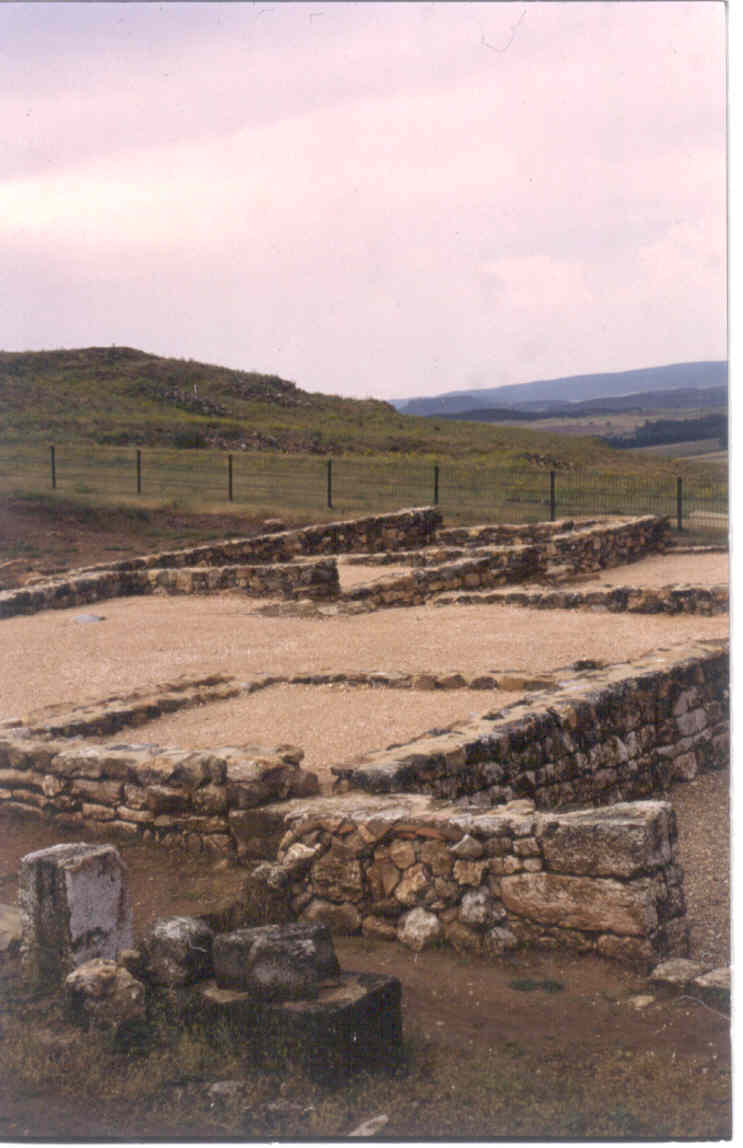
Today, Osma Castle is classified as a ruined hill castle with partially preserved walls and towers. Visitors can freely explore the site, enjoying a scenic walk up the hill and panoramic views of the surrounding landscape. Although the interior offers limited structural remains, the castle's layout and surviving elements provide valuable insight into its historical and architectural significance.
Recent restoration efforts between 2016 and 2020 have stabilized the ruins, improving accessibility and preserving the site for future generations. The castle remains an important cultural landmark, illustrating the region's layered history from Celtiberian through medieval Christian periods.
The town of osma and its fortifications
The town of Osma, established in the 12th century, grew in prominence during the Middle Ages, eventually surpassing the castle in importance. The construction of the Roman Catholic Cathedral of San Pedro de Osma symbolized the town's religious and civic development.
To protect this growing settlement, extensive city walls were built in the 15th century under the direction of Bishop Pedro de Montoya. These fortifications, partially preserved today, reflect the shift from castle-centric defense to urban fortification, marking a new phase in the region's military architecture.
Local legends and cultural significance
Local tradition recounts a dramatic episode in 1469 when Prince Ferdinand of Aragon allegedly escaped death at Osma Castle by disguising himself as a merchant. While this story lacks historical documentation, it adds to the castle's rich tapestry of legends and cultural memory.
Overall, Osma Castle stands as a testament to the enduring strategic importance of this hilltop site across multiple historical eras. Its ruins, combined with the nearby town and Roman heritage, offer a fascinating glimpse into Spain's complex medieval past.
Frequently asked questions (FAQ)
- What is the historical significance of Osma Castle?
- Osma Castle dates back to the 10th century and played a crucial role in the defense of the region against various invasions. Its strategic location made it a vital stronghold during the Reconquista, showcasing the architectural style and military innovations of its time.
- When was Osma Castle built?
- Osma Castle was originally constructed in the early 10th century, with subsequent modifications and expansions made over the centuries. The castle reflects various architectural influences, particularly from the Romanesque and Gothic periods, making it a fascinating site for history enthusiasts.
- Can I visit Osma Castle year-round?
- Yes, Osma Castle is open to visitors throughout the year. However, it is advisable to check the local schedule for any seasonal events or maintenance closures that might affect access.
- What are the opening hours of Osma Castle?
- Osma Castle typically opens to the public from 10 AM to 6 PM during the weekdays, and from 10 AM to 8 PM on weekends. It's recommended to verify the opening hours before your visit, as they may vary depending on the season or special events.
- Is it possible to access Osma Castle with limited mobility?
- While Osma Castle has some areas that are accessible, the terrain can be uneven and may pose challenges for visitors with limited mobility. It’s best to contact the castle management in advance to inquire about specific accessibility options available during your visit.
- What is the best time to visit Osma Castle?
- The best time to visit Osma Castle is during the spring and fall when the weather is mild, making it comfortable for exploring the castle grounds. Additionally, these seasons often feature fewer crowds than the summer months, allowing for a more relaxed experience.
- Are there any nearby attractions to explore after visiting Osma Castle?
- Yes, after visiting Osma Castle, you can explore the charming town of El Burgo de Osma, which is home to the stunning Cathedral of El Burgo de Osma and various historical sites. The surrounding countryside also offers beautiful walking trails and picturesque views.
- What are the ticket prices for visiting Osma Castle?
- Ticket prices for Osma Castle are generally affordable, with discounts available for children, students, and seniors. It's advisable to check the official website for the most up-to-date pricing and any special offers.
Information
Address
Calle Real, El Burgo de Osma, Soria, Spain
Loading map...
Visitor reviews
No reviews yet. Been here? Write the first review and help other travelers!
Write the first reviewVisited this castle? Share your experience
Your review helps other travelers and adds first-hand knowledge to our encyclopedia.