Uraniborg
Uraniborg stands as a significant monument in the history of astronomy and scientific innovation. Built between 1576 and 1580 on the island of Ven in the Öresund strait, this Renaissance observatory was commissioned and operated by the renowned Danish astronomer Tycho Brahe. At the time, the island was part of the Kingdom of Denmark, but it is now within the borders of modern Sweden. Uraniborg was the first purpose-built observatory in Europe designed explicitly for detailed astronomical observation and research, marking a pivotal shift in scientific methodology during the 16th century.
Architectural design and facilities
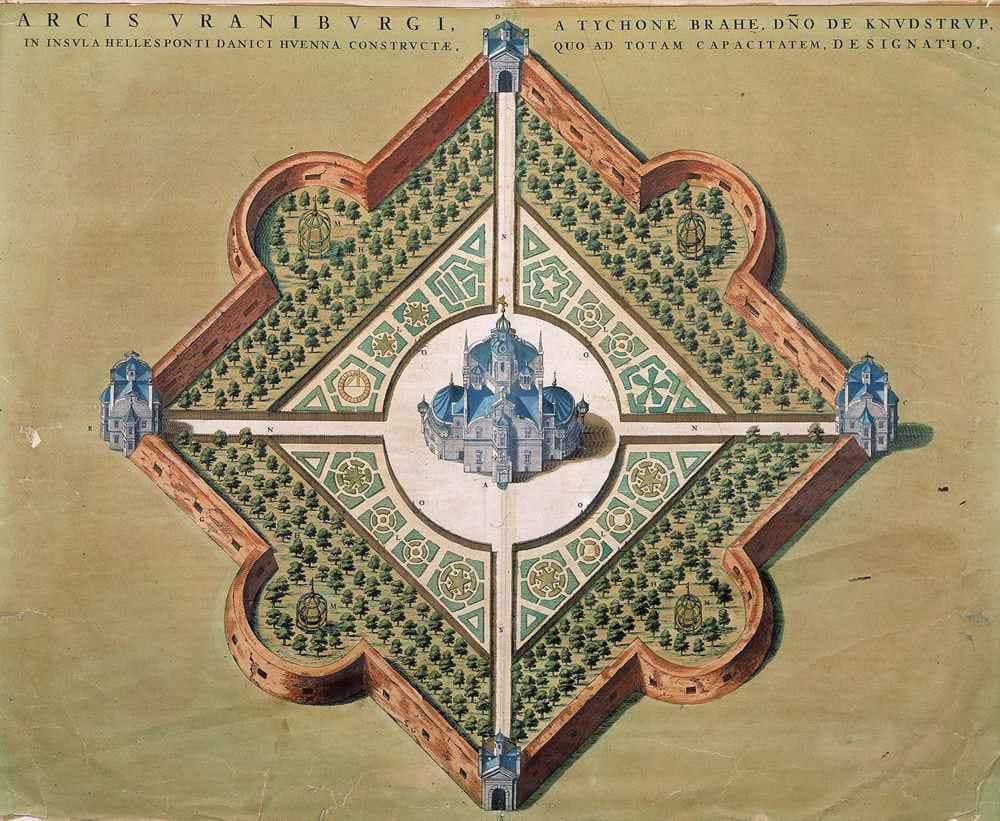
The design of Uraniborg was unique for its era, combining elements of a palace, laboratory, and observatory. The structure featured a main building with a central tower and four wings arranged around a courtyard. This layout provided ample space for Brahe’s instruments and living quarters for himself and his assistants. The building was constructed primarily from stone and brick, reflecting the renaissance architectural style with its emphasis on symmetry and proportion.
In addition to the visible structures, Brahe expanded the site with an underground complex called Stjärneborg, located nearby. This subterranean observatory housed several of Brahe’s most precise instruments, protected from the elements and vibrations, allowing for more accurate measurements. The integration of both above-ground and underground facilities demonstrated Brahe’s innovative approach to observational astronomy.
Scientific achievements and instruments
Tycho Brahe was not only an astronomer but also a prolific inventor of precision instruments. At Uraniborg, he developed and refined many devices, including large quadrants, sextants, and armillary spheres. These tools enabled him to make some of the most accurate astronomical observations of his time, predating the invention of the telescope. His meticulous data collection laid the groundwork for future astronomers, including Johannes Kepler.
The observatory was also a center for research beyond astronomy. Brahe conducted experiments in alchemy and meteorology, reflecting the Renaissance spirit of interdisciplinary study. The combination of these fields within Uraniborg illustrates the broad scientific curiosity that characterized this period.
Historical context and legacy
Uraniborg’s operation was closely tied to the support of the Danish crown. However, after Brahe fell out of favor with King Christian IV in 1597, he left Denmark, and the observatory's active use declined. Following Brahe’s death in 1601, Uraniborg was destroyed, and its functions were eventually replaced by the Rundetårn (Round Tower) in Copenhagen, inaugurated in 1642.
The island of Ven, including the site of Uraniborg, was transferred to Swedish control in the 17th century. Despite its ruinous state, the site remains an important archaeological and cultural landmark. Restoration efforts began in 1985 to preserve the remains and promote understanding of Brahe’s contributions to science.
Archaeological significance and preservation
Today, Uraniborg is classified as archaeological ruins. Excavations have revealed foundations and remnants of the original buildings and instruments, providing valuable insights into 16th-century scientific architecture and practices. The site attracts scholars and visitors interested in the history of astronomy and Renaissance science.
Preservation efforts focus on maintaining the integrity of the ruins while allowing public access. Interpretive displays and guided tours help contextualize the site’s historical importance. Uraniborg’s remains serve as a testament to the innovative spirit of Tycho Brahe and the dawn of modern astronomy.
Frequently asked questions (FAQ)
- How do I get to Uraniborg on the island of Ven?
- Uraniborg is located on Ven, accessible by ferry from the Swedish mainland. Visitors can take regular ferry services from Landskrona or Helsingborg to reach the island.
- What can I see when visiting the ruins of Uraniborg?
- Visitors can explore the archaeological ruins of the observatory, including the foundations of the main building and the underground Stjärneborg. Informative displays provide insights into Tycho Brahe's scientific work.
- When is the best time to visit Uraniborg?
- The best time to visit Uraniborg is during the warmer months from late spring to early autumn, when the ferry services operate frequently and the weather is favorable for outdoor exploration.
- Is Uraniborg accessible for people with limited mobility?
- Access to the ruins involves uneven terrain and some outdoor walking paths, which may be challenging for visitors with limited mobility. It is advisable to check with the visitor center for specific accessibility information.
- Are guided tours available at Uraniborg?
- Yes, guided tours are offered during the peak tourist season, providing detailed historical and scientific context about Tycho Brahe and the observatory's significance.
Photo gallery

Photo by Stanlekub•Public domain
Information
Opening hours
10:00-17:00, daily
Ticket prices
€8 adult, €4 child
Current owner
Swedish National Heritage Board
Loading map...
Visitor reviews
No reviews yet. Been here? Write the first review and help other travelers!
Write the first reviewVisited this castle? Share your experience
Your review helps other travelers and adds first-hand knowledge to our encyclopedia.