Uppsala Castle
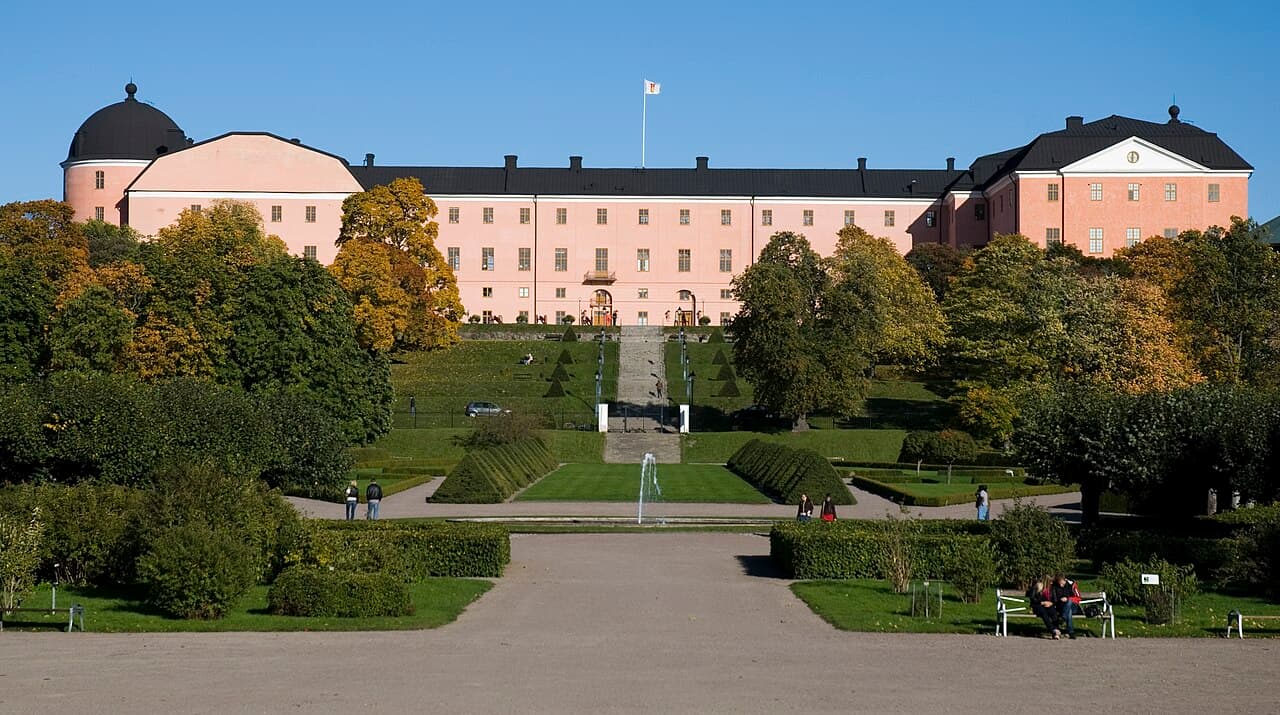
Uppsala Castle stands prominently in the historic city of Uppsala, Sweden, as a remarkable example of a 16th-century renaissance royal fortress. Established during a pivotal era when Sweden was emerging as a major European power, the castle has played a significant role in the nation's political, military, and cultural history. Its imposing structure atop the Kasåsen esker commands views of the city and the nearby Uppsala Cathedral, symbolizing the complex relationship between royal authority and ecclesiastical power.
The castle's construction began in 1549 under the reign of King Gustav I Vasa, following the turbulence of the Dacke War. This uprising underscored the necessity for fortified royal residences to assert control and provide defense. The initial design featured royal living quarters in the southwest corner and two massive western bastions named Gräsgården and Styrbiskop. The latter was deliberately oriented towards the cathedral, reflecting the monarchy's assertion over the church.
Architectural evolution and expansions
Under King Erik XIV, the castle underwent significant expansion, including the addition of a representation wing housing the hall of state and a castle church. This period also marked one of the castle's darkest moments, the Sture Murders of 1567, when several noblemen, including members of the influential Sture family, were killed within its walls.
The castle suffered a devastating fire in 1572 that severely damaged both the royal apartments and the new representation wing. Renowned architect Franciscus Pahr was commissioned to rebuild and enhance the structure. His plans introduced a new south wing with royal apartments and a multifunctional hall serving both state and church functions, as well as a northern courtyard surrounded by elegant colonnades.
Following Pahr's death, Willem Boy likely took over the project, completing the eastern half of the south wing and designing plans for a northern wing with towers connected by an extended eastern wing known as "The Long Castle" (Långslottet). This gave the castle a distinctive U-shaped layout, though the northern wing was never realized. The castle thus combined both defensive and representational functions in its architecture.
Historical significance and events
Uppsala Castle was the site of numerous important historical events. In 1630, King Gustavus Adolphus declared Sweden's entry into the Thirty Years' War from within its walls, marking a decisive moment in European history. Later, in 1654, the castle witnessed the abdication of Queen Christina, one of Sweden's most enigmatic monarchs.
The castle's courtyard was enhanced in the 1640s with a fountain ingeniously supplied by water pumped from the nearby Fyris river, showcasing early engineering achievements aimed at improving the castle's amenities.
Destruction and restoration
The great Uppsala fire of 1702 inflicted severe damage, particularly to the south wing. Due to widespread fires elsewhere and resource constraints, restoration was delayed, and parts of the castle were quarried for stone used in constructing Stockholm Palace. Restoration efforts resumed between 1743 and 1762 under the direction of architect Carl Hårleman and Duke Adolf Frederick. They focused on repairing the less damaged eastern section of the south wing, converting it into royal apartments while preserving surviving decorative stucco behind the altar of the former castle church.
The western section of the south wing, originally housing the royal apartments, remained unrestored. The southeast tower was partially rebuilt during this period and fully reconstructed by 1815, later serving as a county prison. The castle's historic Gunilla bell, first cast in 1588 and recast after the fire, was moved from the southeast tower to the battlements of the Styrbiskop bastion, where it served as a curfew bell.
Modern use and cultural heritage
Today, Uppsala Castle functions as the residence of the County Governor of Uppsala County and houses the Uppsala Art Museum within its south wing, linking its rich history to contemporary culture. The Vasaborgen museum preserves the ruins of the original royal apartments, allowing visitors to explore the castle's 16th-century origins.
The castle's long-standing role as a center of regional governance is underscored by its connection to notable figures such as Dag Hammarskjöld, former Secretary-General of the United Nations, who spent part of his childhood there while his father governed the county.
Architectural remnants, including the colonnaded courtyard, surviving stucco decorations with biblical inscriptions, and the imposing bastions, provide tangible links to the castle's layered history of royal power, religious influence, and military defense.
Architectural features and layout
The castle's original layout combined defensive and residential elements, anchored by the Gräsgården and Styrbiskop bastions on its western side. The southwest corner housed the initial royal apartments, while the south wing evolved into a multifunctional space with state halls, a castle church, and royal living quarters.
The U-shaped design created by the south wing and the eastern "Long Castle" wing remains a defining characteristic, although the northern wing was never built. The castle's orientation shifted from an original west-east axis to a north-south alignment over time.
The courtyard's fountain, installed in the 1640s, was an engineering feat that utilized water pumped from the Fyris river, enhancing the castle's aesthetic and functional qualities.
Castle church and decorative elements
The castle church is notable for its multi-level stucco reredos behind the altar, featuring biblical inscriptions from Psalms 33:18 and 145:18, which remain visible today. These decorations highlight the religious significance attributed to the space and the castle's role as a seat of both secular and ecclesiastical power.
The gunilla bell and bastions
The Gunilla bell, originally cast in 1588 and recast in 1759, was relocated from the southeast tower to the battlements of the Styrbiskop bastion. It served as a curfew bell, symbolizing the castle's military and administrative functions.
Visitor information and accessibility
Visitors to Uppsala Castle can explore the Uppsala Art Museum housed within the south wing, which showcases a diverse collection of modern and contemporary art. The Vasaborgen museum offers insights into the castle's early history through its preserved ruins.
The castle grounds also provide a scenic setting for cultural events and official ceremonies held in the restored Hall of State (Rikssalen). The castle remains an active administrative center, so some areas may have restricted access.
Its location in the city of Uppsala makes it easily accessible by public transport and car, with nearby amenities and other historic sites such as the Uppsala Cathedral and Gustavianum museum enhancing the visitor experience.
Best time to visit
The castle is open to visitors mainly during the warmer months, with the Uppsala Art Museum operating regular hours. Spring through early autumn offers pleasant weather for exploring the castle grounds and nearby attractions.
Ticket prices and opening hours
Ticket prices for the Uppsala Art Museum are generally modest, with discounts available for students and seniors. Opening hours typically run from mid-morning to late afternoon, but visitors should check current schedules as they may vary seasonally.
Photo gallery

Information
Website
Visit websiteSources & official resources
Verify the information above using these authoritative references.
Loading map...
Visitor reviews
No reviews yet. Been here? Write the first review and help other travelers!
Write the first reviewVisited this castle? Share your experience
Your review helps other travelers and adds first-hand knowledge to our encyclopedia.