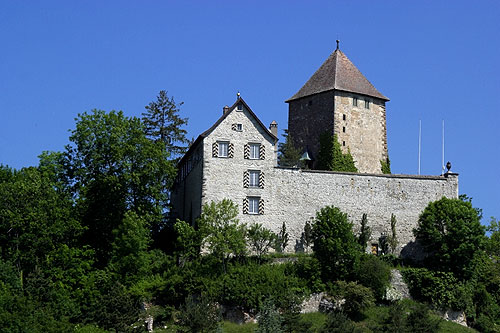
Unterhof Castle
Unterhof Castle, located in Diessenhofen, Switzerland, is a significant example of a High Medieval fortress with origins tracing back to the 12th century. First documented in 1185, the castle originally served as the residence and administrative center for the stewards of Diessenhofen, a role that highlights its importance in regional governance and defense during the medieval period.
Historical context and ownership
The castle's history is closely tied to the political developments of the region. In 1264, Rudolf of Habsburg incorporated the stewards of Diessenhofen into his service, reflecting the castle's strategic and administrative significance within the expanding Habsburg territories. This association with the Habsburg dynasty underscores the castle's role in the broader power dynamics of medieval Switzerland and the Holy Roman Empire.
Architectural development and features
Unterhof Castle underwent significant expansions until 1399, including the construction of a two-part east wing composed of the northeast and southeast tracts. This expansion also included the addition of a keep, a central fortified tower that served both as a residence and a final defensive stronghold. The castle's fortifications were enhanced with a new defensive wall, reflecting the need for improved protection during a period marked by regional conflicts and evolving military technology.
Structural layout
The castle's layout is typical of High Medieval hill castles, designed to maximize defensibility while accommodating administrative functions. The keep stands as the dominant architectural feature, surrounded by residential wings and enclosed by protective walls. The castle's position and construction materials would have been chosen to leverage natural terrain advantages, although specific details on these aspects require further archaeological study.
Modern restoration and current use
Since 1990, Unterhof Castle has undergone extensive renovations aimed at preserving its historical fabric while adapting the structure for contemporary use. These restoration efforts have helped maintain the castle's well-preserved condition, ensuring that key architectural elements remain intact for future generations.
Today, the castle's oldest section operates as a restaurant, allowing visitors to experience the historical ambiance within a functional modern setting. This adaptive reuse is a common approach in castle conservation, balancing heritage preservation with economic sustainability.
Cultural and heritage significance
Unterhof Castle stands as a valuable cultural landmark within the canton of Thurgau. Its continuous use and preservation contribute to the understanding of medieval administrative and defensive architecture in Switzerland. The castle's association with the Habsburgs and its role in regional history provide important insights into the political landscape of the High Middle Ages.
Visitors to Diessenhofen can explore the castle's exterior and enjoy its restaurant, which offers a unique opportunity to engage with Swiss medieval heritage in a tangible way. The castle's preservation also supports local tourism and educational initiatives focused on medieval history and architecture.
Information
Loading map...
Visitor reviews
No reviews yet. Been here? Write the first review and help other travelers!
Write the first reviewVisited this castle? Share your experience
Your review helps other travelers and adds first-hand knowledge to our encyclopedia.