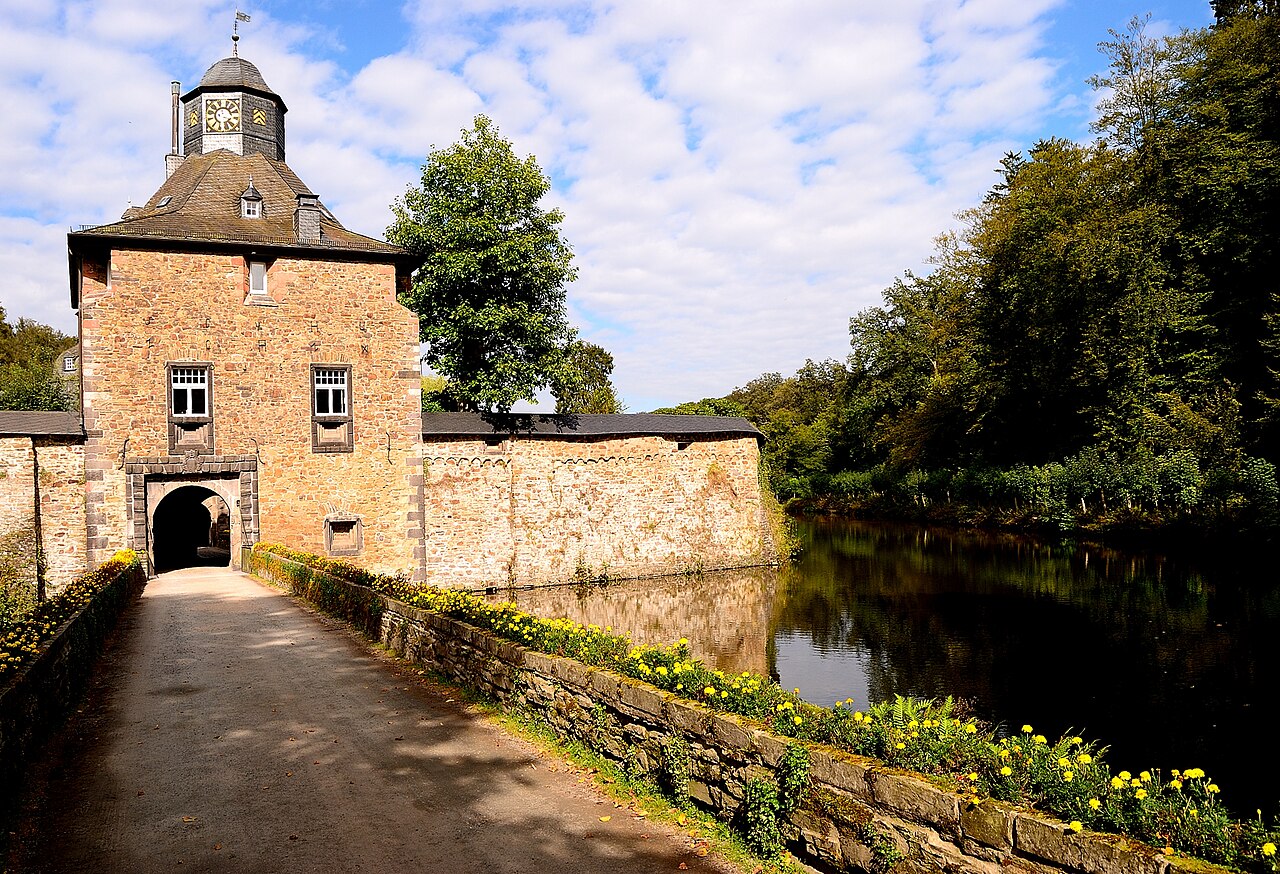
Unteres Schloss Siegen
Unteres Schloss Siegen stands as a remarkable example of a hill castle in the town of Siegen, Germany, with a rich history that spans over five centuries. Originally established as a Franciscan monastery in the late 15th century, the site has undergone significant transformations reflecting the religious, political, and cultural shifts in the region. Today, it serves as a vibrant university campus, blending historic architecture with modern educational functions.
Early origins and religious foundation
The origins of Unteres Schloss trace back to 1473 when Archbishop Adolf II of Mainz granted permission for the establishment of a Franciscan monastery. Construction was initiated under the patronage of Count Johann V following his pilgrimage to the Holy Land in 1486. The monastery was dedicated to the Franciscan friars and housed a community of over twenty members. It served as an important religious center, hosting the Franciscan provincial chapter meetings in the early 1500s. The monastic church, dedicated to St. John the Baptist, was a focal point of spiritual life until the Reformation brought significant changes.
Reformation impact and secular transformation
In 1534, the monastery ceased operations after the Franciscan community refused to accept the Protestant church order imposed by Count Wilhelm. This refusal led to their expulsion and the dissolution of the monastic community. The church was repurposed as an evangelical city church until it was destroyed in the devastating Siegen city fire of 1695. The site’s religious role evolved significantly during this period, reflecting the broader religious conflicts of the Reformation and the Thirty Years’ War.
Educational and noble residence phases
Between 1594 and 1609, the former monastery buildings temporarily housed the Hohe Schule, a Calvinist educational institution founded by Count Johann VI of Nassau-Dillenburg in 1584. This highlights the site's shifting function from religious to educational use during the early modern period.
In the 17th century, the complex was transformed into a noble residence known as the Nassauischer Hof, serving the Protestant branch of the House of Nassau-Siegen. Significant expansions and renovations were undertaken, including the construction of a princely crypt designed by Maurits Post around 1668. From 1680 onwards, further enlargements included the addition of a prominent gatehouse with three distinctive towers topped by lanterns and curved domes, completed in 1690 under Wilhelm Moritz.
Reconstruction after the 1695 fire
The catastrophic Siegen fire of 1695 destroyed much of the complex except for the gatehouse and princely crypt. Architect Peter Rembold led a comprehensive rebuilding effort from 1698 to 1711. His work included reconstructing the north wing (Kurländerflügel), creating a baroque garden outside the old city walls, and erecting the Dicke Turm (Thick Tower), which served as an archive. This tower replaced a collapsed medieval city fortification tower and was later connected to the north wing by a linking building added in 1802.
Further enhancements included completing the central corps de logis with an elegant arcade supported by twenty-one pillars, and the addition of the south wing (Wittgensteiner Flügel) starting in 1717 under architect Erich Philipp Ploennies. These expansions exemplify the baroque architectural style that characterizes much of the castle’s current appearance.
18th and 19th century administrative functions
Throughout the 18th and 19th centuries, Unteres Schloss adapted to various administrative roles. From 1816, it housed the Bergamt Siegen, the regional mining office, reflecting the area's economic focus. Starting in 1818, it also hosted the Königliche Bergschule, a royal mining school that educated specialists vital to the mining industry.
The castle square accommodated essential civic functions such as the local post office and judicial offices, including district courts, until 1976. This period underscores the castle’s integration into the civic life of Siegen beyond its noble and religious origins.
20th century to present: modern adaptation and university use
In the 20th century, parts of the complex were utilized by a branch of the JVA Attendorn prison and various state authorities between 1936 and 2011. After extensive renovations completed in 2016, Unteres Schloss was repurposed as a campus for the University of Siegen. It now hosts several university faculties and the university library, blending historic ambiance with modern academic life.
The castle square remains a vibrant community space, hosting open-air cinema screenings, public viewings of football championships, and an annual Christmas market initiated in 2018. This ongoing public engagement highlights the castle’s role as a cultural and social hub in contemporary Siegen.
Architectural features and notable structures
Layout and wings
The castle complex is organized around a central main building with multiple wings reflecting its phased expansions. The north wing (Kurländerflügel), the central corps de logis incorporating the Fürstengruft (princely crypt), and the south wing (Wittgensteiner Flügel) form the core of the structure. The Fürstengruft, designed circa 1668 by Maurits Post, is a significant burial chapel later emphasized by a central risalit added in 1884.
Gatehouse and defensive elements
The gatehouse, completed in 1690, is notable for its three towers topped with lanterns and curved domes, creating a distinctive silhouette. Originally part of the castle’s defensive and ceremonial entrance, its portal was relocated in the 19th century to the chapel wing of the nearby Oberes Schloss, demonstrating architectural reuse.
Baroque garden and the dicke turm
The Herrengarten, a formal baroque garden laid out beyond the old city walls, included an orangery built in 1703 for protecting delicate plants. The same year saw the construction of the Dicke Turm (Thick Tower), which replaced a medieval fortification tower and functioned as an archive. Today, the tower features a carillon that plays daily melodies, marking key hours and adding to the castle’s cultural atmosphere.
Lost features and wartime damage
Earlier structures such as the stable (Marstall) and a ball house once stood on the northeast side of the castle square but were destroyed during World War II air raids and have not been rebuilt. These losses reflect the impact of modern warfare on historic sites.
Preservation and current condition
Today, Unteres Schloss Siegen is well preserved and adapted for modern use. Key historical elements such as the arcade walkways, the corps de logis, and the varied wings remain intact, showcasing a blend of baroque architectural details and later modifications. Photographic records and visitor experiences highlight views of the Wittgensteiner Flügel, the Kurländerflügel with the Dicke Turm, and the entrance to the Fürstengruft, offering a comprehensive sense of the castle’s layered history and architectural evolution.
Frequently asked questions about unteres schloss siegen
- What is the historical significance of Unteres Schloss Siegen? Unteres Schloss Siegen is significant for its transformation from a 15th-century Franciscan monastery to a noble residence and later a university campus, reflecting regional religious, political, and educational history.
- Can visitors tour the princely crypt (Fürstengruft)? The princely crypt is an important architectural and historical feature, often accessible during guided tours or special events, offering insight into the burial traditions of the House of Nassau-Siegen.
- When was the baroque garden created? The Herrengarten baroque garden was laid out during the rebuilding phase after the 1695 fire, specifically in the early 18th century around 1703.
- Is the castle accessible to the public? Since its adaptation as a university campus, parts of the castle are open to the public during university events, exhibitions, and community gatherings, though some areas may be restricted for academic use.
- What architectural styles are represented at Unteres Schloss? The castle predominantly features baroque architecture from its 17th and 18th-century expansions, with earlier medieval and monastic elements integrated into its structure.
- Are there any special events held at the castle? The castle square hosts open-air cinema screenings, football championship viewings, and an annual Christmas market, making it a lively cultural venue in Siegen.
Frequently asked questions (FAQ)
- What is the historical significance of Unteres Schloss Siegen?
- Unteres Schloss Siegen is significant for its transformation from a 15th-century Franciscan monastery to a noble residence and later a university campus, reflecting regional religious, political, and educational history.
- Can visitors tour the princely crypt (Fürstengruft)?
- The princely crypt is an important architectural and historical feature, often accessible during guided tours or special events, offering insight into the burial traditions of the House of Nassau-Siegen.
- When was the baroque garden created?
- The Herrengarten baroque garden was laid out during the rebuilding phase after the 1695 fire, specifically in the early 18th century around 1703.
- Is the castle accessible to the public?
- Since its adaptation as a university campus, parts of the castle are open to the public during university events, exhibitions, and community gatherings, though some areas may be restricted for academic use.
- What architectural styles are represented at Unteres Schloss?
- The castle predominantly features baroque architecture from its 17th and 18th-century expansions, with earlier medieval and monastic elements integrated into its structure.
- Are there any special events held at the castle?
- The castle square hosts open-air cinema screenings, football championship viewings, and an annual Christmas market, making it a lively cultural venue in Siegen.
Information
Sources & official resources
Verify the information above using these authoritative references.
Loading map...
Visitor reviews
No reviews yet. Been here? Write the first review and help other travelers!
Write the first reviewVisited this castle? Share your experience
Your review helps other travelers and adds first-hand knowledge to our encyclopedia.