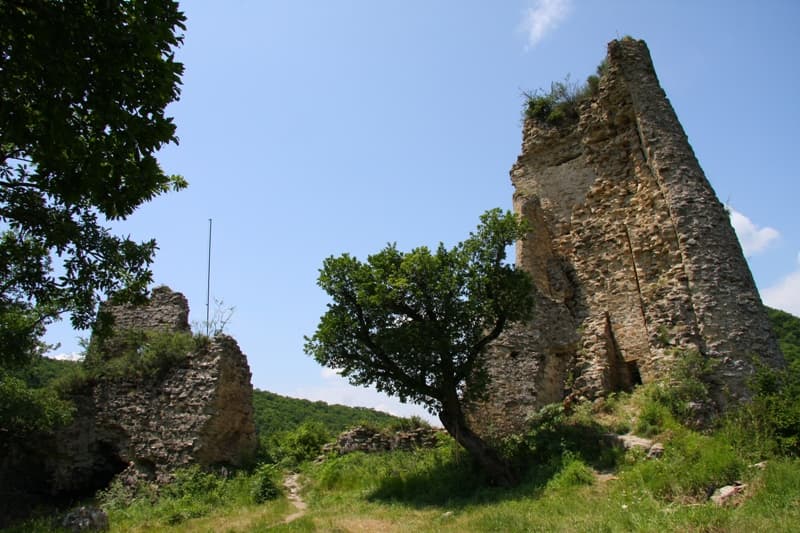
Ujarma Castle
Ujarma Castle stands as a significant early medieval bastioned fortress in the Kakheti region of Georgia. Located on a strategic ridge overlooking the steep northern slope descending to the Iori River, the castle was originally part of a fortified city that played a crucial role in the region's political and military history. The site is situated near the village of Ujarma in the Sagarejo municipality, positioned along the Tbilisi-Telavi road, close to the Gombori Pass through the Tsiv-Gombori Range in the historical province of Gare Kakheti.
Origins and early history
The fortress is traditionally attributed to Aspacures I of Iberia, who is said to have constructed it in the 3rd century. This suggests that Ujarma Castle may have replaced an even older fortification, potentially dating back to the Urartian period, indicating the site's long-standing strategic importance. By the 4th century, Ujarma had become the political center of Kakheti, highlighting its prominence in the early medieval Georgian kingdom of Iberia.
Architectural evolution and fortifications
During the second half of the 5th century, the fortress underwent significant strengthening under the reign of Vakhtang I of Iberia. These enhancements likely included the construction of robust defensive walls and bastions designed to withstand sieges and invasions. The castle's position on a ridge provided natural defenses, complemented by man-made fortifications such as battlemented walls, towers, and possibly moats.
Within the castle's walls, archaeological excavations have revealed the remains of water reservoirs, a palace complex, and a church that has been restored, indicating the multifunctional nature of the fortress as both a military stronghold and a royal residence.
Strategic role and historical events
Ujarma Castle was a key defensive site during the turbulent periods of Georgian history. In 502 AD, Vakhtang I died here after being mortally wounded while repelling a Persian invasion, underscoring the fortress's military significance. The castle endured a lengthy siege and was destroyed by Arab forces in 914, reflecting the ongoing conflicts in the Caucasus region during the early medieval period.
Reconstruction and later history
In the 12th century, King George III of Georgia undertook the restoration of Ujarma Castle, rebuilding it as a royal treasury and reinforcing its role within the Georgian kingdom. However, the fortress's strategic importance declined following the Mongol invasions of the 13th century and the subsequent fragmentation of Georgia into smaller kingdoms and principalities.
Despite the lack of mention in historical records after this period, archaeological evidence indicates continued building activity at the site until the 18th century. By then, the once formidable fortress had diminished to the status of a village, marking the gradual decline of Ujarma's military and political relevance.
Modern rediscovery and tourism
Before the construction of the new Tbilisi-Telavi road in 2010, Ujarma Castle was largely forgotten and left in ruins. The improved accessibility brought renewed interest, making it a minor tourist destination. Visitors can explore the castle ruins, including the restored church and the remnants of the palace and water reservoirs, which provide insight into the site's historical functions.
The castle is currently accessible during opening hours for a small fee. Ongoing archaeological excavations continue to uncover the site's rich history, attracting scholars and tourists alike. While the ruins of the lower city remain less visited, they contribute to the overall understanding of Ujarma's past as a fortified urban center.
Architectural significance and classification
Ujarma Castle is classified as a bastioned fortress, a type characterized by projecting bastions that allowed defenders to cover adjacent walls with crossfire. Its construction and modifications reflect the early medieval period's military architectural practices in the Caucasus region. The castle's layout, combining natural topography with man-made fortifications, exemplifies the strategic use of landscape in fortress design.
The presence of a palace and church within the walls also indicates the dual role of the site as both a defensive structure and a seat of royal authority, typical of fortified cities in medieval Georgia.
Frequently asked questions (FAQ)
- How do I get to Ujarma Castle?
- Ujarma Castle is located near the village of Ujarma in the Sagarejo municipality, accessible via the Tbilisi-Telavi road close to the Gombori Pass. Visitors can reach it by car or local transport along the შ38 road.
- What is the historical significance of Ujarma Castle?
- Ujarma Castle was a major political and military center in early medieval Kakheti, built in the 3rd century and strengthened under Vakhtang I of Iberia. It witnessed key historical events, including sieges and royal activities.
- Can I visit the restored church inside Ujarma Castle?
- Yes, the restored church within Ujarma Castle is open to visitors during opening hours. It is part of the castle complex and offers insight into the religious architecture of the period.
- When was Ujarma Castle last rebuilt or restored?
- The castle was notably rebuilt in the 12th century by King George III of Georgia. Modern restoration efforts have focused on the church and archaeological excavations have been ongoing since 2010.
- Is Ujarma Castle suitable for family visits?
- Ujarma Castle is suitable for families interested in history and archaeology. The site is safe to explore, though some areas are ruins, so supervision of children is advised.
Photo gallery

Information
Address
Next to the შ38 road, Georgia
Loading map...
Visitor reviews
No reviews yet. Been here? Write the first review and help other travelers!
Write the first reviewVisited this castle? Share your experience
Your review helps other travelers and adds first-hand knowledge to our encyclopedia.



