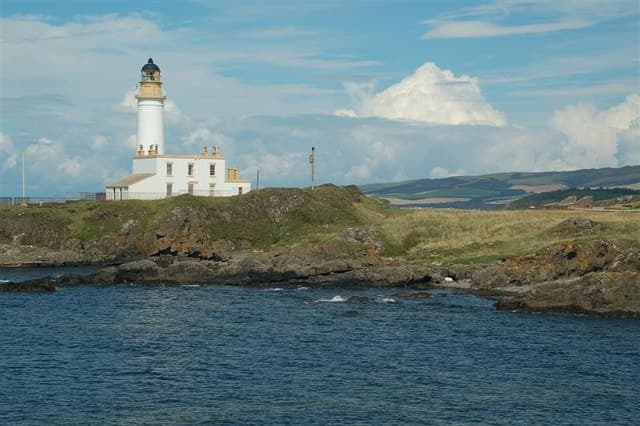
Turnberry Castle
Turnberry Castle stands as a notable medieval ruin on the rugged coast of Ayrshire, Scotland, near the village of Kirkoswald and close to the town of Maybole. This castle, dating back to the 13th century, was historically the seat of the Earls of Carrick, a title held by Scottish nobility with significant influence during the High Medieval period. The castle’s location on a promontory overlooking the sea provided strategic advantages for defense and control of the surrounding lands.
Historical significance and noble lineage
Turnberry Castle was originally constructed in the High Medieval era and served as the ancestral home of the Earls of Carrick. The earldom was an important Scottish lordship, and the castle played a key role in regional power dynamics. The site is famously connected to Robert the Bruce, who was born at Turnberry Castle around 1274. Robert the Bruce later became King of Scots and a central figure in Scotland’s struggle for independence from England.
The Bruce family and Turnberry
The Bruce family acquired the castle through marriage and used it as a principal residence. The castle’s association with Robert the Bruce adds considerable historical weight, as it is linked to his early life and heritage. The castle was a symbol of the Bruce family's status and influence in southwestern Scotland.
Architectural features and layout
Today, Turnberry Castle exists primarily as archaeological ruins, with only fragments of its original structure visible. The castle was originally built as a coastal fortress, taking advantage of its position on a promontory to oversee the surrounding sea routes and lands. The defensive design likely included thick stone walls, battlements, and a gatehouse, typical of High Medieval fortifications.
The castle’s layout would have included a keep or main tower serving as the stronghold, surrounded by curtain walls enclosing a courtyard. The proximity to the sea also meant that the castle had natural defensive benefits, with steep cliffs and water forming barriers on multiple sides.
Material and construction techniques
Constructed primarily from local stone, the castle’s walls were designed to withstand sieges and attacks common during the medieval period. Masonry techniques of the 13th century focused on durability and defensive strength, with thick walls and narrow arrow slits for archers. While much of the stonework has eroded or been removed over centuries, archaeological studies have helped identify the original footprint and structure.
Decline and current condition
Turnberry Castle fell into ruin over the centuries, likely due to a combination of military conflict, neglect, and changing political landscapes. By the modern era, only fragments of the castle remained, classified as archaeological ruins. The site is protected as a historic monument, preserving its remnants for study and public interest.
The ruins lie adjacent to the renowned Turnberry Golf Course, which has brought additional visitors to the area. Despite the limited remains, the castle’s dramatic coastal setting continues to attract historians, archaeologists, and tourists interested in Scotland’s medieval heritage.
Visiting Turnberry Castle
The castle ruins are accessible to the public, though facilities are minimal given the site's archaeological nature. Visitors can explore the coastal landscape and view the castle’s remains from designated paths. The nearby golf resort and Ayrshire’s scenic countryside offer additional attractions for travelers.
Due to its exposed coastal location, the site can be affected by weather conditions, so visitors are advised to wear appropriate footwear and clothing. Interpretive signage at the site provides historical context to enhance the visitor experience.
Nearby attractions and cultural context
Turnberry Castle is part of a rich cultural landscape that includes other medieval sites and historic towns in Ayrshire. The region’s connection to Robert the Bruce and Scotland’s independence struggles makes it a focal point for Scottish heritage tourism.
Nearby towns such as Maybole and Ayr offer museums, historic churches, and cultural events that complement a visit to the castle. The castle’s location on the coast also provides opportunities for enjoying Scotland’s natural beauty, including coastal walks and wildlife observation.
Frequently asked questions (FAQ)
- What is the historical significance of Turnberry Castle?
- Turnberry Castle is a site of great historical importance, as it is believed to be the birthplace of Robert the Bruce, one of Scotland's most revered kings. The castle dates back to the 13th century and played a crucial role in the Wars of Scottish Independence.
- When was Turnberry Castle built?
- Turnberry Castle was constructed in the late 13th century, with its origins often attributed to the period around 1250. The castle has undergone several changes over the centuries, reflecting the turbulent history of Scotland.
- Can I visit Turnberry Castle?
- Yes, Turnberry Castle is open to visitors, allowing them to explore its historic ruins and the surrounding area. However, it's advisable to check local guidelines or restrictions before your visit.
- What are the opening hours for Turnberry Castle?
- Turnberry Castle is typically open year-round, with specific hours varying seasonally. It's best to check the local tourist information for the most current opening times before planning your visit.
- Is it possible to access Turnberry Castle with limited mobility?
- Access to Turnberry Castle can be challenging due to uneven terrain and the nature of the ruins. Visitors with limited mobility should consider contacting local tourist services for advice on accessibility options and potential accommodations.
- What is the best time to visit Turnberry Castle?
- The best time to visit Turnberry Castle is during the spring and summer months when the weather is milder and the landscape is vibrant. This allows for a more enjoyable exploration of the castle and its surroundings.
- Are there any nearby attractions to visit?
- Yes, there are several nearby attractions, including the stunning Turnberry Golf Club and the picturesque village of Kirkoswald. These locations provide additional opportunities for sightseeing and leisure activities.
- How much are the ticket prices for Turnberry Castle?
- Admission to Turnberry Castle is generally free, as it is a historical ruin without a formal entrance fee. However, donations to preserve the site are appreciated and can help maintain its historical significance.
Photo gallery

Information
Current owner
Private owner
Loading map...
Visitor reviews
No reviews yet. Been here? Write the first review and help other travelers!
Write the first reviewVisited this castle? Share your experience
Your review helps other travelers and adds first-hand knowledge to our encyclopedia.


