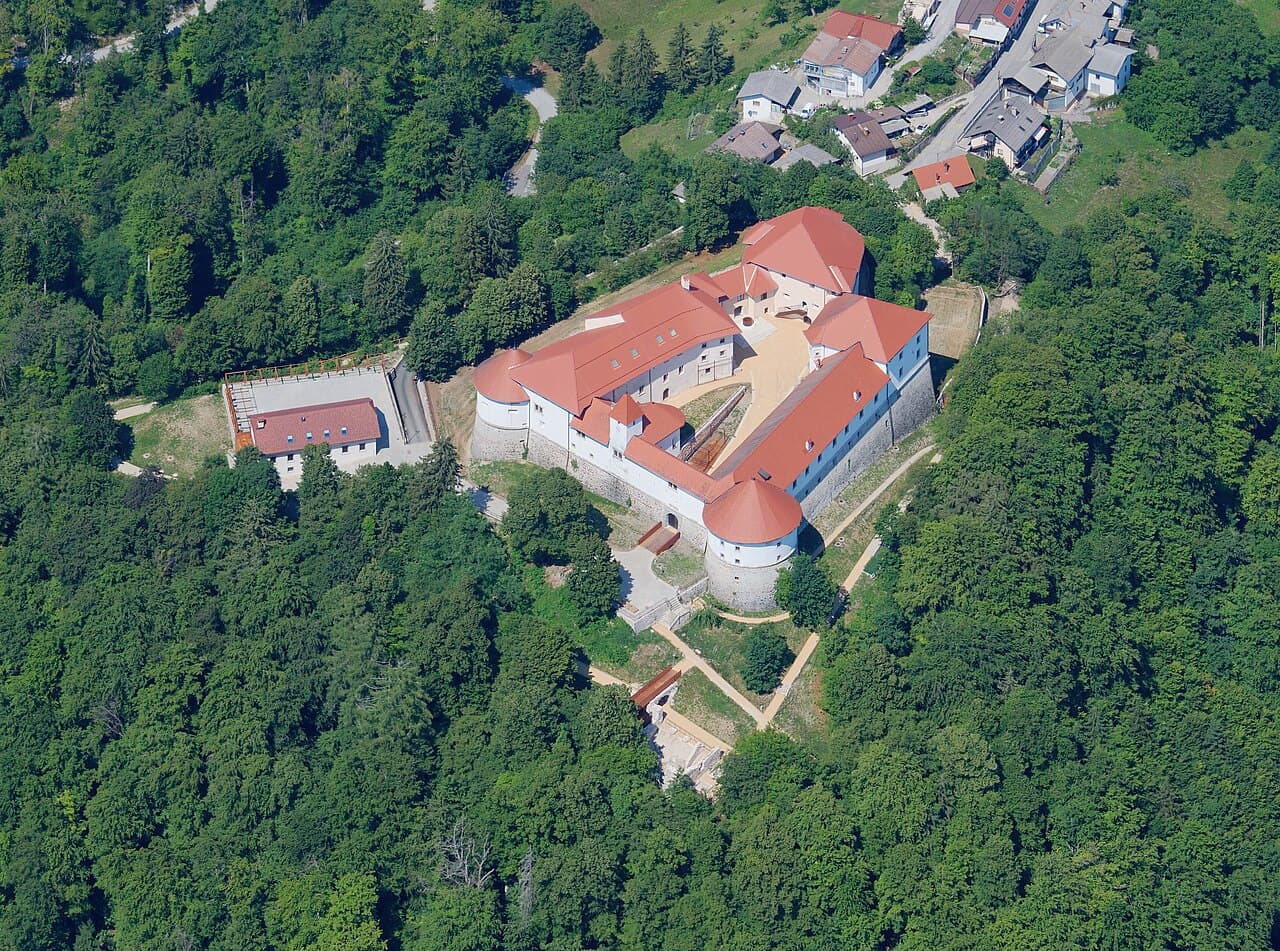
Turjak Castle
Turjak Castle is a prominent 13th-century hill castle located above the settlement of Turjak in the municipality of Velike La0de, in the Lower Carniola region of Slovenia. Situated approximately 20 km southeast of Ljubljana, it stands as one of the most significant and architecturally impressive castles in the area. The castle's history is deeply intertwined with the noble family von Auersperg, who played a crucial role in the region's medieval and early modern history.
Early history and medieval origins
The site of Turjak Castle has been occupied since at least the late 11th century. The first castle was constructed by the knights von Auersperg, later counts, who are first documented in the region around 1062 with Konrad von Auersperg. This original fortress was strategically positioned on a lower slope but was destroyed in 1140 during a violent succession dispute between Pilgram IV von Auersperg and his brother-in-law Otto von Ortenburg. Pilgram IV, who held the castle, was defeated, and the fortress was burned down.
Rebuilt in 1190 by Count Adolf II von Auersperg, the castle again became a focal point of conflict. His son Otto von Auersperg became involved in regional wars against noble houses such as von Gortz and Ortenburg, as well as the Patriarchate of Aquileia. These conflicts led to the castle's destruction once more, prompting the abandonment of the original site in favor of a new location further upslope, where the present-day Turjak Castle stands. The current castle is first mentioned in historical records in 1220.
Ownership and historical conflicts
Throughout the 13th and 14th centuries, Turjak Castle remained under the control of various branches of the Auersperg family. In 1270, it was sold to another family branch by Peter and Wolfgang von Auersperg, only to be repurchased by Balthazar von Auersperg, who notably served as chancellor of the Holy Roman Empire. The 14th century saw ownership by Gerhard von Auersperg and later by his brothers Friederich, Volkard, and Herward.
The castle endured significant challenges, including being completely destroyed by the 1511 earthquake. It was rebuilt promptly and successfully withstood the 1515 peasants' revolt, which devastated many other castles in the region. Turjak Castle also faced repeated assaults by Turkish raiders in 1491 and 1528, both of which were repelled, demonstrating its strategic and defensive strength.
Architectural evolution and features
Turjak Castle exhibits a triangular layout perched on a terraced hill. Its design includes large Renaissance defensive towers at each vertex of the triangle, connected by residential wings. The western tower houses a suite of dungeons with varying levels of confinement, reflecting medieval defensive architecture. The tall central palacium, dating from the Romantic period, adds a distinctive vertical emphasis to the castle's silhouette.
The castle has undergone multiple renovations and alterations throughout its history. Engravings by Valvasor from the 1680s depict a rectangular structure with small towers at two corners and a large bastille on the eastern end. This layout corresponds to the major rebuilding after the 1511 earthquake. Some elements from before the 16th century survive, particularly the northern wing and parts of the defensive walls. The original 10th or 11th-century castle ruins remain visible on the lower slope.
Dual chapels and religious significance
Uniquely, Turjak Castle contains two chapels reflecting its complex religious history. The Catholic chapel on the west side has functioned as a church since 1789 and, after renovation in 1990, holds mass every Sunday. The second chapel, a Romanesque Protestant chapel named after Jurij Dalmatin, contains the tombs of Protestant counts and features Gothic frescoes. This chapel highlights the castle's role in the Protestant Reformation in Slovenia during the 16th century, when the Auerspergs supported Protestant leaders such as Primož Trubar and Jurij Dalmatin. These figures found sanctuary at Turjak Castle and worked on the first translation of the Bible into Slovene here. The counts also financially supported early Slovene book printing projects.
Turjak castle in modern history
During World War II, Turjak Castle was the site of a significant battle on 19 September 1943, when it was captured by Partisan forces after a prolonged fight with the garrison of Slovene Axis auxiliaries. Approximately 500 prisoners were taken, many of whom suffered retribution in the form of war crimes. The castle sustained severe damage during this conflict and remained in ruins for several years following the war.
Post-war, the castle was nationalized and has since undergone slow but steady restoration efforts to preserve its historical and architectural legacy. Today, Turjak Castle stands as a well-preserved monument reflecting centuries of Slovenian history, noble lineage, religious transformation, and military resilience.
Architectural and cultural significance
Turjak Castle is a notable example of a hill castle that has evolved through the High Medieval period into the Renaissance and Romantic eras. Its combination of defensive towers, residential wings, and dual chapels illustrates the multifunctional nature of noble castles in Slovenia. The castle's survival through natural disasters, military conflicts, and political upheaval underscores its importance as a cultural landmark.
The castle's connection to the Auersperg family, one of Slovenia's most influential noble houses, and its role in the Slovene Protestant Reformation further enhance its historical value. The preservation of Gothic frescoes and the Protestant chapel adds artistic and religious depth to the site.
Visiting Turjak castle today
Visitors to Turjak Castle can explore its Renaissance towers, the dungeon suites, and the two chapels, each offering insights into different aspects of its history. The castle's location on a terraced hill provides scenic views of the surrounding Lower Carniola landscape. Restoration efforts have made the castle accessible and safe for public tours, allowing guests to connect with Slovenia's medieval heritage.
Frequently asked questions (FAQ)
- How do I get to Turjak Castle?
- Turjak Castle is located in Turjak, Slovenia, approximately 20 kilometers from Ljubljana. Visitors can reach the castle by car or by public transport, with buses operating from Ljubljana to nearby towns. Once in Turjak, a short walk will take you to the castle grounds.
- What is the historical significance of Turjak Castle?
- Turjak Castle dates back to the 12th century and is one of the most notable medieval castles in Slovenia. It has played a significant role in the region's history, serving as a noble residence and a strategic military fortification. The castle's architecture and its transformation over the centuries reflect the historical changes in the area.
- When was Turjak Castle last renovated?
- Turjak Castle underwent significant renovations in the 20th century, particularly in the 1980s, to restore its historical features and make it accessible to visitors. Ongoing preservation efforts continue to maintain the castle's structure and heritage. Visitors can appreciate the blend of medieval and more modern architectural elements during their visit.
- Can I take guided tours at Turjak Castle?
- Yes, guided tours are available at Turjak Castle, providing visitors with in-depth insights into its history and architecture. Tours are typically conducted in Slovenian, but some services may offer information in English as well. It's recommended to check in advance for language options and to book your spot.
- Why is Turjak Castle a popular tourist destination?
- Turjak Castle is popular due to its rich history, stunning architecture, and picturesque setting surrounded by nature. The castle offers panoramic views of the surrounding countryside, making it a favorite among photographers and history enthusiasts alike. Additionally, its proximity to Ljubljana makes it an easy day trip for visitors.
- Is it possible to host events at Turjak Castle?
- Yes, Turjak Castle can be rented for various events, including weddings, corporate gatherings, and cultural events. The castle's unique atmosphere and beautiful surroundings provide a memorable backdrop for any occasion. Interested parties should contact the castle management for details on availability and services offered.
- What are the opening hours for Turjak Castle?
- Turjak Castle is generally open to visitors from April to October, with specific opening hours varying by season. During peak tourist months, the castle may offer extended hours to accommodate visitors. It's advisable to check the official website for the most current information before planning your visit.
- What are the ticket prices for visiting Turjak Castle?
- Ticket prices for Turjak Castle are typically affordable, with discounts available for students and seniors. Children under a certain age may enter for free, making it a family-friendly destination. For the latest pricing and any special offers, it's best to consult the official castle website or contact the visitor center.
- When is the best time to visit Turjak Castle?
- The best time to visit Turjak Castle is during the spring and autumn months, when the weather is pleasant and the surrounding landscapes are particularly beautiful. Summer can be busy with tourists, while winter may limit access due to weather conditions. Regardless of the season, visitors can expect a unique experience at the castle.
- Are there any nearby attractions to visit along with Turjak Castle?
- Yes, several attractions are located near Turjak Castle, including the charming village of Turjak and the nearby St. Nicholas Church. The area is also rich in natural beauty, with hiking trails and scenic views offering opportunities for outdoor activities. Visitors can easily combine their castle tour with these nearby sites for a full day of exploration.
Photo gallery

Information
Loading map...
Visitor reviews
No reviews yet. Been here? Write the first review and help other travelers!
Write the first reviewVisited this castle? Share your experience
Your review helps other travelers and adds first-hand knowledge to our encyclopedia.


