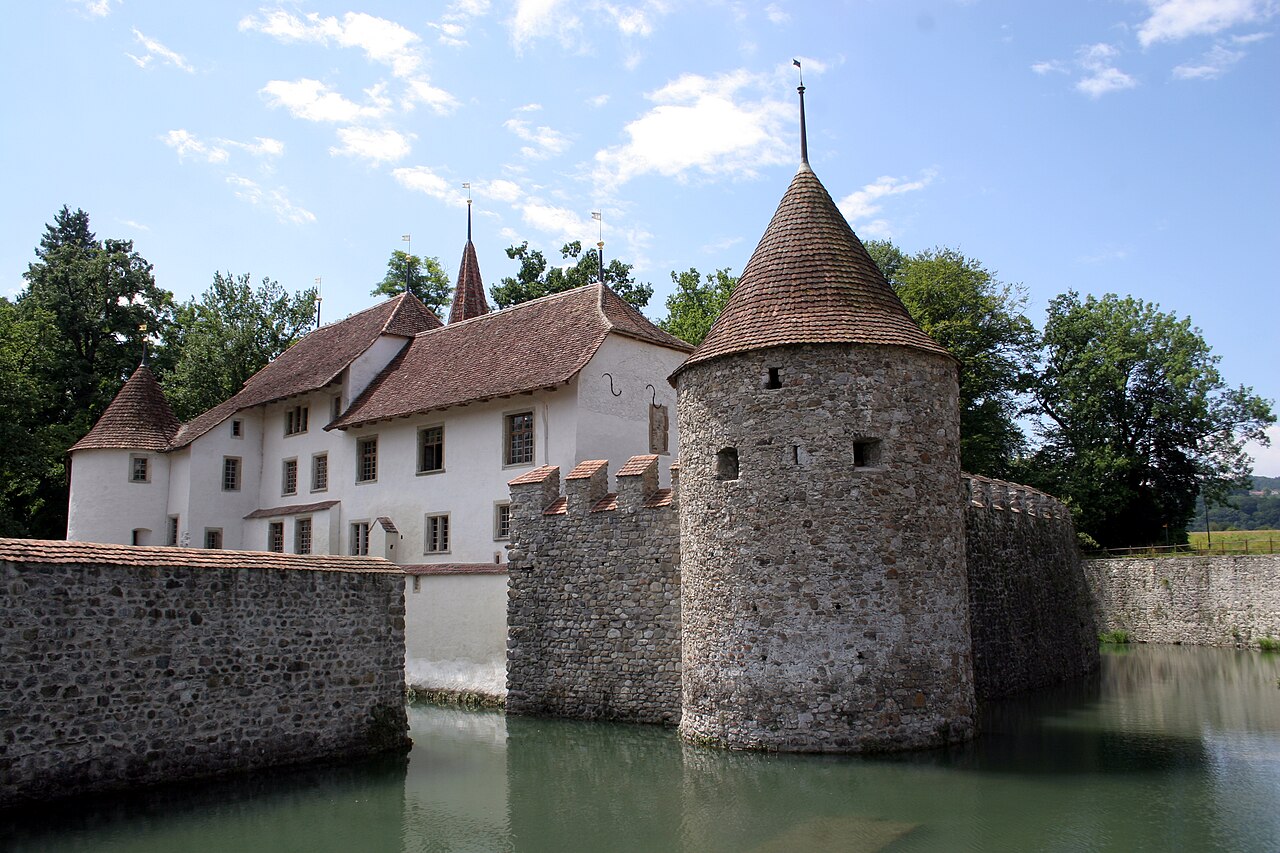
Trostburg Castle
Trostburg Castle, located in Teufenthal, Switzerland, is a historic hill castle with origins dating back to the 12th century, although the earliest documented references emerge in the 13th century. The castle's early history remains largely obscure, but it is known that the Trostburg family were significant local knights serving initially the Counts of Kyburg and later the Habsburg dynasty. The castle occupies a strategic position on a line of hills, sharing its landscape with nearby Liebegg Castle, built by a junior line of the Trostburg family in the early 13th century.
Medieval origins and early history
The castle likely originated in the 12th century as a fortified residence for the Trostburg family, whose members appear in historical records from the early 13th century. On 28 May 1241, Burkhart I of Trostberg and Ludwig of Liebegg are noted as witnesses and unfree knights under the service of the Kyburg Counts. By the early 14th century, the family had transitioned their allegiance to the Habsburgs, with Rudolf von Trostberg serving as the Habsburg vogt at Kyburg Castle in 1317.
The Trostburg lineage ended around the mid-14th century, and the castle passed to the Lords of Rinach. Following the 1415 Bernese conquest of Aargau, the castle's owner, Hans Rudolf von Rinach, maintained possession but had to acknowledge Bernese sovereignty and grant Bern the right of first purchase.
Renaissance expansions and ownership changes
In 1486, the castle was sold to Hans von Hallwil, a notable figure who had triumphed at the Battle of Murten. The Hallwil family fortified and expanded Trostburg Castle, adding a chapel and a four-story residence hall known as the Hallwil House on the northwest side. These enhancements reflected Renaissance architectural influences and the family's status. The Hallwil family retained ownership for approximately 130 years.
By 1616, Hugo von Hallwil relocated to Bohemia and attempted to sell the castle to the city of Brugg. To prevent Brugg’s expansion, Bern intervened, purchasing the castle and subsequently selling it to a cooperative of wealthy Bernese citizens. Bern retained judicial rights and some income, which were managed from Lenzburg Castle. Over the next century, the castle fell into disrepair, with only the Hallwil House remaining habitable.
Decline, industrial use, and partial restoration
By the mid-18th century, Trostburg Castle was described as resembling a "peasant's hovel," indicating significant decay. In the 19th century, the site was repurposed as a music box factory, marking a shift from noble residence to industrial use. Early 20th-century efforts by a German butcher aimed at partial reconstruction were halted by the outbreak of World War I. In 1922, a major section of the western curtain wall collapsed, further damaging the structure.
In 1933, the castle was acquired by a private owner who used it as a residence. A significant archaeological project in 1999 investigated the castle's history and undertook vital repairs to stabilize and strengthen the remaining walls, preserving the site for future generations.
Architectural features and layout
Trostburg Castle is situated on a hilltop, with its defensive walls wrapping around the summit. The castle's bergfried is a notable feature—a square tower measuring approximately 6.6 meters on each side and standing about 7 meters tall. The hill slopes away from the tower to the north, with a courtyard located to the south and west.
The western and northern slopes descend towards the Hallwil House, which is a four-story residence building with robust walls ranging from 1 to 1.7 meters thick. The castle's curtain walls and towers reflect typical medieval defensive architecture, designed to control the surrounding landscape and provide protection against attacks.
The bergfried and defensive structures
The bergfried served as a last refuge during sieges and as a symbol of lordly power. Its square footprint and solid construction are characteristic of High Medieval castle architecture in the region. The curtain walls, though partly ruined, once enclosed the courtyard and connected the main residential and defensive buildings.
The hallwil house and renaissance influences
The addition of the Hallwil House in the late 15th or early 16th century introduced Renaissance architectural elements, including enhanced residential comfort and a private chapel. This building's thick walls and multiple stories indicate its dual role as a residence and a fortified structure.
Historical significance and cultural heritage
Trostburg Castle embodies the complex feudal and political history of the Aargau region. Its transitions from Kyburg to Habsburg control, followed by Bernese sovereignty, mirror the broader geopolitical shifts in medieval and early modern Switzerland. The castle's association with notable families such as the Trostburgs, Rinachs, and Hallwils highlights its role as a center of local power and aristocratic life.
The castle's decline and adaptive reuse in the industrial era reflect changing economic and social conditions. Today, the site is valued for its archaeological and architectural heritage, with preservation efforts ensuring its survival as a cultural landmark.
Visiting trostburg castle
While Trostburg Castle remains privately owned, its historical and architectural significance attracts interest from scholars and enthusiasts. The 1999 archaeological restoration has stabilized the ruins, allowing for safer exploration of the site’s medieval structures. Visitors can appreciate the castle's strategic hilltop location and its blend of medieval and Renaissance architectural features.
Frequently asked questions (FAQ)
- How do I get to Trostburg Castle?
- Trostburg Castle is located in Teufenthal, Switzerland, and can be accessed by car or public transportation. If you're traveling by train, the nearest station is in the town of Zofingen, from where you can take a short taxi ride or a local bus to reach the castle.
- What is the historical significance of Trostburg Castle?
- Trostburg Castle dates back to the 13th century and served as a strategic fortification during various conflicts in the region. It has a rich history that includes tales of nobility and is an important part of Swiss heritage.
- When was Trostburg Castle built?
- Construction of Trostburg Castle began in the early 13th century, with significant expansions and renovations occurring over the centuries. The architecture reflects the medieval style typical of the era, showcasing the castle's historical evolution.
- Can I take guided tours of the castle?
- Yes, guided tours are available at Trostburg Castle, providing visitors with insights into its history, architecture, and legends. It is recommended to book in advance, especially during peak tourist seasons, to secure your spot.
- Why is Trostburg Castle a popular tourist destination?
- Trostburg Castle is popular due to its stunning architecture, panoramic views of the surrounding landscape, and its fascinating history. Visitors are drawn to its well-preserved structures and the opportunity to explore the castle grounds and learn about its past.
- Is it possible to host events at Trostburg Castle?
- Yes, Trostburg Castle offers facilities for hosting various events, including weddings and corporate gatherings. The unique setting and historic ambiance make it a memorable venue for special occasions.
- What are the opening hours of Trostburg Castle?
- Trostburg Castle is typically open to visitors from 10 AM to 5 PM during the summer months, while winter hours may vary. It's advisable to check the official website for the most current opening times before your visit.
- What are the ticket prices for visiting Trostburg Castle?
- Tickets for Trostburg Castle are reasonably priced, with discounts available for students and seniors. Children under a certain age may enter for free, making it an affordable outing for families.
- When is the best time to visit Trostburg Castle?
- The best time to visit Trostburg Castle is during the spring and summer months when the weather is pleasant and the gardens are in full bloom. Additionally, many cultural events and festivals are held during this time, enhancing the visitor experience.
- Are there any nearby attractions to explore?
- Yes, there are several nearby attractions, including beautiful hiking trails and picturesque villages in the region. The surrounding area also offers opportunities for outdoor activities, such as cycling and nature walks, making it a great destination for day trips.
Information
Website
Visit websiteSources & official resources
Verify the information above using these authoritative references.
Loading map...
Visitor reviews
No reviews yet. Been here? Write the first review and help other travelers!
Write the first reviewVisited this castle? Share your experience
Your review helps other travelers and adds first-hand knowledge to our encyclopedia.