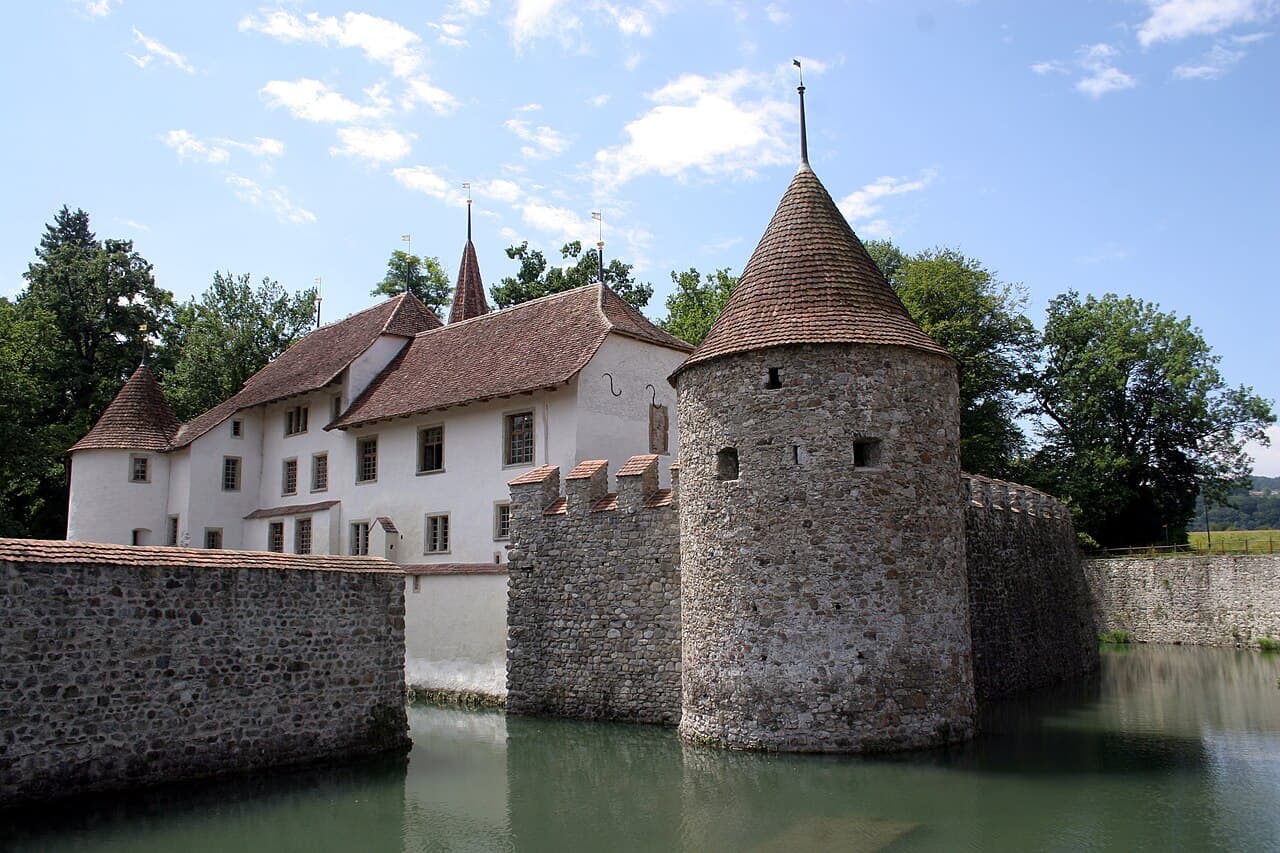
Hallwyl Castle
Hallwyl Castle stands as one of the most significant moated castles in Switzerland, renowned for its unique location on two islands formed by the River Aabach just north of Lake Hallwil. This 13th-century water castle offers an exceptional glimpse into medieval and early modern fortification architecture and noble residence life. Since opening to the public in 1925 and becoming the property of the Canton of Aargau in 1994, it has been an important cultural and historical site, integrated into the Museum of Aargau.
Early origins and medieval foundation
The origins of Hallwyl Castle trace back to the late 12th century, with the first documented mention in 1256. Initially, the site consisted of a solitary residential tower or keep built beside the River Aabach, serving as the fortified home of the noble von Hallwyl family. This family, part of the Argovian nobility, played a prominent role in regional politics and military affairs for over eight centuries.
By the mid-13th century, the castle expanded with the construction of a palas—a residential building combining storage on the lower floor and living quarters above—signifying the growth of the castle from a simple tower into a more complex fortified residence. The early 14th century brought significant transformation under Johans I. von Hallwyl (1305–1348), who converted the castle into a two-island water castle by creating an artificial island and surrounding the complex with a ring wall and moat. This period saw the addition of a round tower that remains a key architectural feature today.
Destruction, reconstruction, and military evolution
Hallwyl Castle endured two major fires, one in 1380 and another in 1415 during the Bernese conquest of Aargau. Despite these setbacks, it was swiftly rebuilt and expanded. Between 1420 and 1425, the palas was extended southward, enhancing the living quarters. By the late 15th century, under Dietrich von Hallwyl (1462–1509), the castle's defenses were modernized with the addition of thick-walled artillery towers featuring narrow shooting slits, reflecting the adaptation to gunpowder weaponry and changing military tactics.
The late 16th century saw a major renovation from 1578 to 1590 led by Burkhard III. von Hallwyl, who transformed the castle into a late Gothic residence. This included the construction of stair towers, remodeling of facades, and redesign of the great hall, giving the castle much of its present architectural character.
Castle layout and architectural features
Hallwyl Castle is uniquely situated on two main islands, the Rear Island and the Front Island, with a third island housing the castle mill. The Rear Island contains the remains of the original bergfried or main tower, built with unhewn boulders, alongside the palas and three additional towers: a stair tower, an archive tower, and a dungeon tower. The moat and ring wall reinforce the island's defensive position.
The Front Island is more spacious and was developed later, featuring four buildings arranged around a large courtyard. These include the stables, now repurposed, a granary built in the early 16th century that serves as an exhibition and visitor center today, and a prominent residential building with an attached stair tower. The castle mill, dating from the 14th century but rebuilt in 1637, occupies a third island, highlighting the castle's economic infrastructure.
Restoration and modern preservation
In the 19th century, Hallwyl Castle underwent a partial Neo-Gothic restoration initiated by Hans Theodor von Hallwyl between 1871 and 1873. However, these changes were largely reversed during early 20th-century restorations led by Wilhelmina von Hallwyl and architect Anders Roland, who aimed to restore the castle's authentic medieval appearance. Archaeological excavations from 1910 to 1916, and later between 1995 and 2003, have contributed valuable insights into the castle's history and construction.
Since the Hallwil Foundation opened the castle to the public in 1925, it has become a cultural hub offering thematic tours that explore the lives of the noble family and their subjects. Audio guides provide immersive narratives from multiple perspectives, including family members and peasants. The castle also hosts diverse events such as operatic performances under the stars, nature excursions, and special exhibitions.
Today, Hallwyl Castle is well preserved and serves as a prime example of a medieval water castle in Switzerland, offering visitors a comprehensive experience of its architectural evolution, historical significance, and cultural heritage.
Historical significance and cultural heritage
The von Hallwyl family, whose lineage spans over 800 years, distinguished themselves in various fields including military service on confederate battlefields, European courts, politics, science, commerce, and finance. The castle's strategic location and architectural adaptations reflect the broader historical shifts in medieval and early modern Switzerland.
Its preservation and public accessibility have made Hallwyl Castle a valuable educational resource and tourist attraction, illustrating the complexities of noble life, feudal governance, and military architecture through centuries of Swiss history.
Visitor experience and educational programs
Visitors to Hallwyl Castle can explore eleven thematic areas within the castle rooms, each providing detailed insights into different historical periods and aspects of castle life. The audio guides enhance the experience by presenting stories in the first person, including voices of noble family members and common folk alike. Special audio guides tailored for children make the castle accessible and engaging for younger audiences.
The castle's event calendar includes public guided tours, nature walks, and cultural events, fostering a dynamic connection between the past and present. The triennial operatic performances, set against the fairy-tale backdrop of the castle under the night sky, are particularly popular and highlight the castle's role as a living cultural venue.
Frequently asked questions (FAQ)
- What is the historical significance of Hallwyl Castle?
- Hallwyl Castle, located in Seengen, Switzerland, dates back to the 13th century and is a prime example of medieval architecture. It served as a noble residence for the Hallwyl family and is an important site for understanding Swiss history and feudal society.
- When was Hallwyl Castle built?
- Hallwyl Castle was originally constructed in the late 13th century, with various modifications made over the centuries. The castle's current form reflects a blend of medieval and Renaissance architectural styles, showcasing its evolution through time.
- What are the opening hours for Hallwyl Castle?
- Hallwyl Castle is typically open to visitors from April to October, with specific hours that may vary by season. It is advisable to check the official website for the most accurate and current information on opening times before your visit.
- Can I take guided tours of Hallwyl Castle?
- Yes, guided tours are available at Hallwyl Castle, offering visitors an in-depth look at its history and architecture. These tours are led by knowledgeable guides who provide fascinating insights into the castle's past and its significance in Swiss culture.
- Is Hallwyl Castle accessible for visitors with disabilities?
- Hallwyl Castle is committed to making its facilities accessible to all visitors. While some areas may present challenges due to the castle's historic nature, there are provisions in place to assist those with mobility issues, including accessible routes and facilities.
- What is the best time to visit Hallwyl Castle?
- The best time to visit Hallwyl Castle is during the spring and summer months, from April to September, when the weather is pleasant and the gardens are in full bloom. Additionally, these months often feature special events and exhibitions that enhance the visitor experience.
- Are there any nearby attractions to Hallwyl Castle?
- Yes, there are several nearby attractions, including the picturesque Lake Hallwyl and the charming town of Seengen, which offer lovely walking trails and local dining options. Visitors can also explore additional historical sites in the surrounding region, making it a great day trip.
- What are the ticket prices for Hallwyl Castle?
- Ticket prices for Hallwyl Castle vary depending on age and the type of tour selected. Generally, entrance fees are affordable, and discounts may be available for families, students, or seniors, so be sure to check the official website for detailed pricing information.
Photo gallery

Information
Website
Visit websiteSources & official resources
Verify the information above using these authoritative references.
Loading map...
Visitor reviews
No reviews yet. Been here? Write the first review and help other travelers!
Write the first reviewVisited this castle? Share your experience
Your review helps other travelers and adds first-hand knowledge to our encyclopedia.



