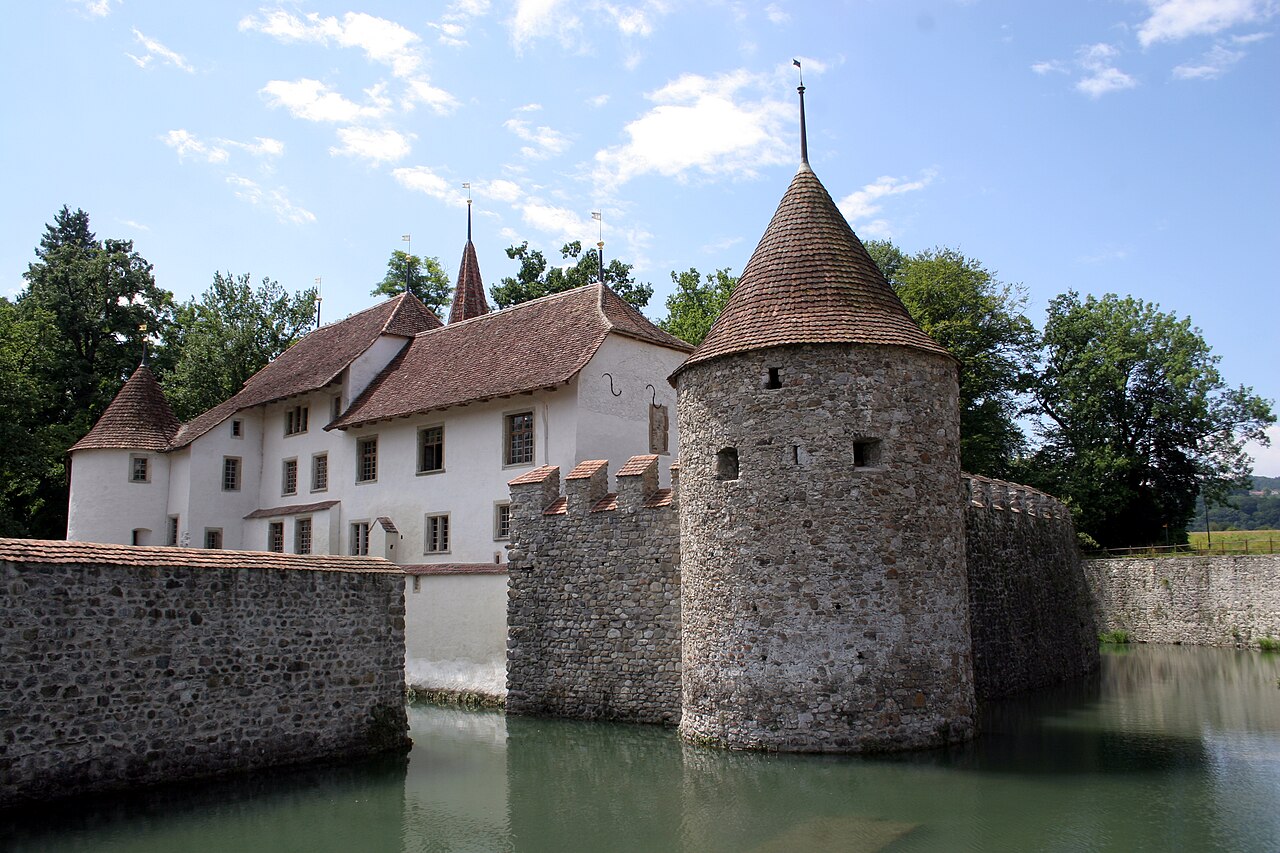
Liebegg Castle
Liebegg Castle, located in Gränichen, Switzerland, has a complex history rooted in the High Medieval period. The castle's origins trace back to the 12th century, with the first fortress likely constructed in the latter half of that century. This early structure was associated with the von Liebegg family, who were probably a junior branch of the von Trostburg lineage. The family's earliest documented mention dates to 1241, when Burkhard I and Ludwig von Liebegg appeared as witnesses in a legal document. At that time, they held the status of unfree knights serving the Counts of Kyburg.
Medieval origins and feudal affiliations
The initial castle was situated on the highest point of a hilltop, a strategic position typical for hill castles of the era. About a century after the first castle's construction, a second castle was built just south of the original site. When the Kyburg lineage ended, the Habsburgs assumed overlordship of the region, including Liebegg. The Habsburgs divided control of the castle's jurisdiction, granting half to the von Liebegg family as the Twing of Liebegg, while the other half was given to the Lords of Aarburg, who subinfeudated it back to the von Liebeggs. This arrangement reflected the complex feudal relationships of the time.
Transition of power and architectural transformation
In 1415, the city-state of Bern captured the Aargau region from the Habsburgs. Despite this significant political change, Liebegg Castle was not attacked, and the von Liebegg family retained their holdings under Bernese rule. The family's male line ended in 1433 with the death of Johann or Hemmann von Liebegg, after which the estate passed to Petermann von Luternau and his descendants. By the 16th century, the von Luternau family had become one of Bern's most influential noble houses.
During 1561-62, Augustin von Luternau demolished the medieval fortress and constructed a late-Gothic residence on the site, known as the Luternauhaus. This building replaced the original defensive structures with a more comfortable noble residence, reflecting the changing role of castles from military fortifications to status symbols and administrative centers.
Baroque rebuilding and later modifications
In 1602, the castle changed hands to Marx Escher from Zürich, who sold it shortly thereafter to Reinhard Graviseth in 1615. Graviseth constructed a new castle and residence hall south of the Luternauhaus in 1617, embodying Baroque architectural principles. His ownership lasted about fifty years, followed by transactions involving the von Breitenlandenberg and Graviseth families again. In 1772, the von Diesbach family inherited the property.
The 1798 French invasion and the establishment of the Helvetic Republic ended the feudal system, stripping noble families of their land rights though many retained their castles. The von Diesbach family held Liebegg Castle but lost the associated land holdings.
19th and 20th century changes and current use
In 1875, Friedrich Bernhart von Diesbach sold Liebegg Castle to industrialist Guido Hunziker-Zuest of Aarau. His son Julius Hunziker lived there until 1941. The Canton of Aargau acquired the castle in 1946, repurposing it for educational uses. From 1958, it housed a cantonal agricultural school, and between 1983 and 1998, it served as the cantonal teacher's college.
The castle's architectural fabric has evolved notably over centuries. The original medieval castle has left no visible remains. The late-Gothic Luternauhaus stands on the site of the first castle, though its south wing was demolished in the 19th century due to ruin. The Baroque residence built in 1617 suffered damage from an earthquake in 1817, which caused the western wall to collapse. Due to unstable foundations, the structure was moved several meters and rebuilt in the Neoclassical style.
Today, Liebegg Castle functions as a venue for meetings, conferences, weddings, and other events. Its layered history from medieval fortress to noble residence and modern institutional use illustrates the architectural and social transformations typical of Swiss castles.
Architectural features and layout
Liebegg Castle's architecture reflects its multiple phases of construction and remodeling. The initial castles were typical hill castles with strategic positioning for defense. The late-Gothic Luternauhaus introduced residential comfort and stylistic elements such as pointed arches and decorative stonework characteristic of the period. The 17th-century Baroque residence added grandeur and symmetry, common in noble estates of the time.
The Neoclassical reconstruction after the 1817 earthquake simplified some Baroque ornamentation, favoring clean lines and balanced proportions. Although much of the medieval fortifications have disappeared, the castle complex retains significant historical and architectural value through its later structures.
Frequently asked questions (FAQ)
- How do I get to Liebegg Castle?
- Liebegg Castle is located in Gränichen, Switzerland, and is easily accessible by public transport or car. If you are traveling by train, the nearest station is in Aarau, from which you can take a bus or taxi to the castle.
- What is the historical significance of Liebegg Castle?
- Liebegg Castle dates back to the late 13th century and is one of the most important historical sites in the region. It played a crucial role in the defense of the area during the Middle Ages and has been well-preserved, showcasing the architectural style of that period.
- When was Liebegg Castle built?
- Construction of Liebegg Castle began in the late 1200s, with its first documented mention occurring in 1293. Over the centuries, it has undergone various renovations but retains much of its original medieval charm.
- Can I visit Liebegg Castle year-round?
- Yes, Liebegg Castle is open to visitors year-round, although opening hours may vary seasonally. It's advisable to check the official website for the most up-to-date information on visiting hours and special events.
- Why is Liebegg Castle a popular tourist attraction?
- Liebegg Castle attracts visitors due to its rich history, stunning architecture, and beautiful surroundings. The castle offers guided tours that provide insights into its past and the life of its inhabitants.
- Is it possible to hold events at Liebegg Castle?
- Yes, Liebegg Castle offers facilities for hosting various events, including weddings and corporate gatherings. The picturesque setting and historical ambiance make it a unique venue for special occasions.
- What are the ticket prices for visiting Liebegg Castle?
- Ticket prices for entry to Liebegg Castle are generally affordable, and discounts may be available for students and groups. It's best to check the official website for current pricing and any special offers.
- What is the best time to visit Liebegg Castle?
- The best time to visit Liebegg Castle is during the spring and early autumn when the weather is pleasant for exploring the grounds. Additionally, the castle often hosts special events and activities during the summer months.
- Are there any nearby attractions to visit along with Liebegg Castle?
- Yes, there are several attractions near Liebegg Castle, including the beautiful hiking trails in the surrounding hills and the charming town of Gränichen. Visitors can also explore nearby museums and cultural sites that enhance the historical experience.
Information
Loading map...
Visitor reviews
No reviews yet. Been here? Write the first review and help other travelers!
Write the first reviewVisited this castle? Share your experience
Your review helps other travelers and adds first-hand knowledge to our encyclopedia.