Trimontium
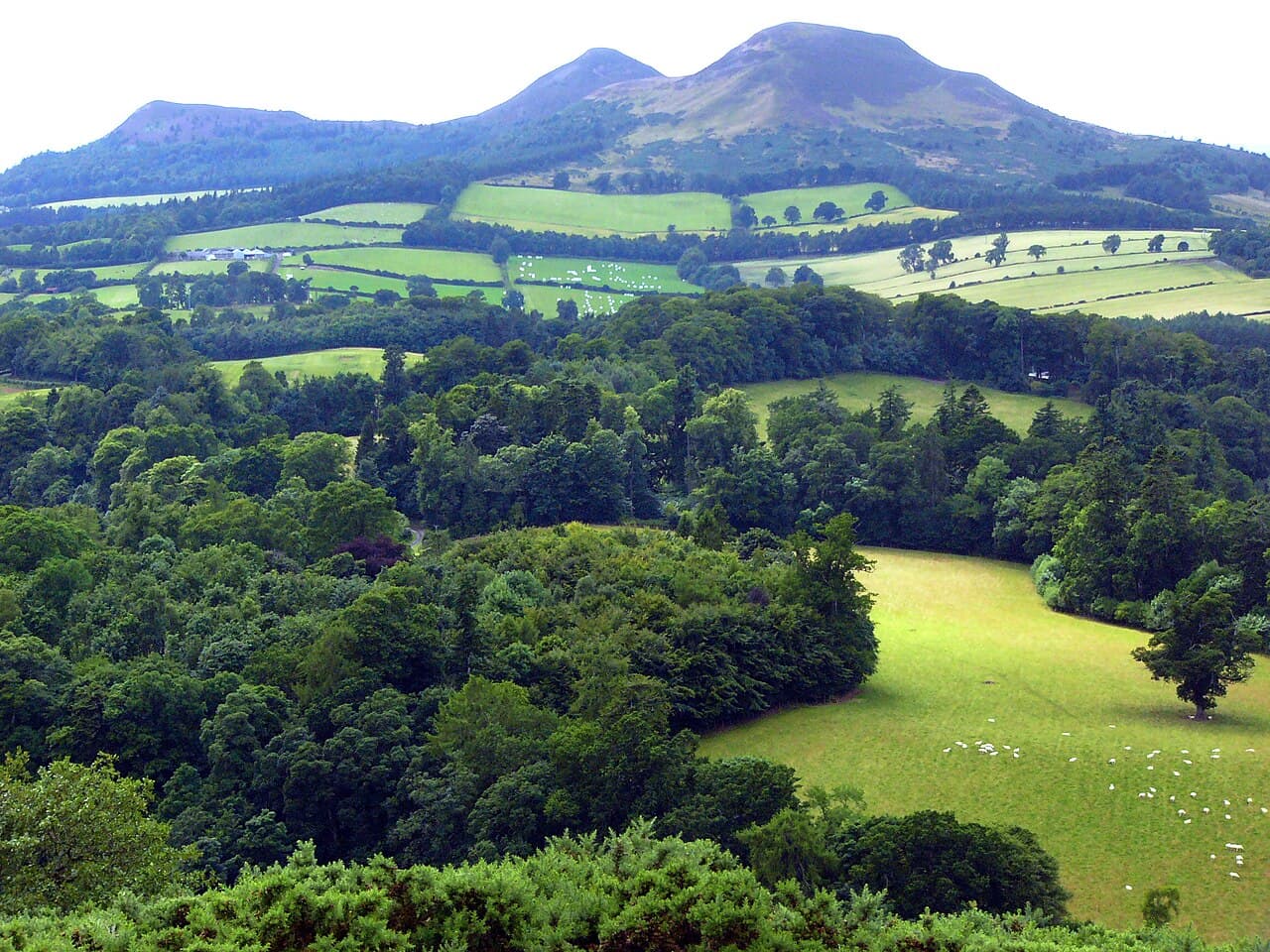
Trimontium was a significant Roman fort complex located at Newstead, near Melrose, in the Scottish Borders. Its name, derived from the Latin trium montium, meaning "three hills," refers to the prominent Eildon Hills under which it was situated. This strategic location beneath these hills provided a commanding view of the surrounding landscape and was essential for controlling movement along the Roman road network in northern Britain.
Constructed in the 1st century AD, Trimontium was occupied intermittently from approximately 79 AD to 184 AD. It was established during the Roman expansion into what is now Scotland, an area considered hostile and challenging to control. The fort was positioned about 60 miles (100 kilometers) north of Hadrian's Wall, at the end of the Roman road known as Dere Street, which was a critical military and trade route extending northwards from the wall.
Architectural scale and military significance
Trimontium was notably the largest of the "outpost" forts beyond Hadrian's Wall, covering an area roughly three times larger than any fort along the wall itself. By around 180 AD, it had become the most northerly settlement of the entire Roman Empire, marking the extent of Roman military presence in Britain. The fort's size and location underscore its importance as a base for Roman operations in the region, serving both defensive and logistical roles.
Site layout and surrounding landscape
The fort was strategically placed on the banks of the River Tweed, with the nearby Rivers Tweed and Leader providing natural routes for the movement of goods and people. The proximity to these waterways complemented the Roman road network, facilitating efficient supply and communication lines. The imposing Eildon Hills, including the Iron Age hillfort atop Eildon North, were a constant visual reminder of the indigenous population and the challenging terrain.
Fort design and features
While much of the original fort's layout has been lost to time, archaeological excavations have revealed evidence of substantial defensive structures, including ramparts and ditches typical of Roman military architecture. The expansive size of Trimontium suggests it housed a considerable garrison, along with facilities for storage, administration, and possibly civilian settlements adjacent to the military installation.
Archaeological discoveries and historical importance
Trimontium is internationally recognized for the discovery of one of the largest caches of Roman military artifacts found in Britain. Archaeologists uncovered 117 pits containing a wide array of objects, including weapons, armor, tools, and everyday items used by Roman soldiers. These finds provide invaluable insight into the daily life, military practices, and logistical operations of the Roman army stationed at the northern frontier.
The site was also identified in the ancient geographical writings of the Roman scholar Ptolemy, who mentioned Trimontium in his Geography. This historical reference corroborates the fort's significance and helps to place it within the broader context of Roman Britain.
Historical context and legacy
Trimontium's establishment and occupation occurred during a period of Roman attempts to consolidate control over Caledonia, the Roman name for Scotland. The fort served as a key military outpost in a region marked by resistance from local tribes. Its presence demonstrates the extent of Roman ambition and the challenges faced in maintaining an empire's northern boundary.
Today, the remains of Trimontium stand as a testament to Roman engineering and military strategy in northern Britain. The site continues to be a focus for archaeological research and public interest, offering a window into the complexities of Roman frontier life.
Frequently asked questions (FAQ)
- How do I visit Trimontium and what are the opening hours?
- Trimontium is accessible to the public at the Newstead site near Melrose. It is managed by Historic Environment Scotland and typically open during daylight hours year-round, but it is advisable to check the official website for any seasonal variations or special events.
- What is the historical significance of Trimontium?
- Trimontium was the largest Roman fort north of Hadrian's Wall and served as the northernmost military base of the Roman Empire by 180 AD, illustrating the extent of Roman expansion into Scotland.
- What architectural features can be seen at Trimontium today?
- Visitors can observe the archaeological remains of the fort's defensive earthworks, including ramparts and ditches. Interpretive signage helps explain the layout and function of the site, though much of the original stonework has not survived.
- Is Trimontium accessible for visitors with mobility issues?
- The site is primarily an open archaeological area with uneven terrain and limited paved paths. Visitors with mobility challenges should prepare accordingly and may wish to contact Historic Environment Scotland for specific accessibility information.
- When is the best time to visit Trimontium?
- Spring through early autumn offers the best weather for exploring the outdoor site, with longer daylight hours and milder conditions enhancing the experience.

Information
Current owner
Historic Environment Scotland
Loading map...
Visitor reviews
No reviews yet. Been here? Write the first review and help other travelers!
Write the first reviewVisited this castle? Share your experience
Your review helps other travelers and adds first-hand knowledge to our encyclopedia.