Trim Castle
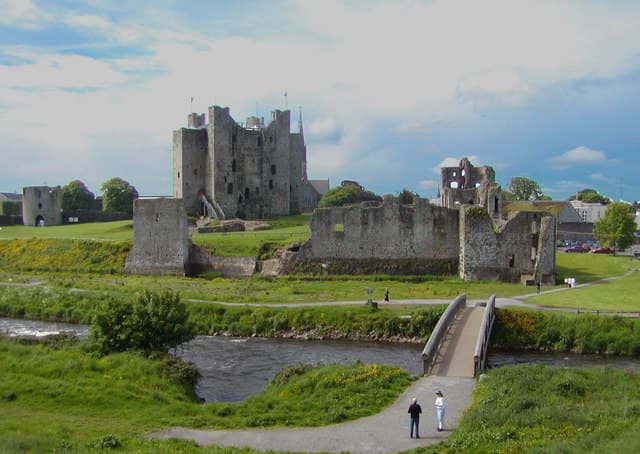
Trim Castle (Irish: Caisleán Bhaile Átha Troim) stands as one of the most significant and largest Norman fortresses in Ireland. Located on the south bank of the River Boyne in Trim, County Meath, it covers an extensive area of approximately 30,000 square meters. This hill castle was constructed over a period of about 30 years during the 12th century, primarily under the direction of Hugh de Lacy and later his son Walter de Lacy. It served as the administrative center, or caput, of the Lordship of Meath, a key Norman stronghold in medieval Ireland.
Historical context and construction
The castle's origins date back to the aftermath of the Norman invasion of Ireland, which began in 1169. Hugh de Lacy, a prominent Norman lord granted the Lordship of Meath by King Henry II of England, initiated the construction of Trim Castle as a symbol of Norman authority and military strength in the region. The castle's strategic position on a natural rise above the River Boyne allowed it to control river traffic and oversee the surrounding fertile lands.
Construction began in the late 12th century, with the castle evolving from an initial wooden motte-and-bailey structure to a massive stone fortress. The transition to stone marked a significant advancement in medieval military architecture, reflecting the Normans' intent to establish a permanent and formidable presence. The castle's design incorporated a large keep, multiple defensive walls, towers, and a deep moat fed by the river, enhancing its defensive capabilities.
Architectural features and layout
Trim Castle is renowned for its impressive Romanesque and early Gothic architectural elements, characteristic of Norman military construction of the period. The most striking feature is its massive keep, which is one of the largest in Ireland and Britain. The keep is a multi-storey stone tower with thick walls, narrow arrow slits, and battlements designed for defense and surveillance.
The castle's curtain walls form an irregular polygonal enclosure, punctuated by several round towers and square towers that provided flanking fire and increased defensive coverage. The moat surrounding the castle was both a physical barrier and a psychological deterrent to attackers. Inside the walls, the castle contained a range of functional spaces including a great hall, private chambers, a chapel, kitchens, and storage rooms, which supported the daily life of the lord and his retinue.
The keep and defensive structures
The keep is the centerpiece of Trim Castle's defenses. Its robust construction includes thick stone walls up to 5 meters wide, designed to withstand siege engines and mining attempts. The keep's interior was divided into several floors connected by narrow staircases, with the upper floors serving as living quarters and the lower levels used for storage and defense.
Defensive features such as murder holes, arrow slits, and machicolations allowed defenders to repel attackers from protected positions. The castle's gatehouse was heavily fortified, featuring portcullises and drawbridges that controlled access to the inner ward.
Role in medieval Ireland and subsequent history
Throughout the medieval period, Trim Castle played a central role in the Norman administration and military campaigns in Ireland. It was a base for controlling the surrounding lands and served as a residence for the powerful de Lacy family. The castle witnessed numerous conflicts, including skirmishes during Irish resistance against Norman rule and later involvement in the Tudor conquest of Ireland.
By the early modern period, the castle's military importance declined, and it gradually fell into disuse and partial ruin. Despite this, Trim Castle remains one of the best-preserved examples of Norman military architecture in Ireland and continues to attract historians, archaeologists, and visitors interested in medieval history.
Preservation and public access
Today, Trim Castle is owned and maintained by the Irish Government through the Office of Public Works (OPW). It is listed as a National Monument in County Meath, reflecting its cultural and historical significance. The castle is open to the public, offering guided tours that explore its architectural features and historical context.
Visitors can explore the extensive grounds, climb parts of the keep, and view exhibitions detailing the castle's construction, its role in Irish history, and the lives of its medieval inhabitants. The castle's location near the River Boyne also places it within a landscape rich in archaeological and historical sites, including the nearby Hill of Tara and Newgrange.
Visitor information and tourism
Trim Castle is accessible year-round, with varying opening hours depending on the season. Admission fees contribute to the castle's upkeep and conservation efforts. The site offers educational programs and hosts events that highlight medieval history and Norman heritage in Ireland.
Architectural significance and legacy
Trim Castle stands as a prime example of Norman military architecture adapted to the Irish landscape. Its scale and complexity illustrate the Normans' strategic approach to conquest and settlement. The castle's preservation provides valuable insights into 12th-century fortification techniques, social organization, and feudal governance.
The castle has also influenced popular culture, notably serving as a filming location for the movie "Braveheart," which brought international attention to its striking medieval appearance. As a heritage site, Trim Castle continues to contribute to Ireland's historical narrative and tourism industry.
Frequently asked questions (FAQ)
- How do I get to Trim Castle?
- Trim Castle is located in the town of Trim, County Meath, Ireland. It is accessible by car and public transport, with bus services connecting from Dublin and nearby towns.
- What is the historical significance of Trim Castle?
- Trim Castle was the largest Norman fortress in Ireland and served as the administrative center of the Lordship of Meath, playing a key role in medieval Irish history.
- Can I explore the interior of Trim Castle?
- Yes, visitors can explore parts of the castle, including the keep and inner wards, through guided tours that provide detailed historical and architectural information.
- When is the best time to visit Trim Castle?
- The castle is open year-round, but spring and summer offer the best weather for exploring the extensive grounds and enjoying outdoor exhibits.
- Are there any events held at Trim Castle?
- Trim Castle hosts educational programs and medieval-themed events throughout the year, enhancing visitor experience and historical understanding.
Photo gallery

Information
Current owner
Irish Government - Office of Public Works
Loading map...
Visitor reviews
No reviews yet. Been here? Write the first review and help other travelers!
Write the first reviewVisited this castle? Share your experience
Your review helps other travelers and adds first-hand knowledge to our encyclopedia.