Trigueros Castle
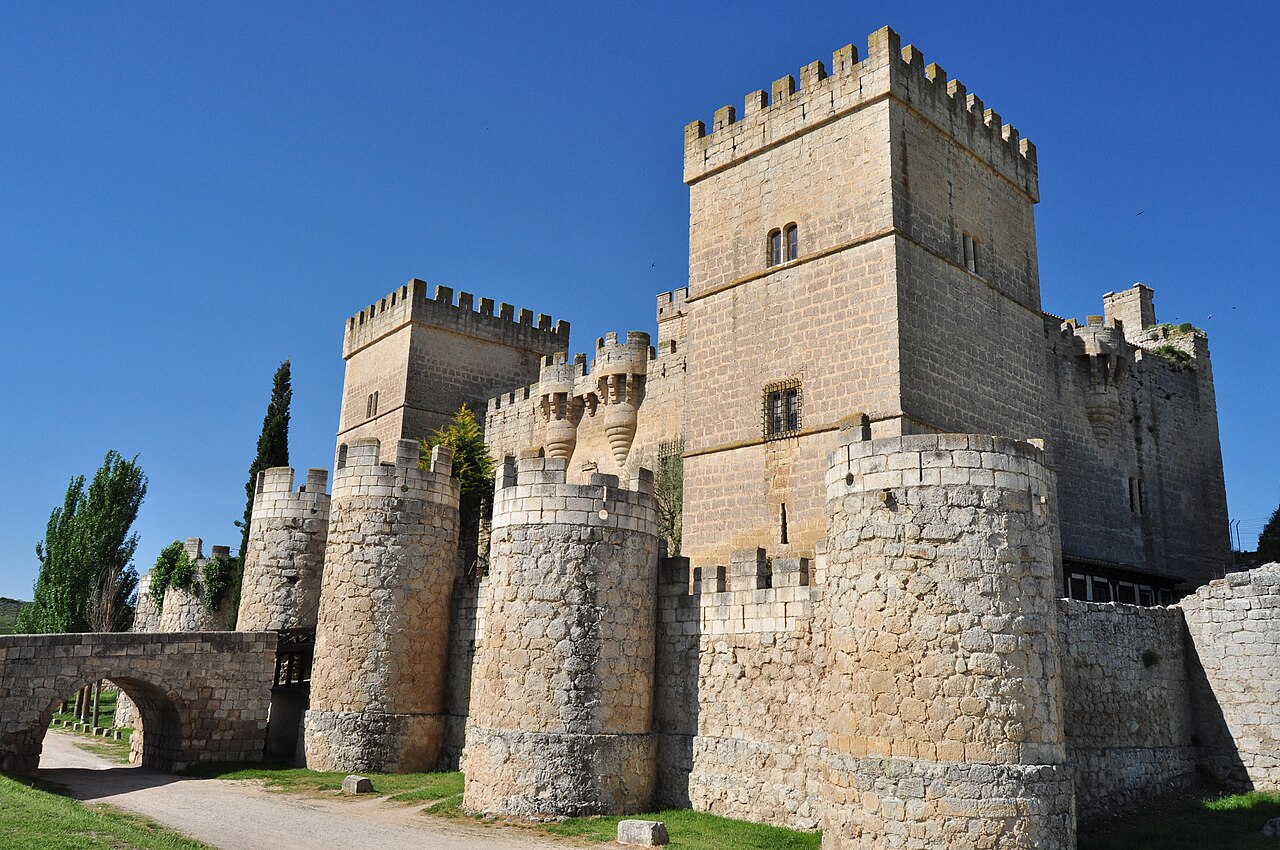
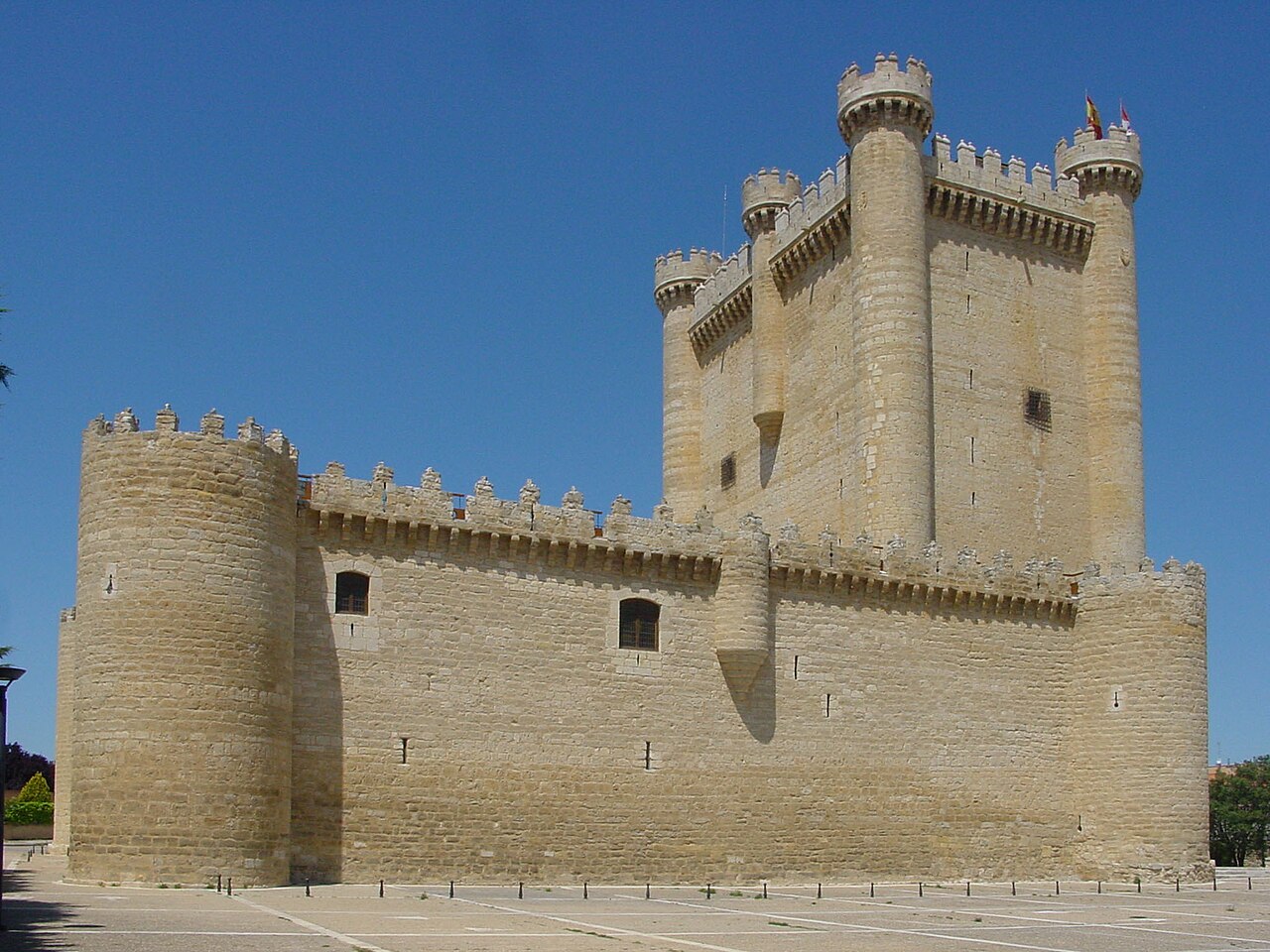
Trigueros Castle, located in the village of Trigueros del Valle in the province of Valladolid, Spain, is a notable example of a late medieval hill castle that served primarily as a fortified noble residence rather than a strategic military fortress. Its positioning on a small hill within the village, overshadowed by higher surrounding elevations, suggests its role was more residential and symbolic of noble authority than defensive dominance.
Historical background and noble lineage
The castle's origins trace back to the 14th century, with construction and significant enhancements occurring in the mid-15th century. The earliest documented noble proprietors were the Robles and Guevara families, influential lineages in the region. In 1427, King Juan II granted Fernán Alfonso de Robles the right to establish a mayorazgo (entailed estate) including Trigueros and its valley, cementing the family's territorial control. However, Fernán Alfonso's political opposition to the king's favorite, Álvaro de Luna, led to his imprisonment and execution by 1430, marking a turbulent period for the estate.
The castle underwent extensive construction in 1453 under Gutierre de Robles, the third lord of Valdetrigueros, and his wife María de Guevara. Their family crests and the date are prominently displayed above the main entrance, marking this phase as a defining moment in the castle's architectural development. The couple also contributed to the local parish church of San Miguel, commissioning a crucero and funerary chapels, emphasizing their lasting influence in the community.
Following Gutierre's death, his son Fernán Alfonso de Robles became the fourth lord, initially seizing control of the castle against his mother's wishes but maintaining possession by 1480. The castle remained in the Robles family until the late 16th century, when it passed through marriage to the Luján family, who later became the Counts of Castroponce.
Architectural features and layout
Trigueros Castle is arranged around a roughly rectangular main enclosure measuring approximately 56 by 40 meters. The castle features rectangular corner towers that rise only slightly above the curtain walls, with one tower designed for habitation. The square keep tower (torre del homenaje) is centrally positioned on the northern wall and is notable for its massive walls, about 2 meters thick and 10 meters wide, serving as the last defensive refuge.
The main entrance is located in the center of the western wall, accessed through a fortified gate tower with three successive heavy wooden doors, enhancing security. Above this entrance, the coats of arms of the Robles and Guevara families and the year 1453 remain visible, symbolizing the castle's noble heritage.
Beneath the courtyard lie three vaulted underground chambers, historically used as stables and storage areas. The courtyard itself contains remnants of various buildings and a cistern, indicating the castle's self-sufficiency in water and domestic functions.
Surrounding the main enclosure is a second defensive wall approximately 70 by 50 meters in size, now largely in ruins. This outer wall was reinforced with cylindrical artillery towers equipped with slits for firearms, dating to around 1500, reflecting adaptations to evolving military technology.
Defensive innovations and artillery adaptations
After the 1521 revolt of the Comuneros, when local vassals attacked the castle in response to abuses by the Robles family, the fortress was repaired and modified to accommodate artillery. This included the construction of angular towers designed to better withstand cannon fire and improve the castle's defensive capabilities against early modern siege warfare.
The castle's layout demonstrates a deliberate use of overlapping fields of fire, secure internal corridors within the walls, and elevated walkways (adarves) that allowed defenders to move safely and defend the structure effectively.
Historical events and social context
The castle's history is intertwined with the broader social and political upheavals of late medieval and early modern Spain. The 1521 assault during the Castilian War of the Communities was a significant episode, illustrating the tensions between noble authority and local populations. The castle was briefly occupied by rebels before being reclaimed by Gutierre de Robles Bazán, the fifth lord.
Ownership passed through several generations, and by the late 16th century, the castle became part of the holdings of the Luján family, who were later ennobled as Counts of Castroponce. This transition reflects the common practice of property transfer through marriage among noble families.
Current condition and preservation efforts
Today, Trigueros Castle stands as a partially ruined monument. While some external walls have collapsed, notably a significant section in 2016 due to heavy rain, the interior has undergone partial restoration. The castle now hosts a permanent thematic exhibition featuring creatively designed rooms such as a dragon's dungeon and an enchanted greenhouse, contributing to its cultural and tourist appeal.
Preservation challenges remain due to the castle's age and exposure to natural elements. The municipality manages the site and continues efforts to stabilize and restore key structural elements, aiming to balance historical integrity with public accessibility.
Unique features and underground structures
One of the castle's remarkable aspects is its extensive vaulted underground stables, known as caballerizas subterráneas abovedadas. These arched chambers beneath the courtyard highlight the importance of cavalry and logistics in the castle's operation.
Additionally, the surrounding hills contain numerous underground storage spaces, some possibly dating back 500 years, used historically by villagers for storing goods. These subterranean structures add to the castle's historical and architectural interest.
Frequently asked questions (FAQ)
- How do I get to Trigueros Castle?
- Trigueros Castle is located in the village of Trigueros del Valle, Valladolid, Spain, on Calle Heroes. It is accessible by local roads, and the nearest major city is Valladolid.
- What is the historical significance of Trigueros Castle?
- Trigueros Castle was a fortified residence of the noble Robles and Guevara families, reflecting late medieval architecture and social history, including events like the 1521 Comuneros revolt.
- When was Trigueros Castle built and modified?
- The castle was originally built in the 14th century and underwent significant construction in 1453, with artillery adaptations added around 1500 after the 1521 revolt.
- Can I visit the interior of Trigueros Castle?
- Yes, the interior has been partially restored and houses a permanent thematic exhibition. However, some areas may be restricted due to ongoing preservation efforts.
- What architectural features are notable at Trigueros Castle?
- Notable features include the rectangular corner towers, square keep with thick walls, vaulted underground stables, and artillery towers with firearm slits from the early 16th century.
Information
Sources & official resources
Verify the information above using these authoritative references.
Loading map...
Visitor reviews
No reviews yet. Been here? Write the first review and help other travelers!
Write the first reviewVisited this castle? Share your experience
Your review helps other travelers and adds first-hand knowledge to our encyclopedia.