Castle of Ampudia
The Castle of Ampudia stands as a remarkable example of a 15th-century Castilian fortress located in the town of Ampudia, Spain. Constructed between 1461 and 1488, this castle was commissioned by García López de Ayala, a nobleman holding the titles of lord of Ayala and Salvatierra. The castle reflects the architectural and feudal power of the Castilian nobility during the late medieval period, combining defensive military features with residential palace elements.
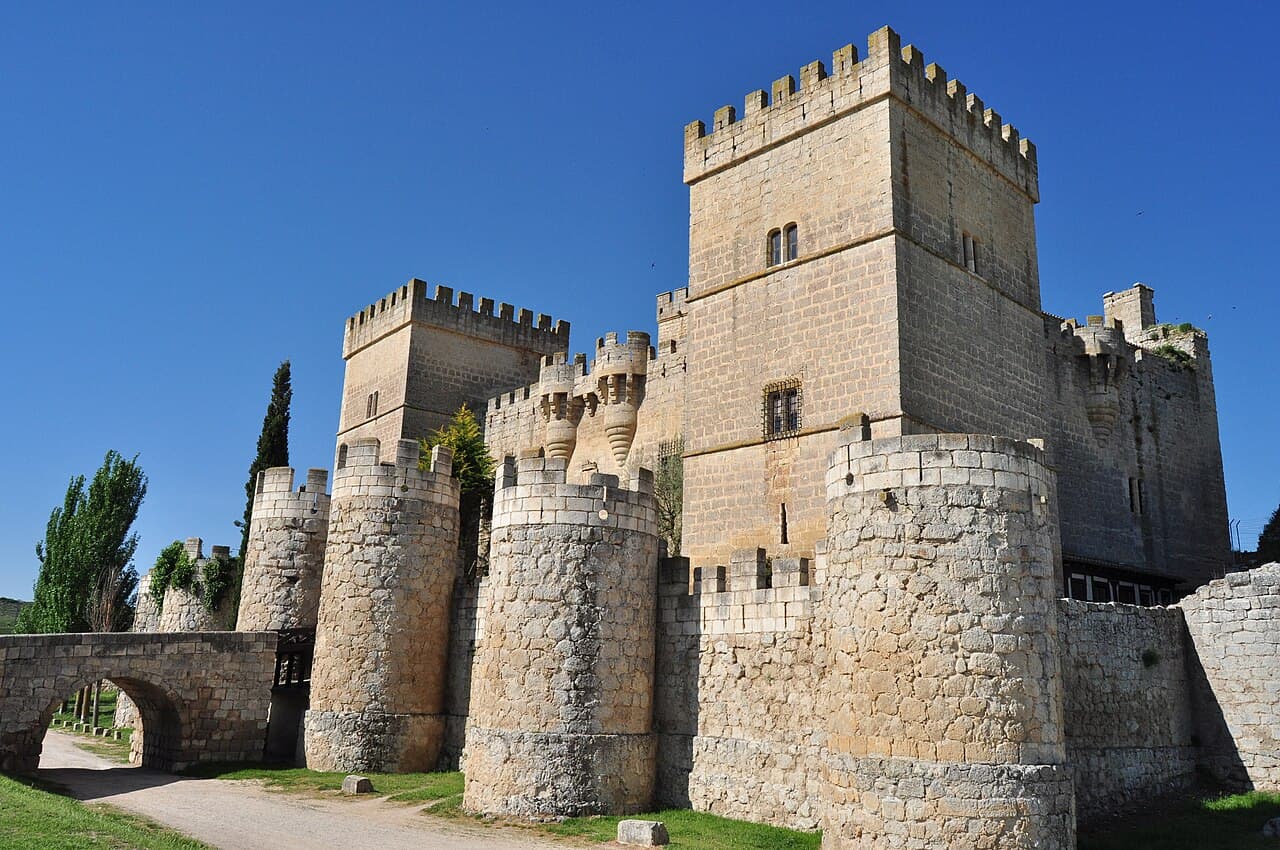
Its trapezoidal footprint is distinctive among Spanish castles, and the fortress is fortified by four corner towers, with the southwest tower serving as the main keep or torre del Homenaje. A wide moat surrounds the castle, crossed by a drawbridge, emphasizing its original defensive purpose. The outer defenses include a barbican wall equipped with cylindrical towers and a gatehouse flanked by two small ornamental watchtowers known locally as escaraguaitas or garitas. Above the main entrance, the heraldic emblem of the Duke of Lerma is prominently displayed, marking the castle's ownership in the late 16th and early 17th centuries.
Historical significance and ownership disputes
The castle's history is deeply intertwined with the noble family of the Ayala lineage. After the death of García López de Ayala, ownership became contested between his successor, Pedro Ayala y Rojas, Count of Salvatierra, and his mother, María Sarmiento. This familial dispute ended with Pedro securing control of the castle. The fortress also played a role in the Comunidades rebellion of 1521, a significant uprising against Emperor Charles I. Pedro Ayala sided with the rebels, which led to the Battle of Ampudia where forces loyal to the emperor clashed with those led by Bishop Antonio de Acuña. Following the defeat of the rebels in 1522, Charles I confiscated the castle but later restored it to the family after payment of a substantial fine.
In 1528, the castle gained further historical prominence when it was used as a secure holding place for the sons of the French king François I, who were kept as royal hostages after the Battle of Pavia. This event underscores the castle's strategic importance during early 16th-century European conflicts.
The duke of lerma and royal patronage
Ownership transferred in 1597 to Francisco Gómez de Sandoval y Rojas, the Duke of Lerma and a favorite of King Philip III. Under his lordship, the castle saw an elevation in status, becoming an occasional residence for the Spanish royal court. King Philip III himself visited the castle multiple times, reinforcing its political and social significance during the early Baroque period. Despite this prominence, the castle eventually fell into neglect and abandonment in the centuries that followed.
Architectural features and restoration
The Castle of Ampudia exemplifies an early Castilian castle-palace design, blending military fortification with residential comfort. The trapezoidal layout is unusual and contributes to its unique silhouette. The four corner towers provide comprehensive defensive coverage, with the torre del Homenaje acting as the central stronghold. The moat and drawbridge enhance the castle's defensive capabilities, typical of late medieval military architecture.
The barbican wall surrounding the castle features cylindrical towers and a fortified gatehouse. The ornamental escaraguaitas or garitas add a decorative yet functional aspect to the defenses. The castle's courtyard, known as the Patio de Armas, is a significant architectural highlight. It is enclosed on three sides by galleries of three levels of arches, characterized by the arquería escarzana style, which features flattened or depressed arches rather than semicircular ones. This tiered design, with each upper floor narrower than the one below, creates a striking visual depth and architectural rhythm.
Interior and collections
Following extensive restoration in the 1960s by Eugenio Fontaneda Pérez, the castle was transformed into a museum. The restoration aimed to recover much of the castle's original grandeur and architectural integrity. Today, the interior houses the Eugenio Fontaneda Collection, which includes archaeological artifacts from the Duero river basin, such as Bronze Age weaponry, Roman funerary stelae, and milestones. The collection also displays sacred art spanning from the 13th to the 18th centuries, along with a diverse array of toys, weapons, musical instruments, and pharmaceutical objects.
The galleries surrounding the Patio de Armas serve as exhibition spaces for noble family coats of arms, architectural fragments, baptismal fonts, and other historical relics. These elements provide visitors with insight into the castle's noble heritage and the artistic traditions of the region.
Cultural importance and preservation status
Declared a National Historic-Artistic Monument in 1931, the Castle of Ampudia is recognized for its cultural and historical significance in Spain. Its preservation and restoration have allowed it to remain a vital link to the region's medieval and early modern past. The castle stands today as a well-preserved monument that offers both architectural beauty and a rich historical narrative, attracting scholars, tourists, and history enthusiasts alike.
Visitors can explore the castle's imposing defensive structures, elegant residential galleries, and the extensive museum collections that reflect centuries of regional history. The castle's unique blend of military and residential architecture makes it an exceptional example of Castilian fortifications adapted to noble living.
Frequently asked questions (FAQ)
- What is the historical significance of the Castle of Ampudia?
- The Castle of Ampudia played a key role in 15th and 16th-century Castilian noble disputes, the Comunidades rebellion, and as a royal hostage site after the Battle of Pavia.
- Can visitors tour the interior collections of the Castle of Ampudia?
- Yes, the castle houses the Eugenio Fontaneda Collection, featuring archaeological artifacts, sacred art, and ethnographic objects, all accessible to visitors.
- When was the Castle of Ampudia constructed and by whom?
- The castle was built between 1461 and 1488 by García López de Ayala, a Castilian nobleman and lord of Ayala and Salvatierra.
- What architectural style characterizes the Castle of Ampudia?
- The castle is characterized by Gothic architecture with distinctive features like the arquería escarzana arches in its courtyard galleries.
- Is the Castle of Ampudia well preserved and accessible to the public?
- Yes, it is a well-restored castle currently owned privately and open to visitors as a museum with historical exhibits.
- What are the visiting hours and ticket prices for the Castle of Ampudia?
- Visiting hours and ticket prices vary; it is recommended to check the official site or local tourist information for current details.
Photo gallery

Information
Sources & official resources
Verify the information above using these authoritative references.
Loading map...
Visitor reviews
No reviews yet. Been here? Write the first review and help other travelers!
Write the first reviewVisited this castle? Share your experience
Your review helps other travelers and adds first-hand knowledge to our encyclopedia.