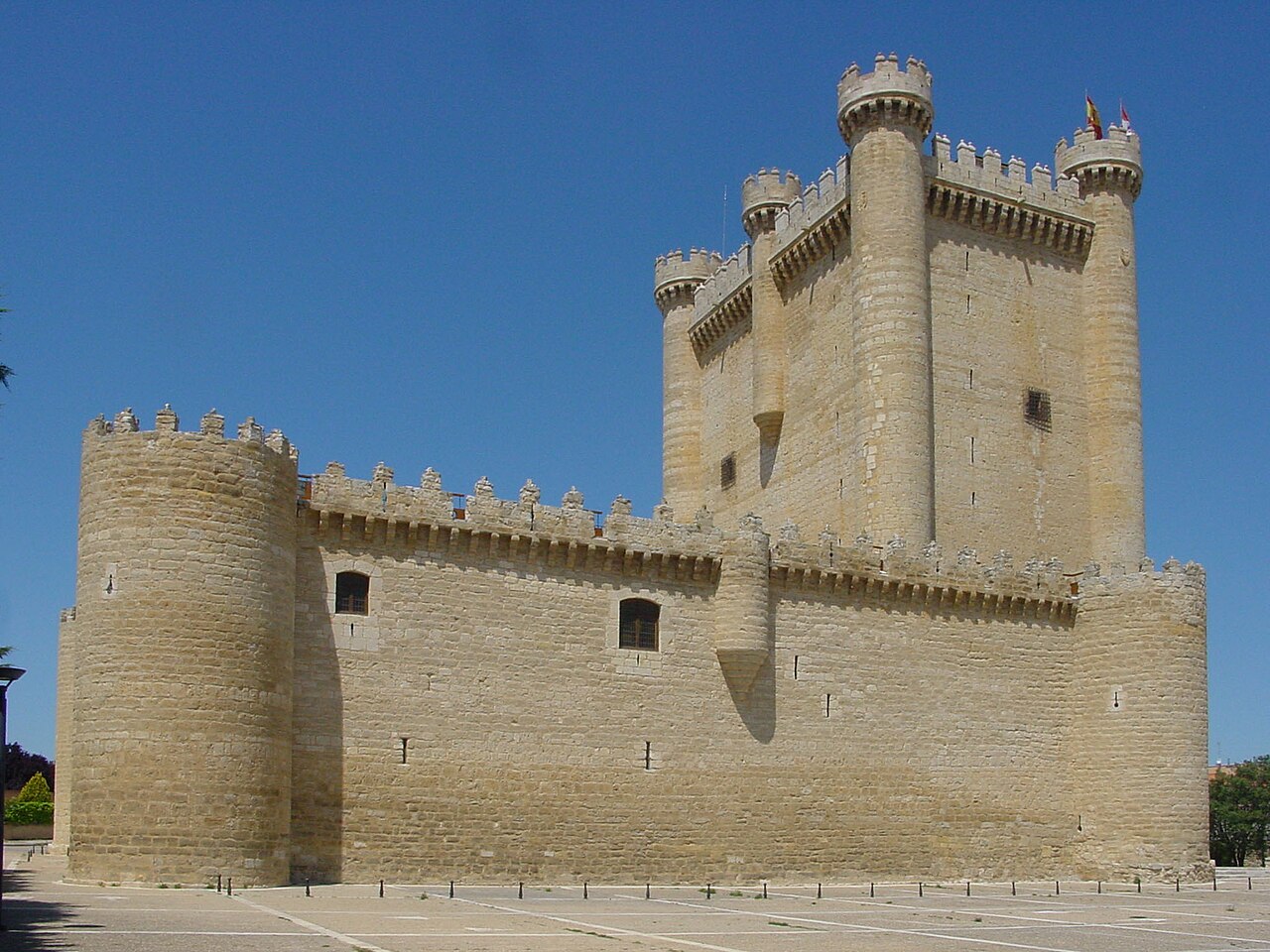
Castillo de Mucientes
The Castillo de Mucientes stands as a notable example of a medieval hill castle located in the municipality of Mucientes, within the historic region of Castile, Spain. Constructed during the High to Late Medieval period, this fortress played a significant role in regional governance, military defense, and noble residence from the 14th century onward. Its remains today offer valuable insights into medieval fortification architecture and the political history of Castile.
Historical background and political significance
The earliest known documentation of the castle dates back to 1326, when King Alfonso XI of Castile granted the area, including a modest castle, to his chief steward, Alvar Núñez Osorio. This event marked the beginning of the castle's close association with the noble lineage of the Counts of Ribadavia, who held lordship over Mucientes for several centuries. During this time, the castle functioned primarily as a residential palace for these noble rulers, reflecting the dual role of many castles as both defensive structures and noble homes.
In the early 16th century, the castle gained heightened royal prominence. In July 1506, it served as a Royal Palace and temporarily acted as the capital of the Kingdoms of Castile. This period is particularly notable for its association with Philip I of Castile, also known as Philip the Handsome, who used the castle as a base to assert control over Castile and to marginalize Queen Joanna I. This episode highlights the castle's importance as a center of political power during a turbulent period in Castilian history.
The castle later became a focal point during the Castilian War of the Communities in 1521. Forces loyal to the uprising, known as the Junta and led by Juan de Padilla, captured the fortress. They entrusted its defense to Juan de Mendoza. Although the Junta ordered the demolition of the castle to prevent its future military use, this order was never carried out, allowing the castle to survive in a diminished capacity.
Architectural layout and defensive features
The Castillo de Mucientes is characterized by an elongated plan measuring approximately 50 meters wide by 185 meters long, a design typical of many medieval fortresses that adapted to the natural terrain. Excavations have uncovered foundational remains of the north and east defensive walls, which delineated the castle's perimeter and contributed to its defensive capabilities.
Central to the fortress was the courtyard, portions of which retain original stone pavement. This courtyard would have served as a focal point for residential, administrative, and military activities within the castle walls. The discovery of a cistern (aljibe) within the grounds reveals the medieval engineering solutions employed to collect and store water, essential for sustaining the castle's inhabitants during sieges or dry periods.
A key defensive structure was the tower of homage, or keep, which served as the strongest and most secure part of the castle. The keep provided a vantage point for surveillance and a refuge during attacks. Although only parts of its foundations remain visible today, they attest to the castle's strategic design and construction techniques.
Additional architectural fragments such as capitals and column drums have been recovered, indicating decorative or structural elements within the castle buildings. These details reflect the craftsmanship and stylistic influences present during the castle's construction and use.
The castle was built on a naturally elevated platform known as an altozano, enhancing its defensive position by providing a commanding view of the surrounding landscape. Encircling the fortress was a moat (foso), a common medieval defensive feature designed to hinder attackers and protect the walls from direct assault. Both the altozano and moat remain important elements in the current archaeological and urban planning context.
Decline, ruin, and archaeological efforts
By the mid-18th century, the Castillo de Mucientes had fallen into significant disrepair, with many sections reduced to ruins. Historical accounts from 1751 describe the castle as largely ruined, with only fragments of its walls standing. The original dimensions of the castle, approximately 50 by 185 meters, were still discernible at this time.
During the 19th and early 20th centuries, the castle's remaining stones were repurposed for local public building projects, accelerating the loss of its masonry and architectural features. By the 1930s, much of the castle's physical presence had been diminished due to this reuse of materials.
Renewed archaeological interest emerged in October 2006, coinciding with the 500th anniversary of the 1506 Cortes of Mucientes held at the castle. Excavations aimed to preserve and study the site, transforming it into a public space that highlights the castle's historic remains and educates visitors about its medieval past.
Cultural and heritage significance
The Castillo de Mucientes is a significant cultural heritage site that offers a tangible connection to the medieval history of Castile. Its role as a noble residence, royal palace, and military fortress illustrates the multifaceted functions of castles in medieval Spain. The site’s archaeological remains provide valuable information about medieval construction techniques, defensive architecture, and the social history of the region.
Current efforts to protect and integrate the castle site within the local urban environment emphasize the importance of preserving such historical landmarks. The castle’s remains, including the altozano and moat, are recognized in urban planning to maintain the historical landscape and promote cultural tourism.
Frequently asked questions (FAQ)
- When was Castillo de Mucientes built?
- The castle was constructed in the 14th century during the High Medieval period, serving as a noble residence and fortress.
- What historical events took place at Castillo de Mucientes?
- Notably, in 1506 it served as a Royal Palace and temporary capital of Castile under Philip I. It was also involved in the Castilian War of the Communities in 1521.
- What remains can visitors see today at Castillo de Mucientes?
- Visitors can see the foundations of defensive walls, parts of the courtyard stone pavement, the cistern (aljibe), and the tower of homage foundations.
- Why is the castle significant in Castilian history?
- It was a political center for noble families, a royal residence, and a military fortress, reflecting the complex history of medieval Castile.
- Is Castillo de Mucientes accessible to the public?
- The site is accessible for archaeological visits and is part of local heritage preservation efforts, though facilities may be limited.
Information
Website
Visit websiteSources & official resources
Verify the information above using these authoritative references.
Loading map...
Visitor reviews
No reviews yet. Been here? Write the first review and help other travelers!
Write the first reviewVisited this castle? Share your experience
Your review helps other travelers and adds first-hand knowledge to our encyclopedia.