Marialva Castle
Marialva Castle, known locally as Castelo de Marialva, is a remarkable medieval fortress perched on a granite hill overlooking the Côa valley in the Beiras e Serra da Estrela region of Portugal. This hill castle commands a strategic position in the historic frontier zone of Riba Côa, an area that witnessed continuous human occupation from the Iron Age through to the modern era. The site originally hosted a castro—a fortified hill settlement—later adapted by the Romans into the city of Civitas Aravorum, illustrating the long-standing military and administrative significance of this location.
Following the decline of Roman authority, the site was successively controlled by the Visigoths and then the Moors, before being conquered by King Ferdinand I of León in the mid-11th century. It was definitively integrated into Portuguese territory during the reign of King Afonso I (Afonso Henriques) in the 12th century, who granted a Foral charter to encourage repopulation and fortification. The castle's stone fortifications were extensively rebuilt and expanded under King Sancho I and later King Denis (1279–1325), with its present layout largely established between the 13th and 14th centuries.
Historical significance and medieval development
Marialva Castle played a crucial role in securing the Portuguese border during the turbulent medieval period, especially in the conflicts with the neighboring kingdoms of León and Castile. The Treaty of Alcañices in 1297 formally recognized Marialva as part of Portugal, cementing its strategic importance. The castle formed part of a defensive chain alongside other fortified towns such as Guarda, Linhares da Beira, Celorico da Beira, Trancoso, and Longroiva, each positioned on high granite ridges to monitor the surrounding valleys and control key routes.
During the 1383–1385 crisis, a civil war over the Portuguese throne, Marialva supported the Master of Avis, who eventually secured the crown as King John I. The castle's military role persisted into the 15th and 16th centuries, with significant enhancements under King Afonso V and King Manuel I, including the issuance of new charters and fortification upgrades. By the 17th century, however, the population began to move outside the walls, leading to partial abandonment of the walled town.
Architecture and fortifications
The castle complex consists of two main enclosed areas: the military citadel at the summit and the surrounding civilian settlement enclosed by walls. Constructed predominantly from locally quarried granite, the fortress exhibits multiple phases of construction reflecting its evolving defensive needs from the High Medieval period through the Renaissance and into the early modern era.
The citadel
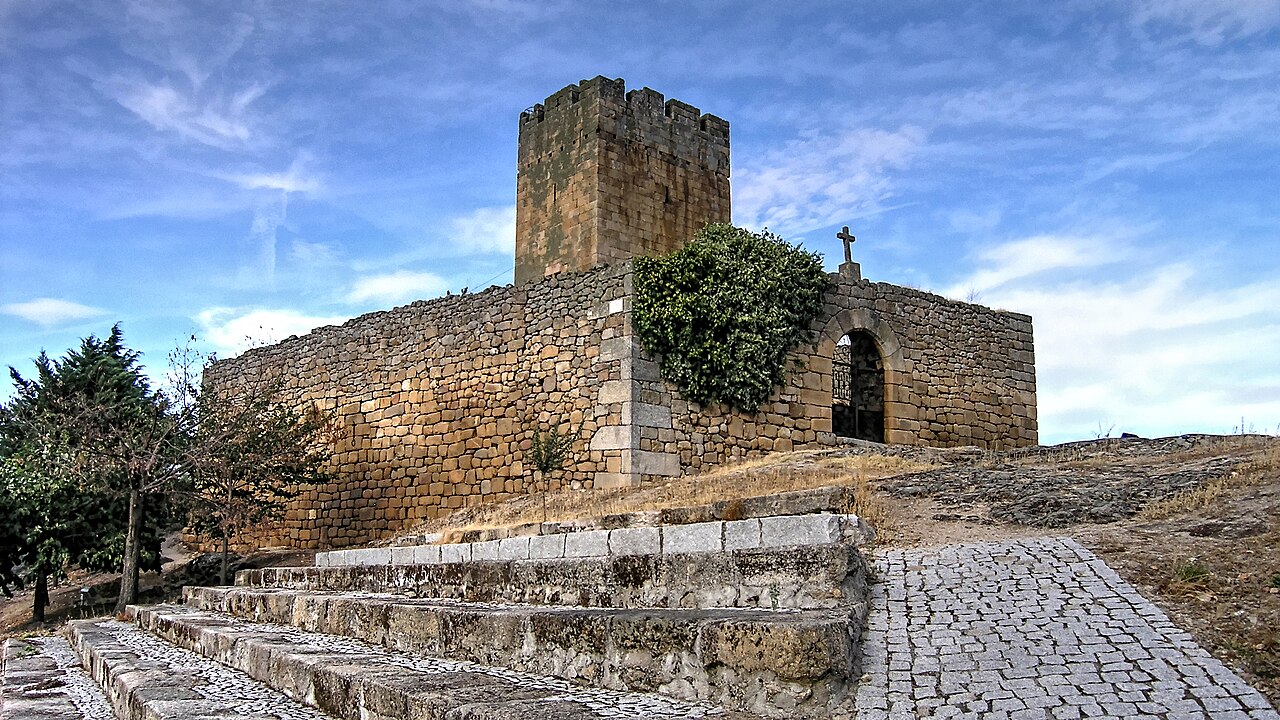
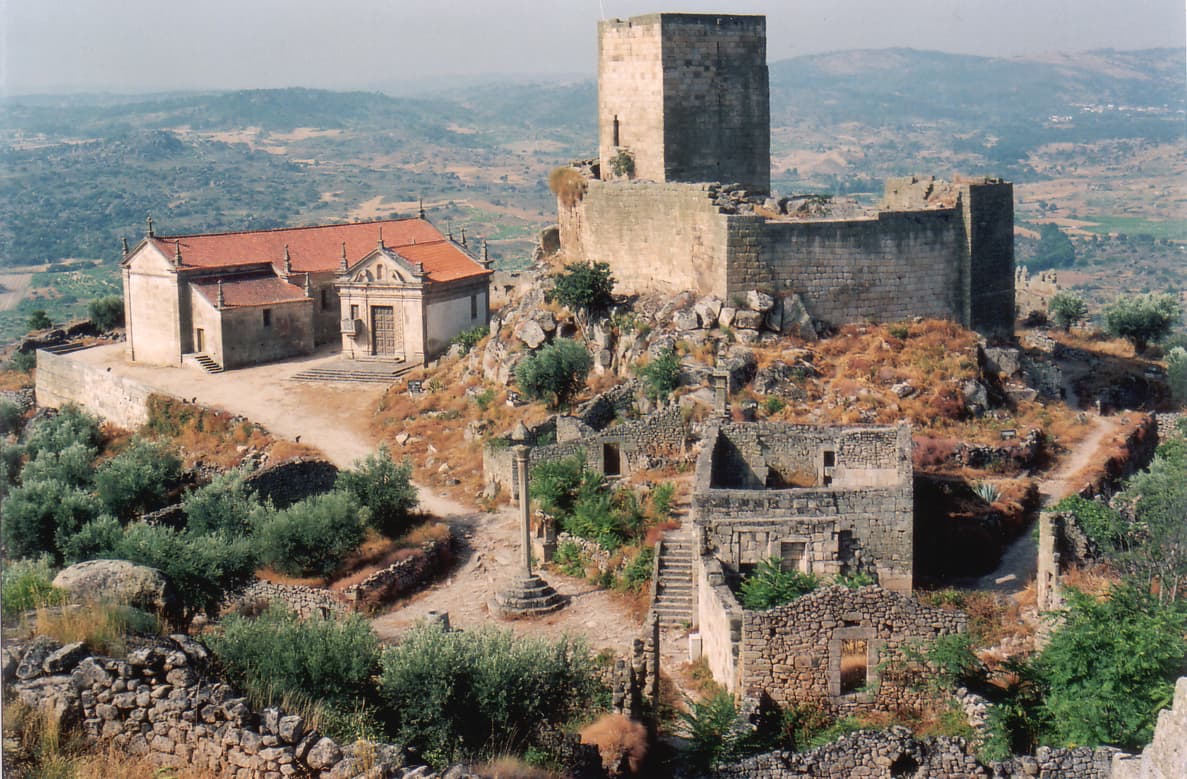
The citadel features a distinctive trapezoidal keep tower dating from the 13th century, crowned with battlements that provided defenders with vantage points for surveillance and archery. This central stronghold is protected by three additional defensive towers and a 16th-century granite wall adapted to the rugged terrain. Two main gates allow access, including one with a characteristic pointed arch, typical of medieval military architecture.
Within the citadel are the remains of a 16th-century brick cistern that supplied water to the garrison, an essential feature for withstanding sieges. The keep's robust construction and elevated position underscore its role as the last line of defense and command center.
The walled town
The civilian enclosure is defined by an oval-shaped granite wall punctuated by four main gates: Porta do Anjo da Guarda with its pointed arch and barrel vault; Porta do Monte or Forca, notable for its combination of pointed and rounded arches; Porta de Santa Maria with a round arch; and a smaller postern gate. These gates were integral to controlling access and facilitating trade and communication.
Defensive strength was further enhanced by three quadrangular towers from the 14th century. The Torre do Relógio stands three stories tall, distinguished by its unique pentagonal battlements and multiple entrances. The Torre dos Namorados, also called Torre da Relação, contains a circular well-cistern within its structure, highlighting the integration of water management into the fortifications. The Torre do Monte survives only as a ruin but was once part of this defensive network.
The streets within the walled town are paved with granite cobbles arranged in decorative patterns, reflecting the settlement's medieval urban character. Ruins of dwellings, public buildings, and administrative structures such as the Town Hall, Court, and Jail—likely dating from the 17th century—are found within the enclosure. This two-story rectangular building features a bell tower, external staircase, and a carved Portuguese coat of arms, demonstrating the civic importance of the site.
Religious and civic buildings
Two churches stand on a flat platform inside the castle walls, representing different architectural styles and historical periods. The Igreja da Misericórdia, also known as Senhor dos Passos, dates from the 17th century and exhibits Mannerist features with a simple rectangular plan and a portal crowned by a pediment with decorative scrolls. Its interior houses a richly gilded and polychrome altarpiece from the 18th century.
The Igreja de Santiago, constructed in 1585, blends Manueline and Baroque styles. It consists of a single nave with a barrel vault and a fully gilded chancel. The façade is marked by a rounded arched portal framed by archivolts resting on slender columns, reflecting the ornate aesthetic of the period.
A Manueline-style pillory from the 16th century stands near the administrative buildings, symbolizing local justice. This stone monument rests on an octagonal stepped base and is topped by an octagonal pyramid with iron reinforcements, underscoring its ceremonial importance.
Later history and preservation
In the Portuguese Restoration War (1640–1668), the castle was further fortified with a bastion to strengthen its defenses against Spanish forces. The village was elevated to a marquisate by King Afonso VI in recognition of military achievements by António Luís de Meneses.
However, the 18th century brought decline due to political scandals such as the Távora affair in 1758, which led to population decline and abandonment of the castle settlement in favor of areas outside the walls. Despite this, the castle retained symbolic significance and became a focus of heritage conservation in the 20th century.
Designated a National Monument in 1978, Marialva Castle has undergone restoration efforts since 1986, coordinated by Portuguese heritage authorities and the local municipality. Management of the site was transferred to the Mêda City Council in October 2023, ensuring continued preservation and public access.
Visiting marialva castle today
Today, Marialva Castle is open to visitors, offering a unique opportunity to explore a well-preserved medieval fortress and the ruins of its historic walled town. Visitors can walk along the ancient granite streets, explore the defensive towers and gates, and appreciate the layered history visible in the architecture and ruins. The castle’s elevated position provides stunning views over the Côa valley and surrounding landscapes.
Admission requires a small fee, and the site is suitable for those interested in medieval military architecture, Portuguese history, and cultural heritage. The castle’s combination of High Medieval fortifications, Renaissance and early modern modifications, and religious and civic buildings make it a rich destination for historical tourism.
Frequently asked questions (FAQ)
- How do I get to Marialva Castle?
- Marialva Castle is located in the Beiras e Serra da Estrela region of Portugal, accessible by car via local roads leading to Largo do Côro. The castle is situated on a hill above the village of Marialva, with parking available nearby.
- What is the historical significance of Marialva Castle?
- Marialva Castle has a rich history dating back to the Iron Age, with layers of Roman, Visigothic, Moorish, and medieval Portuguese occupation. It played a key role in border defense and was part of a chain of fortified towns securing Portugal's frontier with León and Castile.
- When was Marialva Castle built and who built it?
- The current stone castle was primarily constructed during the High Medieval period, beginning in the 11th century. It was expanded and rebuilt under Kings Sancho I and Denis in the 12th and 13th centuries.
- Can I visit the interior of Marialva Castle?
- Yes, visitors can explore the castle's interior ruins, including the keep, defensive towers, gates, and the remains of houses and churches within the walls. Walking paths allow access to many parts of the site.
- Is Marialva Castle suitable for families and children?
- The castle is suitable for families interested in history and outdoor exploration. However, some areas may be uneven or require careful walking, so appropriate footwear is recommended.
- What are the opening hours and ticket prices for Marialva Castle?
- Opening hours and ticket prices can vary seasonally. It is advisable to check with the Mêda City Council or local tourist information before planning your visit.
- Are there other historical sites near Marialva Castle worth visiting?
- Yes, nearby fortified towns such as Guarda, Linhares da Beira, Celorico da Beira, Trancoso, and Longroiva offer additional medieval castles and historic architecture, enriching the cultural itinerary in the Beira region.

Information
Sources & official resources
Verify the information above using these authoritative references.
Loading map...
Visitor reviews
No reviews yet. Been here? Write the first review and help other travelers!
Write the first reviewVisited this castle? Share your experience
Your review helps other travelers and adds first-hand knowledge to our encyclopedia.