Topolcany Castle Ruins
Topolcany Castle Ruins stand as a significant medieval fortress located near the village of Podhradie in Slovakia. Constructed primarily in the late 13th and early 14th centuries, the castle was originally part of the Kingdom of Hungary's strategic defensive network. Its position on a rocky hill of dolomite limestone in the Považský Inovec mountains provided a commanding view of the surrounding territory and control over nearby border areas, making it a vital stronghold in the region.
The castle's origins are often linked to the powerful nobleman Máté Csák, who is credited with its initial construction phase around the beginning of the 14th century. Throughout its history, Topolcany Castle functioned as a royal property and later as a noble estate, overseeing a group of 26 villages. Its ownership changed hands multiple times, with notable families such as the Csák, Széchényi, Országh, Lossonczy, and Forgách dynasties playing key roles in its development and maintenance.
Historical significance and ownership
The castle is first documented in historical records in 1235 as royal property. Over the centuries, it served as the administrative center of a castle estate, reflecting its importance in local governance and military oversight. Contrary to some claims, archaeological evidence confirms that the castle was never occupied by Hussite forces during the early 15th century, despite the turbulent Hussite crusades in the region.
In the 16th century, the Forgách family acquired the castle and undertook significant expansions. These improvements included enhancing the residential quarters and fortifications to adapt to the evolving nature of warfare, particularly with the introduction of firearms. The addition of a forecourt (outer bailey), a southern shooting bastion, and multiple gunports in the walls illustrate the castle's modernization efforts during this period.
The early 18th century brought challenges as the castle suffered damage during the Francis II Rákóczi rebellion. Although partial reconstruction occurred mid-century, the castle gradually declined in importance as administrative functions shifted to nearby settlements. By the late 18th century, the castle was abandoned by its final owners.
Architectural features and style
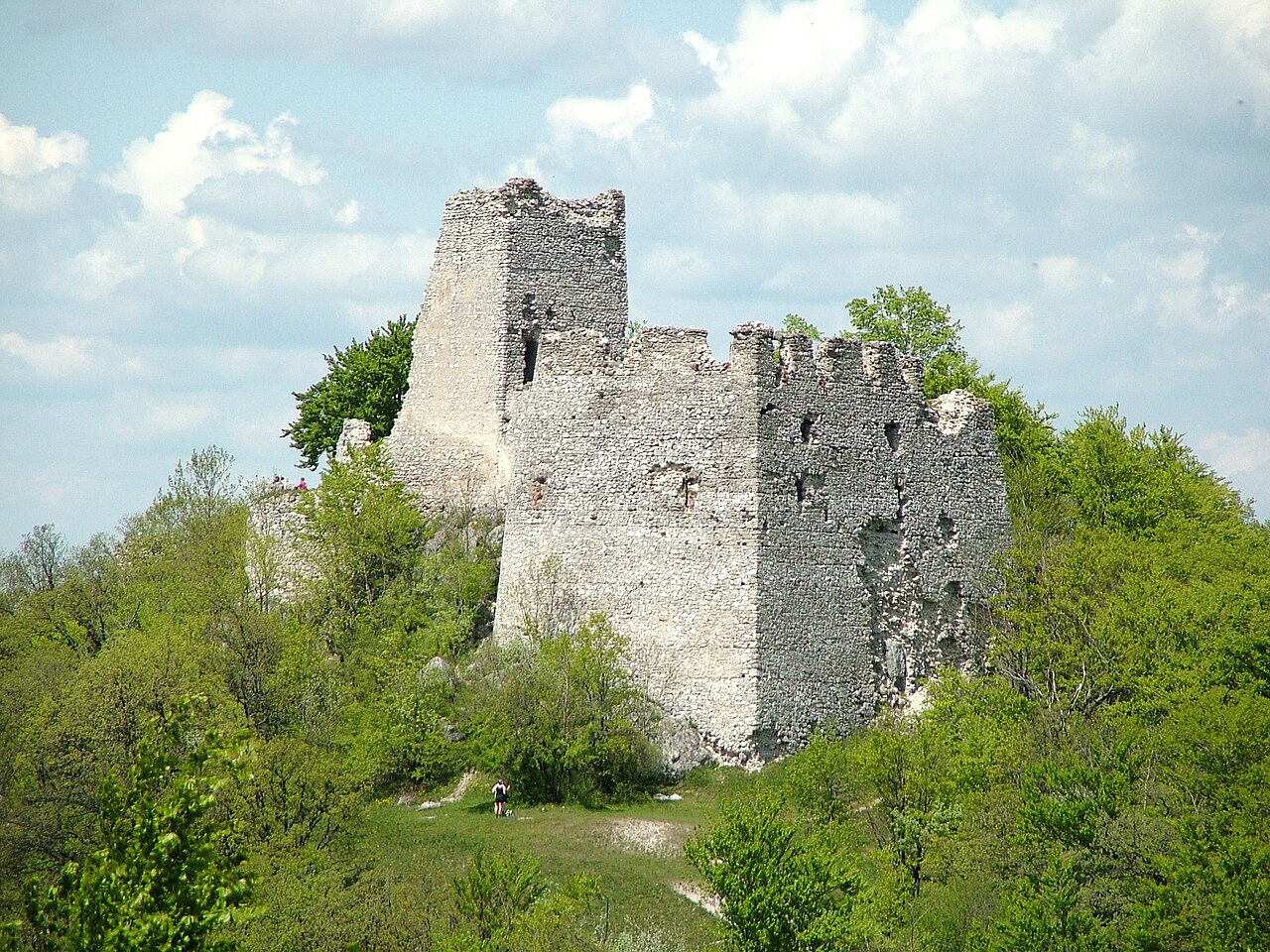
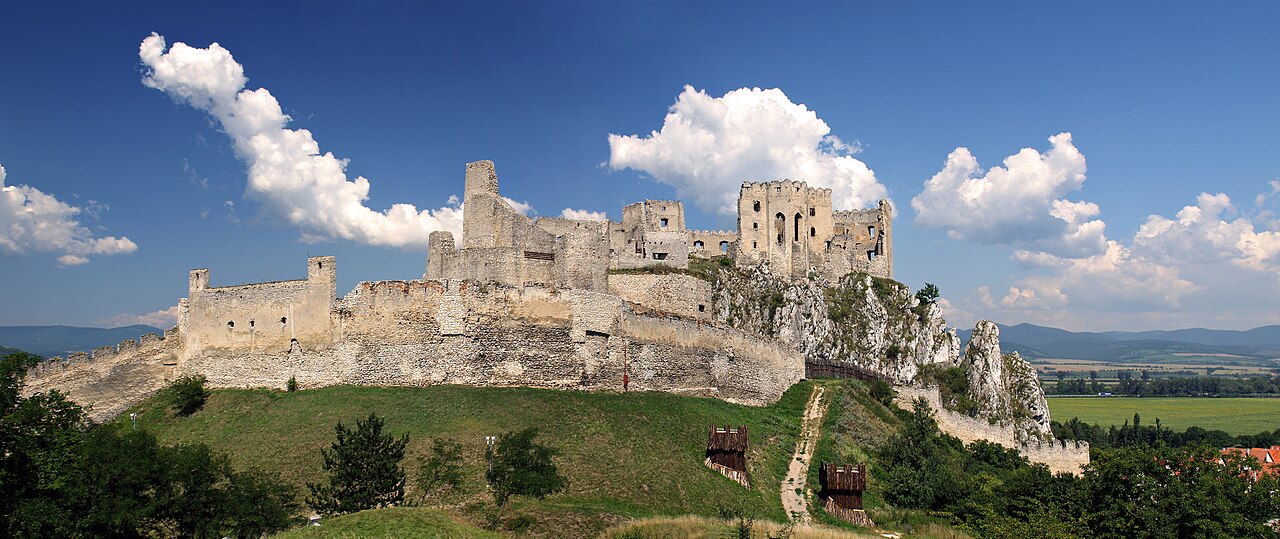
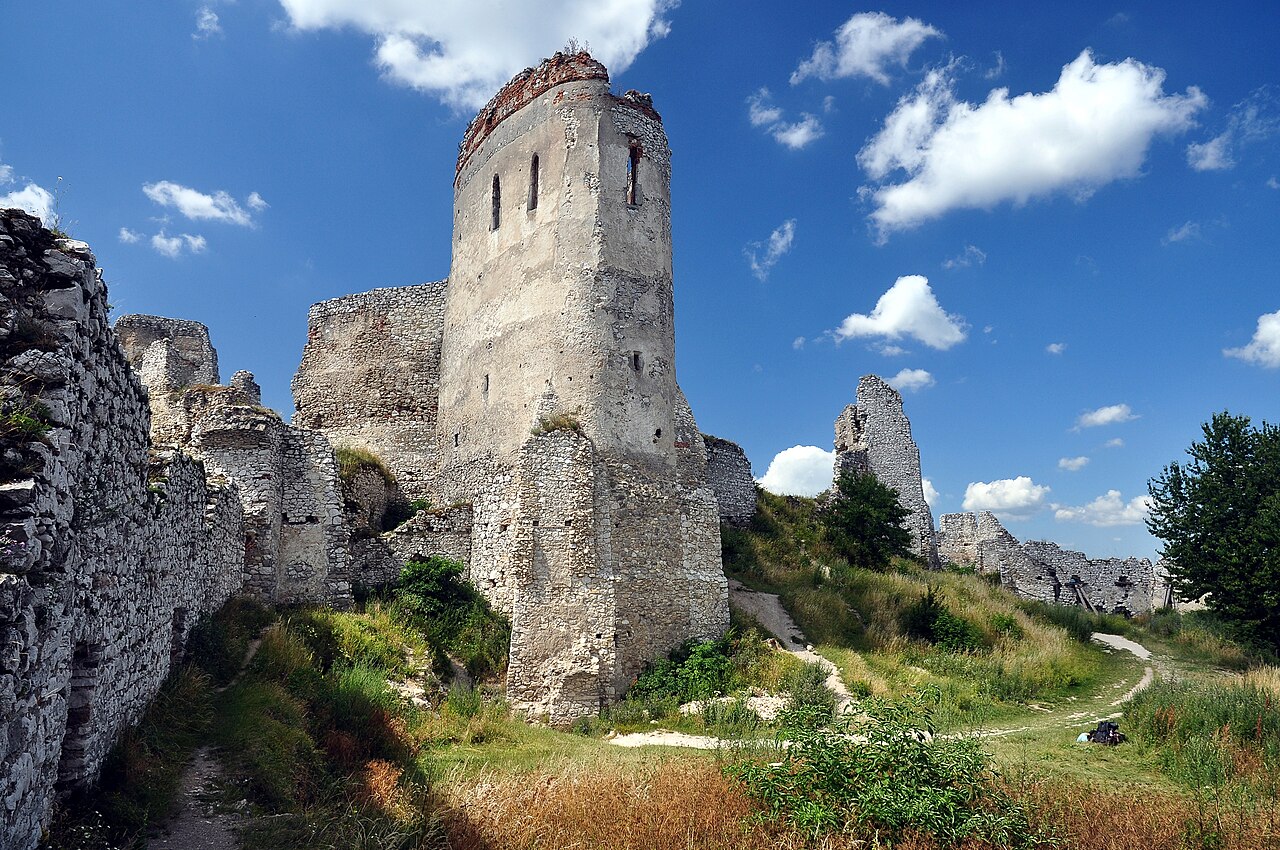
Topolcany Castle is classified as a hill castle, built atop a rocky elevation between approximately 490 and 525 meters above sea level. Its core consists of a Gothic upper castle with a prominent prism-shaped residential tower (keep) that served as both a living space and a defensive stronghold. Surrounding the keep are remnants of a palace and outer defensive walls featuring a gateway, which together formed the castle's primary layout.
The castle's construction utilized locally quarried dolomite limestone, a durable material well-suited for fortification purposes. Defensive upgrades in the 16th century reflect a transition in military architecture, incorporating adaptations for firearms and gunpowder weaponry.
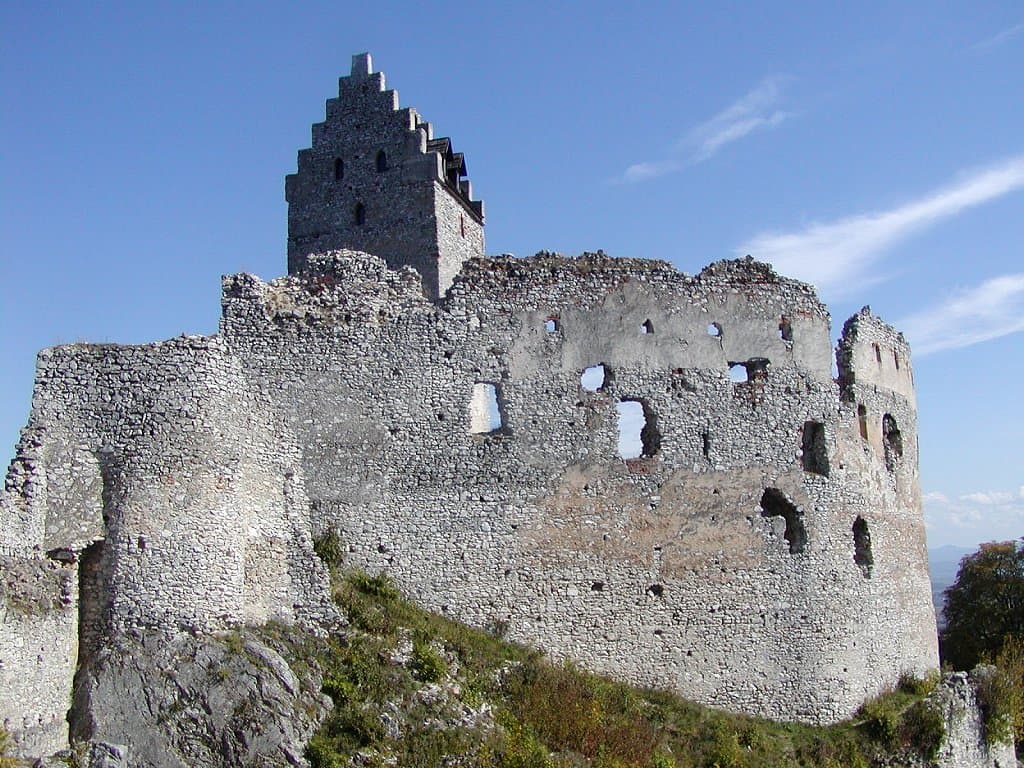
In the late 19th century, the castle underwent a Romantic-style restoration under the ownership of the Stummer family. These restorations included aesthetic modifications such as the addition of stepped gable decorations to the main tower, which enhanced its visual appeal but diverged from the original medieval design.
Defensive elements
The castle's defenses were bolstered by a rock-cut moat carved into the natural stone, which restricted access and enhanced security. The outer bailey and shooting bastion provided additional layers of protection, reflecting the castle's strategic military role. The integration of gunports in the walls during the 16th century marks a significant adaptation to the changing nature of warfare.
Religious and cultural aspects
Within the castle complex stood a chapel dedicated to the Assumption of Mary. This chapel served as a place of worship for the castle's inhabitants and the local community, remaining active until the late 18th century. Its presence highlights the integration of spiritual life within the fortress, a common feature of medieval castles.
Decline and preservation efforts
Following its abandonment in the late 18th century, the castle fell into disrepair. The Rákóczi uprising inflicted considerable damage, and although some reconstruction was attempted, the castle's strategic and administrative importance waned. The 19th-century romantic restorations by the Stummer family sought to preserve and beautify the ruins, reflecting a broader European trend of medieval revivalism.
In June 1999, a severe storm caused part of the palace's eastern wing to collapse, underscoring the vulnerability of the ruins. Since then, restoration and conservation efforts have been ongoing to stabilize and preserve the site. Today, visitors can explore the well-preserved main tower, sections of the defensive walls, and the atmospheric ruins that evoke the castle's rich history.
Visiting topolcany castle ruins
The ruins are accessible to the public and offer a fascinating glimpse into medieval military architecture and noble life. The elevated position provides scenic views of the surrounding landscape, making it a popular destination for history enthusiasts and hikers alike. Preservation efforts continue to ensure that this cultural heritage site remains a testament to Slovakia's medieval past.
Frequently asked questions (FAQ)
- How do I get to Topolcany Castle Ruins?
- Topolcany Castle Ruins are located near the village of Podhradie, close to the town of Topoľčany in Slovakia. Visitors can reach the site by car or local transport, followed by a hike up the hill where the castle stands.
- What is the historical significance of Topolcany Castle?
- Topolcany Castle served as a royal and noble fortress from the 13th century, overseeing local villages and adapting to military changes over centuries. It played a key role in regional defense and administration.
- When was Topolcany Castle built?
- The castle was constructed in the late 13th or early 14th century, with its first historical mention in 1235 as royal property.
- Can I visit the main tower of Topolcany Castle?
- Yes, the main tower is one of the best-preserved parts of the castle and is accessible to visitors, offering views of the surrounding countryside.
- Why is the castle partially restored?
- The castle has undergone various restoration phases, especially in the 19th century and since 1999 after storm damage, but much of the complex remains in ruins due to its age and historical events.
Photo gallery

Photo by Martin Hlauka (Pescan) 16:22, 7 February 2008 (UTC)•Attribution
Information
Website
Visit websiteSources & official resources
Verify the information above using these authoritative references.
Loading map...
Visitor reviews
No reviews yet. Been here? Write the first review and help other travelers!
Write the first reviewVisited this castle? Share your experience
Your review helps other travelers and adds first-hand knowledge to our encyclopedia.