Tonbridge Castle
Tonbridge Castle stands as a significant example of Norman military architecture in England, located in the historic market town of Tonbridge, Kent. Established shortly after the Norman Conquest of 1066, the castle was initially constructed by Richard FitzGilbert, a close relative of William the Conqueror, to secure a strategic crossing over the River Medway. Its original form was a classic motte-and-bailey design, featuring a large earthen mound (motte) topped by wooden fortifications, surrounded by a protective bailey enclosed with timber defenses.
The castle’s early history is marked by its role in the turbulent politics of Norman England. In 1088, Richard’s son, Gilbert de Clare, became embroiled in a rebellion against King William II, leading to a siege of Tonbridge Castle by royal forces. Despite the nearby settlement being set ablaze and Gilbert’s capture, the castle itself remained under the control of the de Clare family, a powerful noble lineage that influenced its development for centuries.
Medieval transformations and feudal conflicts
Throughout the 12th and 13th centuries, Tonbridge Castle was a focal point of feudal disputes, particularly involving the Archbishop of Canterbury and various baronial factions. The castle’s strategic importance was underscored during the First Barons’ War (1215–1217) and the Second Barons’ War (1260s), when control of the fortress frequently shifted between royalist and rebel forces.
In 1259, under the reign of King Henry III, the castle underwent significant stone reconstruction authorized by Richard de Clare, 5th Earl of Hertford. This phase replaced the original timber defenses with robust stone curtain walls and towers, many of which survive today. The transformation reflected evolving military architecture trends, emphasizing stronger, more durable fortifications to withstand sieges and artillery.
Architectural features and layout
The castle’s defining feature is its imposing motte, a large circular mound approximately 20 meters high with a summit measuring 20 by 24 meters. This elevated position provided commanding views over the surrounding landscape and the vital river crossing below. Originally encircled by a deep defensive ditch, the motte was topped by a stone shell keep constructed in the 12th century, replacing earlier wooden structures. Excavations in 1912 uncovered foundations of domestic buildings and a well within the shell keep enclosure, indicating its use as a secure residential and administrative center.
Adjoining the motte is a semicircular bailey, once protected by timber palisades that were later replaced with a thick stone curtain wall up to three meters wide. This wall was reinforced by multiple towers, including two corner towers and an additional tower along its length, enhancing the castle’s defensive capabilities. Portions of these walls remain visible today, particularly near the gatehouse and along the side facing the River Medway.
The gatehouse: a masterpiece of medieval military architecture
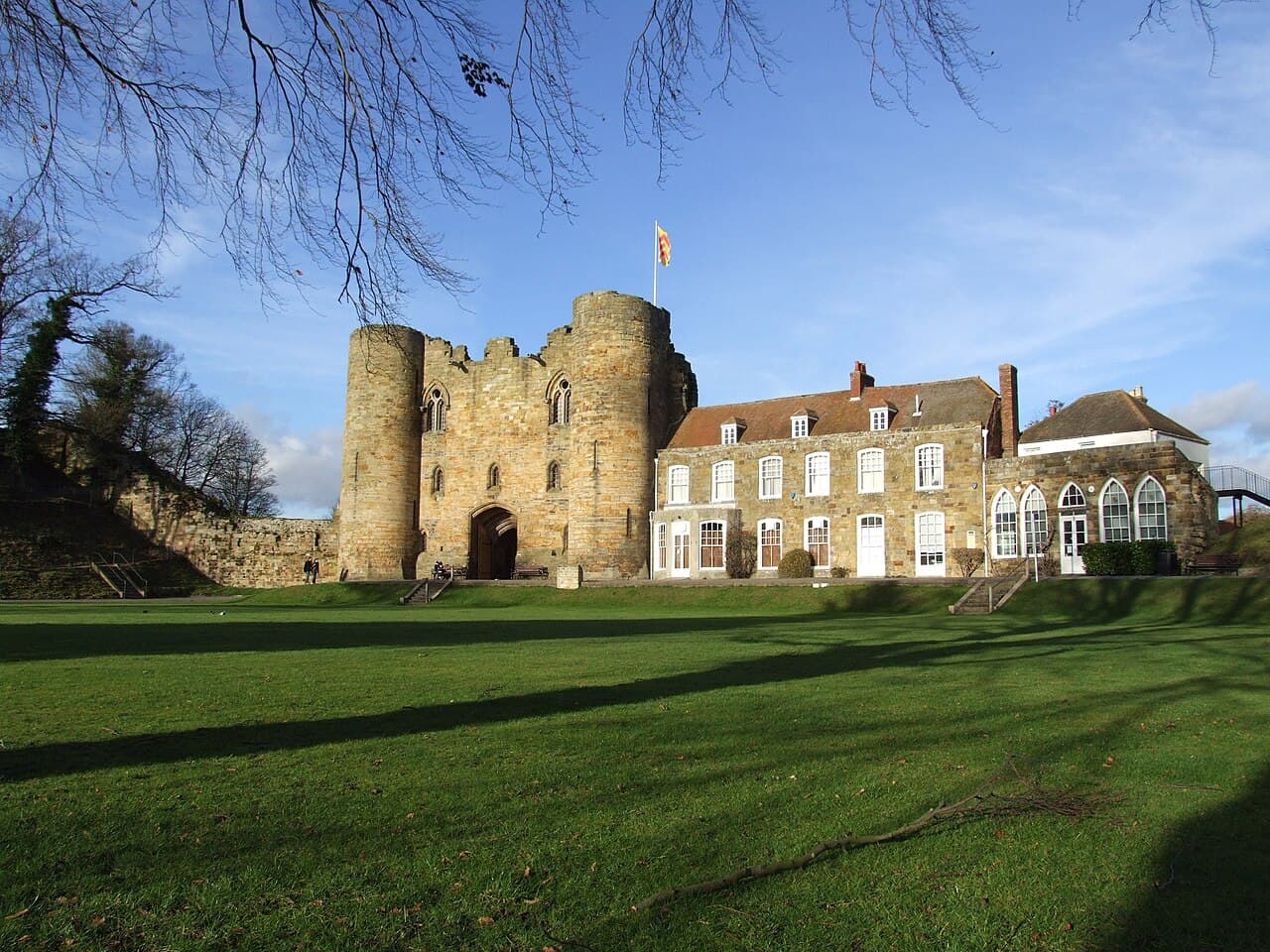
One of Tonbridge Castle’s most remarkable features is its massive gatehouse, built between 1230 and 1260 using sandstone blocks. This fortified entrance replaced an earlier gateway and was designed as a formidable barrier against attackers. The gatehouse includes a long square passage flanked by four semicircular towers, equipped with a drawbridge, two sets of heavy gates, dual portcullises, and murder holes for dropping projectiles on enemies below.
The gatehouse’s upper floors housed living quarters and a great hall illuminated by two pointed-arch windows with decorative stone tracery. Its basement contained a prison cell, while round stair turrets provided access to multiple levels. This gatehouse is recognized as one of the largest and most sophisticated medieval gatehouses in England and served as an architectural model for the later Caerphilly Castle in Wales.
Later history and preservation
Ownership of Tonbridge Castle passed through several noble families, including the de Clares, Audleys, and Staffords. Following the execution of Edward Stafford, 3rd Duke of Buckingham in 1521, the castle reverted to the Crown. Over subsequent centuries, the castle declined in military importance and suffered neglect, with parts dismantled and stones repurposed for local buildings during the 17th and 18th centuries.
During the English Civil War in the mid-17th century, the castle was repaired and fortified by Thomas Weller for the Parliamentarian side. However, after 1646, it was deliberately slighted to prevent further military use. In the 20th century, Tonbridge Castle entered public ownership and underwent multiple restoration campaigns, notably in the 1950s, late 1980s, and early 2000s, which stabilized and partially rebuilt key structures.
During World War II, additional defensive features such as pillboxes and machine gun emplacements were installed on the site to counter the threat of invasion, highlighting the castle’s continued strategic relevance across centuries.
Modern use and visitor experience
Today, Tonbridge Castle is managed by the local council and serves as a heritage site and community venue. The castle grounds include a museum dedicated to its rich history, offering educational displays and artifacts that illuminate its Norman origins and medieval evolution. The restored gatehouse hosts lectures, banquets, and events, allowing visitors to experience the grandeur of medieval architecture firsthand.
The castle’s Georgian-era residential building, adjoining the gatehouse, adds to the site’s architectural diversity. This two-story, L-shaped structure features a brick hipped roof and stone extensions, incorporating reused medieval stonework visible on its courtyard-facing facade.
While little remains of the original keep, demolished by the late 18th century, the surviving earthworks, stone walls, and gatehouse provide a vivid impression of Tonbridge Castle’s historical significance and architectural grandeur.
Architectural significance and legacy
Tonbridge Castle exemplifies the evolution of medieval fortifications from early wooden motte-and-bailey designs to sophisticated stone castles. Its massive stone curtain walls, imposing shell keep, and formidable gatehouse reflect advances in military architecture during the 12th and 13th centuries. The castle’s design influenced later fortresses, notably serving as a model for the gatehouse at Caerphilly Castle.
The site’s preservation and restoration efforts have ensured that Tonbridge Castle remains a key cultural landmark in Kent, offering valuable insights into Norman conquest strategies, feudal conflicts, and medieval castle construction techniques. Its setting overlooking the River Medway continues to highlight its original strategic purpose as a defensive stronghold controlling vital transport routes.
Frequently asked questions (FAQ)
- How do I get to Tonbridge Castle?
- Tonbridge Castle is located in the town center of Tonbridge, Kent, easily accessible by car and public transport. The nearest train station is Tonbridge railway station, about a 10-minute walk from the castle.
- What are the opening hours for Tonbridge Castle?
- The castle is open daily from 10:00 to 16:00, allowing visitors ample time to explore the grounds and museum.
- Is there an admission fee to visit Tonbridge Castle?
- Admission to Tonbridge Castle is free, making it accessible for all visitors interested in exploring its historic features.
- What architectural style is Tonbridge Castle built in?
- Tonbridge Castle showcases a mix of architectural styles, primarily Norman motte-and-bailey design with later medieval stone fortifications and Georgian additions.
- Can I visit the gatehouse and museum at Tonbridge Castle?
- Yes, the restored gatehouse and the on-site museum are open to visitors, offering insights into the castle’s history and medieval life.
- Why is Tonbridge Castle historically significant?
- Tonbridge Castle is historically significant as one of the earliest Norman fortresses in England, playing a key role in regional defense and feudal conflicts during the medieval period.
Photo gallery

Information
Opening hours
10:00-16:00, daily
Ticket prices
Free
Current owner
Tonbridge and Malling Borough Council
Website
Visit websiteSources & official resources
Verify the information above using these authoritative references.
Loading map...
Visitor reviews
No reviews yet. Been here? Write the first review and help other travelers!
Write the first reviewVisited this castle? Share your experience
Your review helps other travelers and adds first-hand knowledge to our encyclopedia.