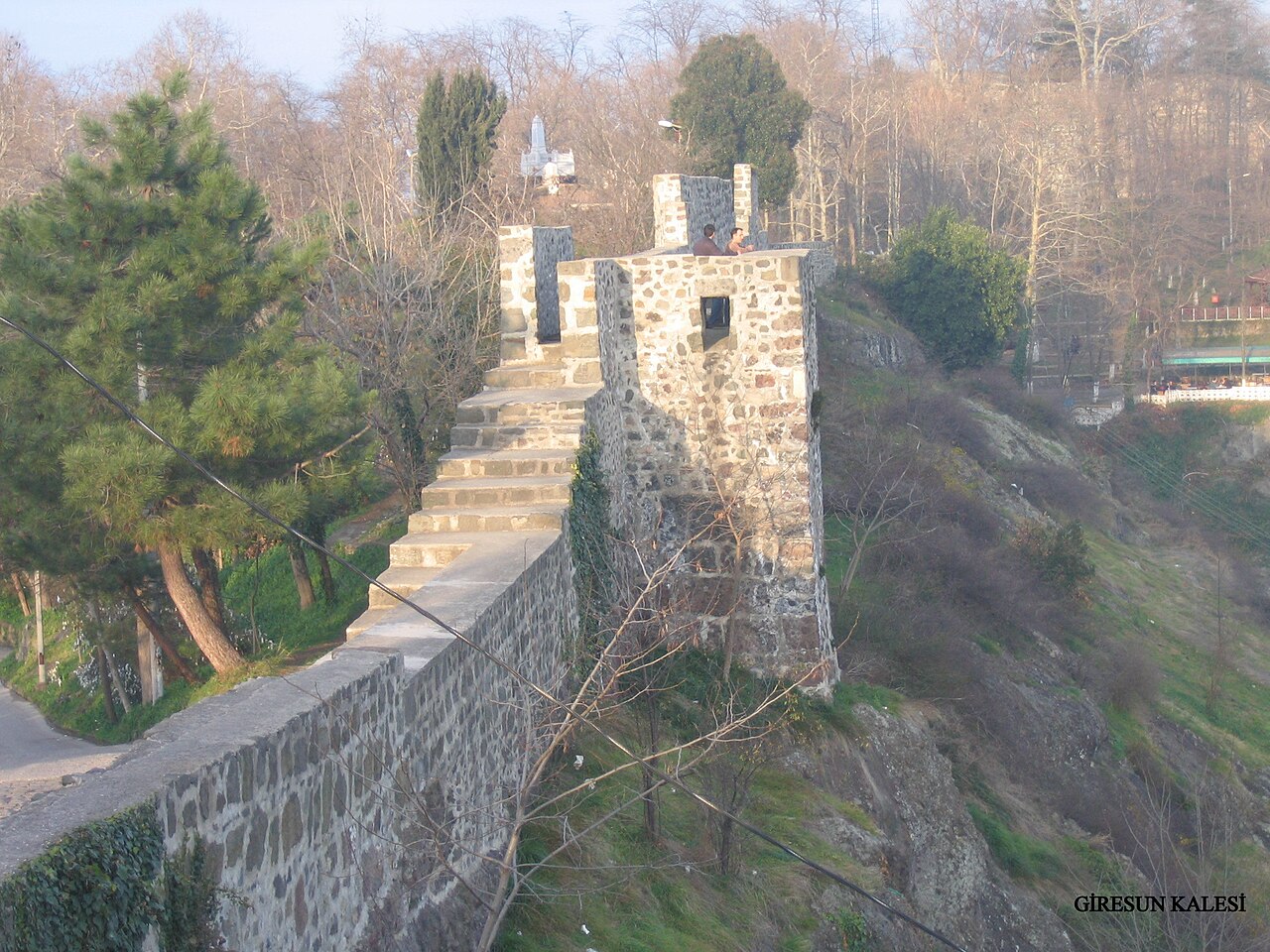
Tirebolu Castle
Tirebolu Castle, locally known as Tirebolu Kalesi, is a historic fortress located in the town of Tirebolu, in the province of Giresun, along the Black Sea coast of northeastern Turkey. The castle occupies a strategically important position on a small promontory extending into the sea, which played a key role in controlling maritime routes and coastal defense throughout its history.
The site of Tirebolu Castle is deeply rooted in antiquity. The town itself was known as Tripoli during the Byzantine period, a name derived from its geographical setting between three small promontories along the coastline. The castle was initially constructed by the Byzantines on the middle promontory, which is a small island about 25 meters high, connected to the mainland by a narrow isthmus. This location offered natural defensive advantages, with steep cliffs protecting most sides and a limited land approach.
Historical background and strategic importance
The origins of Tirebolu Castle likely date back to the Byzantine era, with some indications that a Roman fortification may have existed on or near the site before the Byzantine construction. The castle was an essential part of the defensive network protecting the Black Sea coast from naval threats and controlling local trade routes.
In 1204, following the Fourth Crusade and the fragmentation of the Byzantine Empire, Tirebolu became part of the Empire of Trebizond. This successor state maintained and reinforced the castle as a coastal stronghold. Later, the castle and town fell under the control of the Ottoman Empire, who referred to the fortress as Kurucu Kale. The Ottomans used the castle to secure their northern coastal borders and to monitor maritime activity.
Architectural features and castle layout
The present remains of Tirebolu Castle primarily consist of the inner castle situated on the middle promontory. Historically, the castle complex included an outer castle formed by defensive walls extending on the landward side of the isthmus, but these outer fortifications have not survived to the present day.
The inner castle is characterized by its robust stone walls built to withstand both land and sea attacks. On the western end of the castle, there is a lower-level bastion equipped with cannon ports, which was likely added during the 19th century as part of Ottoman efforts to modernize the fortress's defenses. This bastion reflects the adaptation of the castle to gunpowder artillery warfare.
Within the castle grounds, there once stood a small church, which was probably converted into a mosque following the Ottoman conquest. This religious structure illustrates the cultural and religious transitions that the site underwent over centuries.
Lost structures and nearby fortifications
The Ottomans also fortified the western promontory, known as Çürük Kale (meaning "ruined castle"), but no visible remains of this fortification survive today. The disappearance of these ruins suggests significant destruction or dismantling over time, possibly due to natural erosion or human activity.
Current condition and visitor information
Today, Tirebolu Castle is partially preserved, with the inner castle walls and bastion still standing. The absence of the outer walls limits the understanding of the full extent of the original fortress complex. Despite this, the castle remains an important cultural and historical landmark for the region.
The castle is freely accessible to visitors, offering panoramic views of the Black Sea and the town of Tirebolu. Its location on the promontory provides a unique opportunity to explore a medieval fortress with layers of Byzantine and Ottoman history. Visitors can walk along the surviving walls and examine the cannon bastion, gaining insight into the castle's military evolution.
Architectural significance and cultural heritage
Tirebolu Castle exemplifies the strategic use of natural geography in medieval fortification design. Its position on a narrow isthmus connecting a small island to the mainland demonstrates the tactical advantage of controlling access points. The castle's layered history, from possible Roman origins through Byzantine and Ottoman phases, reflects the complex political and military history of the Black Sea region.
The incorporation of a bastion with cannon ports during the 19th century highlights the transition from medieval to early modern military architecture, adapting to the advent of artillery. The religious transformation of the church into a mosque further indicates the cultural shifts that the fortress witnessed.
As a site open to the public, Tirebolu Castle contributes to the understanding of regional history and architecture. It stands as a testament to the enduring significance of coastal fortifications in Turkey's historical landscape.
Frequently asked questions (FAQ)
- How do I get to Tirebolu Castle?
- Tirebolu Castle is located on Amiral Şükrü Okan Cd. in the town of Tirebolu, Giresun Province. It is accessible by local roads and is within walking distance from the town center.
- What is the historical significance of Tirebolu Castle?
- Tirebolu Castle served as a strategic coastal fortress from the Byzantine period through the Ottoman era, guarding maritime routes and local trade along the Black Sea coast.
- Can I explore the entire castle complex?
- Only the inner castle and a 19th-century bastion remain today. The outer walls have not survived, so the full extent of the original complex is not accessible.
- Is there an entry fee to visit Tirebolu Castle?
- No, the castle is freely accessible to visitors with no entry fee.
- What architectural styles are seen at Tirebolu Castle?
- The castle exhibits a mixed architectural style, with Byzantine medieval masonry and later Ottoman modifications including a 19th-century cannon bastion.
Information
Opening hours
Open daily, freely accessible
Ticket prices
Free
Current owner
Municipality
Address
Amiral Şükrü Okan Cd., Tirebolu, Giresun, Turkey
Loading map...
Visitor reviews
No reviews yet. Been here? Write the first review and help other travelers!
Write the first reviewVisited this castle? Share your experience
Your review helps other travelers and adds first-hand knowledge to our encyclopedia.