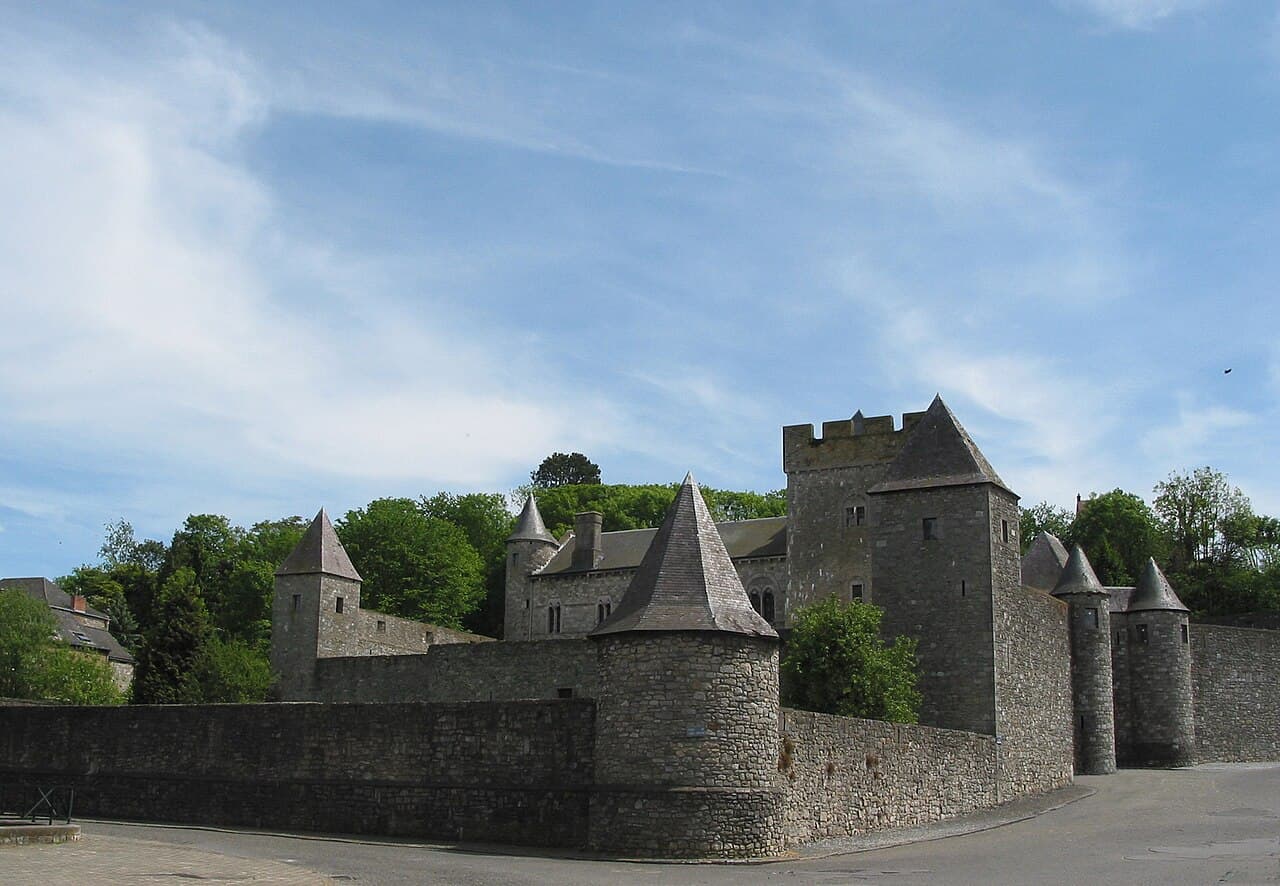
Thy-le-Château Castle — Belgium castle

Thy-le-Château Castle

Thy-le-Château Castle in Namur, Belgium
Walcourt, Belgium
High Medieval (11th–13th c.)
Restored

Thy-le-Château Castle, known locally as Château de Thy-le-Château, is a significant high medieval hill castle situated in the village of Thy-le-Château, within the municipality of Walcourt in the Province of Namur, Wallonia, Belgium. This castle has a rich history dating back to the 12th century, reflecting the turbulent medieval period and the strategic importance of fortifications in the region.

Origins and early history

The castle was first documented at the end of the 12th century when it was owned by Henry IV, Count of Namur, known as 'the Blind'. Local tradition suggests that the castle's foundation is linked to a noble named Jean, who participated in the siege of Tyre during the Crusades in 1124. According to legend, Jean modeled Thy-le-Château Castle on the plans of the city of Tyre, bringing architectural inspiration from the Crusader states back to Belgium. While this story cannot be fully verified, it highlights the castle's early medieval military purpose and its connection to broader European crusading history.

Medieval conflicts and ownership changes

In 1188, the castle was besieged and captured by the forces of Baldwin V, Count of Hainaut. Two years later, in 1190, Baldwin granted the castle to his brother William, known as 'Saint-Sauve'. Over the subsequent centuries, Thy-le-Château Castle passed through the hands of several noble families, including the de Neuville, de Werchin, de Barbençon-Jeumont, de Melun, de Ligne, and de Croÿ families. Each family contributed to the castle's maintenance and modifications, adapting it to evolving defensive needs and residential comforts.

Decline and destruction during the revolutionary period

By 1790, the castle was abandoned and subsequently burned by revolutionaries during the upheavals of the French Revolution. This event marked the beginning of the castle's decline into ruin. Following the revolution, the castle's ruins were acquired in 1830 by the Hanseval family, who repurposed the remains as agricultural buildings, including barns. Later, in 1870, the main building was converted into a brewery, reflecting the adaptive reuse of the site during its period of neglect.

Restoration efforts in the 20th century

In 1910, the castle was purchased by Louis Piret, a local ironmaster with an interest in preserving regional heritage. Beginning in 1920, Piret undertook a comprehensive restoration project aimed at returning the castle to its medieval appearance. This involved removing later additions, conducting archaeological excavations, and using the findings to guide the rebuilding process. The restoration was completed in 1939, successfully reviving the castle's historical character.

World War II damage and post-war reconstruction

Shortly after the restoration, on May 14, 1940, Thy-le-Château Castle suffered severe damage when the German air force bombed a nearby French military convoy, resulting in the castle's destruction. After World War II, Louis Piret resumed restoration efforts, reconstructing the castle once more. The current structure reflects this post-war rebuilding phase, preserving the medieval style while accommodating the damage sustained during the conflict.

Architectural features and style

Thy-le-Château Castle is a classic example of a hill castle typical of the high medieval period. Its strategic location on elevated terrain provided natural defense advantages. The castle's architecture includes robust stone walls, defensive battlements, and a central keep that served as the last refuge during sieges. The restoration efforts aimed to faithfully reproduce these medieval features, emphasizing the castle's military origins while also highlighting its residential elements added over the centuries.

Current status and cultural significance

Today, Thy-le-Château Castle remains private property but is actively used for cultural activities, including exhibitions and events that celebrate the region's heritage. Its location in a quiet village adds to its charm, making it a point of interest for visitors exploring the historical landscape of Namur province. The castle stands as a testament to the region's medieval past, the impact of revolutionary and wartime events, and the dedication to heritage preservation in Belgium.

Visiting Thy-le-Château Castle

While the castle is privately owned, it occasionally opens its doors for cultural events and guided tours. Visitors interested in medieval architecture and Belgian history will find Thy-le-Château Castle a fascinating destination, offering insights into noble life, military architecture, and the complex history of the Wallonia region.

Frequently asked questions (FAQ)

What is the historical significance of Thy-le-Château Castle?
Thy-le-Château Castle is a remarkable example of medieval architecture, with origins dating back to the 12th century. It has played a crucial role in the region's history, serving as a defensive stronghold during various conflicts and showcasing the evolution of military architecture over the centuries.
When was Thy-le-Château Castle built?
The construction of Thy-le-Château Castle began in the 12th century, with significant renovations and expansions occurring in the following centuries. The castle's structure reflects various architectural styles, primarily Romanesque and Gothic, showcasing its long and storied history.
Can I visit Thy-le-Château Castle?
Yes, visitors are welcome to explore Thy-le-Château Castle. Guided tours are available, providing insight into its rich history and architectural features, making it a great destination for history enthusiasts and families alike.
What are the opening hours of Thy-le-Château Castle?
Thy-le-Château Castle is generally open to visitors from Tuesday to Sunday, with specific hours varying by season. It is advisable to check the official website or contact the castle directly for the most current opening times before your visit.
Is it possible to access Thy-le-Château Castle with a wheelchair?
The accessibility of Thy-le-Château Castle may vary, as some areas may be challenging for wheelchair users due to the castle's historic architecture. It is recommended to contact the castle in advance to inquire about specific accessibility options and accommodations.
What is the best time to visit Thy-le-Château Castle?
The best time to visit Thy-le-Château Castle is during the spring and early autumn when the weather is pleasant, and the surrounding landscape is beautiful. Additionally, during these seasons, the castle often hosts various events and activities that enhance the visitor experience.
What are the ticket prices for Thy-le-Château Castle?
Ticket prices for Thy-le-Château Castle vary depending on age and group size, with discounts available for children, seniors, and families. It is advisable to check the official website for the most accurate pricing and any special offers that may be available during your visit.
Are there any nearby attractions to visit?
Yes, Thy-le-Château Castle is located near several attractions, including the charming town of Walcourt and the picturesque landscape of the Sambre Valley. Visitors can also explore other historical sites and natural parks in the area, making it an ideal stop on a broader tour of the region.

Photo gallery

Thy-le-Château Castle
Click to view

Photo by Jean-Pol GRANDMONT•CC BY-SA 3.0

1 photo • Click any image to view in full screen

Information

Hill Castle

Address

Rue Massart, Thy-le-Château, Walcourt, Namur, Belgium

Loading map...

Visitor reviews

No reviews yet. Been here? Write the first review and help other travelers!

Write the first review

Visited this castle? Share your experience

Your review helps other travelers and adds first-hand knowledge to our encyclopedia.
Write a review

(5/5)

0/2000 characters

Your review will be visible after admin approval

Nearby castles

1.7 km
Trazegnies Castle — Belgium castle

Trazegnies Castle

Trazegnies, Belgium

Trazegnies Castle, located in the town of Trazegnies in the province of Hainaut, Belgium, is a remarkable example of a hill castle with a rich history extending back to the 12th century. This castle stands as a testament to the region's medieval heritage and the architectural evolution through the centuries, combining elements from its original defensive purpose with later adaptations into a noble residence. The origins and medieval significance The castle was likely founded in the early 12th century by Gilles I de Trazegnies, a member of the noble House of Trazegnies. This family controlled a powerful and independent seigniory strategically positioned at the crossroads of three important medieval territories: the Duchy of Brabant, the County of Hainaut, and the Prince-Bishopric of Liège. This location made the castle an important military and administrative center during the high medieval period. The earliest surviving part of the castle is the base of the square keep and the lower section of the gatehouse, dating from the 13th century. The castle's medieval fortifications included curtain walls, round corner towers, and a robust defensive layout designed to protect the seigniory and assert the Trazegnies family's influence. The Trazegnies family and their historical role The Trazegnies family was prominent in regional and European affairs. Several members participated in the Crusades, and one notably served as High Constable of France during the reign of King Louis IX. Jean III de Trazegnies was distinguished as a Knight of the Order of the Golden Fleece in 1515 and acted as a proxy groom for Isabella of Portugal on behalf of Charles V, Holy Roman Emperor in 1525. Destruction and reconstruction In 1554, during the Italian War of 1551–1559, the castle suffered significant damage when it was burnt and destroyed by the troops of Henry II of France. This event marked the end of the castle's purely military function. At the end of the 16th century, the castle was rebuilt, transitioning from a fortress to a more comfortable residence. The reconstruction preserved some medieval elements, such as the lower part of the gatehouse, but also introduced new architectural styles. The early 17th century saw the construction of the main residential building in the Louis XIII style, reflecting contemporary tastes and signaling the castle's adaptation to peacetime noble life. Architectural features and layout The castle's layout today reflects its layered history. The medieval gatehouse remains a prominent feature, showcasing Romanesque and Gothic influences in its cellars and foundational structures. These underground spaces provide a rare glimpse into the castle's early construction phases. The 17th-century corps de logis, built by Gillion-Othon de Trazegnies, features a brick and stone façade typical of the Louis XIII style. This contrasts with the older medieval masonry, highlighting the castle's architectural evolution. Historically, the castle included the Beyaert wing, which connected the Louis XII wing to a circular tower. Unfortunately, this wing collapsed in 1920 due to subsidence caused by nearby coal mining activities, leaving the tower isolated from the main structure. Ownership and preservation The castle remained under the Trazegnies family until 1862, when the last marquis of the senior line died. The property then passed to his niece and was eventually sold to the Bascoup coal mining company. The company parceled the estate and sold the castle to private owners. In 1913, the Belgian state acquired the property. By 1926, the castle had fallen into serious disrepair and was at risk of demolition. Thanks to the efforts of architect Marcel Simon and the association "Les Amis du Château de Trazegnies," restoration began to preserve the castle's historic fabric. Despite ongoing challenges such as structural damage from mining subsidence, restoration has continued with support from the Walloon Region. Today, Trazegnies Castle serves cultural purposes, housing communal offices and hosting events. While the castle is privately owned, its grounds are accessible to the public, offering visitors a chance to appreciate its historical and architectural significance. Architectural style and classification The castle is classified as a hill castle, built primarily during the high medieval period. Its architectural style is a blend of medieval Romanesque and Gothic elements, combined with early modern Louis XIII style features from the 17th-century reconstruction. This mixture reflects the castle's evolution from a fortified stronghold to a noble residence. Visiting information and cultural significance While the castle itself is not fully open to the public due to its use for cultural and administrative functions, the surrounding grounds can be freely explored. Visitors can enjoy the castle's scenic setting and learn about its historical importance in the region. Trazegnies Castle remains a significant heritage site in Belgium, illustrating the complex history of feudal power, military conflict, and architectural transformation over nearly a millennium.

High Medieval (11th–13th c.)
Details
3.4 km

Castle of Tarcienne

Walcourt, Belgium

Castle of Tarcienne is an elegant example of a 17th-century Renaissance château situated on a gentle hilltop in the western part of the village of Tarcienne, within the municipality of Walcourt in the Namur region of Belgium. Built in 1674, the castle was commissioned by Charles-Ignace de Colins, a nobleman who desired a residence reflecting the grandeur and refinement of the Louis XIV style, which was influential across Europe during this period. Architectural style and features The Louis XIV style of the castle is characterized by its balanced and symmetrical design, classical proportions, and attention to ornamental detail, which were hallmarks of the Renaissance architectural movement transitioning into the Baroque period. The castle's placement on a slight hilltop not only provided a strategic vantage point but also enhanced its visual prominence in the surrounding landscape. The structure typically features masonry walls of local stone, large windows arranged symmetrically to maximize light, and a formal entrance that would have originally been accentuated by decorative elements such as pilasters and pediments. While detailed interior descriptions are limited due to its private ownership, such castles often included grand halls, private chambers, and service quarters arranged around a central courtyard or garden. Historical context and ownership Constructed during the Renaissance period in the late 17th century, the castle reflects the social and cultural aspirations of the Belgian nobility under the influence of French royal tastes. Charles-Ignace de Colins, the original owner, was part of the local aristocracy who sought to express their status through impressive residences rather than purely defensive fortifications, marking a shift in castle architecture from military to residential purposes. In modern times, the castle remains privately owned by Eric Rosens, who has undertaken efforts to restore the building to its former glory. Restoration work on such historic properties is often meticulous, aiming to preserve original materials and architectural details while adapting the structure for contemporary use. Current condition and accessibility Today, the Castle of Tarcienne is not open to the public, as it is a private residence undergoing restoration. The restoration aims to recover the castle's historical aesthetics and structural integrity, ensuring that this example of Renaissance architecture endures for future generations. Visitors interested in Belgian castles can admire the castle's exterior from nearby public areas, appreciating its hilltop setting and architectural silhouette against the landscape. Significance within the region Located in the Namur region, the castle is part of Belgium's rich heritage of aristocratic residences that illustrate the evolution of castle design from medieval fortresses to elegant country estates. Its Louis XIV style architecture contributes to understanding the cultural exchange between France and the Southern Netherlands during the 17th century. Though less famous than some larger Belgian castles, the Castle of Tarcienne exemplifies the regional nobility's lifestyle and architectural preferences during a transformative era in European history. Visiting information and nearby attractions As the castle is privately owned and undergoing restoration, it is not accessible for tours or public visits. However, the nearby town of Walcourt offers visitors a glimpse into the area's history, including its notable Basilica of Saint-Materne and other heritage sites. Exploring the surrounding Namur countryside provides an enriching experience of Belgium's historical landscape.

Renaissance (15th–17th c.)
Details
5 km

Ham-sur-Heure Castle

Ham-sur-Heure-Nalinnes, Belgium

Ham-sur-Heure Castle, locally known as Château de Ham-sur-Heure, is a prominent historic hill castle located in the town of Ham-sur-Heure-Nalinnes, in the province of Hainaut, within the Wallonia region of Belgium. This castle is a significant example of noble residences that evolved through the High Medieval period into an elegant aristocratic estate, reflecting centuries of architectural and historical development. The earliest documented mention of the castle dates back to the 13th century, although its origins may precede this period. Initially, the castle was under the ownership of various noble families, including the Condé family through marriage, as well as the Béthune, Gui de Dampierre, Luxembourg, and Fosseux families. By the 15th century, the castle was held by the d'Enghien family before passing to the influential House of Mérode in 1487, who would maintain control for several centuries and significantly shape its architecture and status. Medieval origins and early ownership The castle's medieval heritage is deeply rooted in the feudal history of the region. Its strategic position as a hill castle allowed it to serve defensive and administrative functions. The initial fortifications likely consisted of a keep and basic defensive walls, typical of high medieval military architecture. The castle was first recorded in documents when Isabeau de Morialmé was identified as its owner, indicating its importance in local noble affairs. Throughout the 13th and 14th centuries, Ham-sur-Heure Castle changed hands multiple times among prominent noble families, reflecting the complex dynastic ties and political alliances of the era. The castle's ownership by the Condé family in 1209 and 1259, and later by the Lords of Enghien in 1441, underscores its role as a valuable feudal asset. Renaissance expansions and imperial visit The castle underwent significant enlargement and strengthening in the 16th century, particularly around the time of the visit by Charles V, Holy Roman Emperor, in 1540. This imperial visit likely prompted enhancements to the castle's defenses and residential quarters, incorporating Renaissance architectural influences while maintaining its medieval fortification features. Sieges and destruction in the 17th century The turbulent 17th century brought military conflict to Ham-sur-Heure Castle. In 1667, under the command of Ferdinand de Merode, the castle endured a failed siege by French armies during which the castle's keep was destroyed. This event marked a significant blow to the castle's defensive capabilities. Between 1669 and 1671, a protective rubble wall was constructed to reinforce the castle's defenses. Despite these efforts, the castle faced another siege in 1689 by French forces. Despite strong resistance from a Spanish garrison, the castle was forced to surrender under Albert Maximilian de Merode, leading to partial destruction and further damage to its fortifications. Transformation into a luxurious residence Following the military conflicts, the castle's role shifted from a fortress to a noble residence. In the early 18th century, Joseph de Merode transformed the old fortress into a luxurious residence, reflecting the architectural tastes of the period. This transformation included the addition of elegant living quarters, refined facades, and landscaped surroundings. Between 1776 and 1779, Balthazar-Philippe, the last Count de Merode-Deynse, initiated further rebuilding efforts. However, these were left incomplete as he relocated to Vienna during the upheavals of the French Revolution. Consequently, the castle remained uninhabited and fell into a state of neglect for approximately 70 years. 19th-century restoration and modern use At the end of the 19th century, the castle underwent extensive restoration under the patronage of Louise de Rochechouart Mortemart and her daughter, Renée Victurienne de Merode, wife of Charles-Jean d'Oultremont. This restoration, directed by architect Pierre Langerock from Leuven, lasted over two decades and restored the castle from near ruin to its present appearance. The work cost two million gold francs and included structural repairs, aesthetic enhancements, and modernization of the residence. During World War I, Ham-sur-Heure Castle hosted several distinguished guests, including the son of Wilhelm II, German Emperor. From December 1918 to January 1919, Edward VIII, then Prince of Wales, stayed at the castle while visiting the Australian Army Corps stationed nearby, highlighting the castle's continued strategic and symbolic importance. In 1956, the castle was purchased by the municipality of Ham-sur-Heure and repurposed as the town hall. Following the 1977 municipal reorganization, it became the administrative center for the larger municipality of Ham-sur-Heure-Nalinnes. Today, the castle is well-preserved and maintained, though it is not open to the public for tours, serving primarily administrative functions. Architectural features and setting The castle is constructed primarily of stone and is characterized by its hill castle typology, featuring a central courtyard and a south-facing facade. The rear facades overlook the Eau d’Heure river and surrounding meadows, providing a picturesque rural setting that enhances its historic charm. The architectural style of the castle reflects a blend of High Medieval fortifications and later Renaissance and early modern residential adaptations. The 19th-century restorations introduced elements consistent with the period's tastes, including refined masonry, decorative details, and landscaped parkland surrounding the castle. Despite its long history of sieges and partial destruction, the castle today stands as a testament to the resilience and evolving functions of noble residences in Belgium. It retains key features such as the protective rubble wall added in the 17th century and the layout shaped by centuries of noble occupancy. Park and surroundings The castle is set within a park that enhances its historic ambiance. The grounds provide a tranquil rural landscape that complements the castle's architectural presence. While the castle is not open for public visits, the exterior and park offer scenic views appreciated by locals and visitors alike. Current status and accessibility Ham-sur-Heure Castle is currently owned by the municipality and functions as the town hall for Ham-sur-Heure-Nalinnes. It is well-preserved and maintained but is not accessible to the public for interior tours. Visitors can appreciate its exterior architecture and the surrounding parkland from public areas.

High Medieval (11th–13th c.)
Details
