Thurant Castle
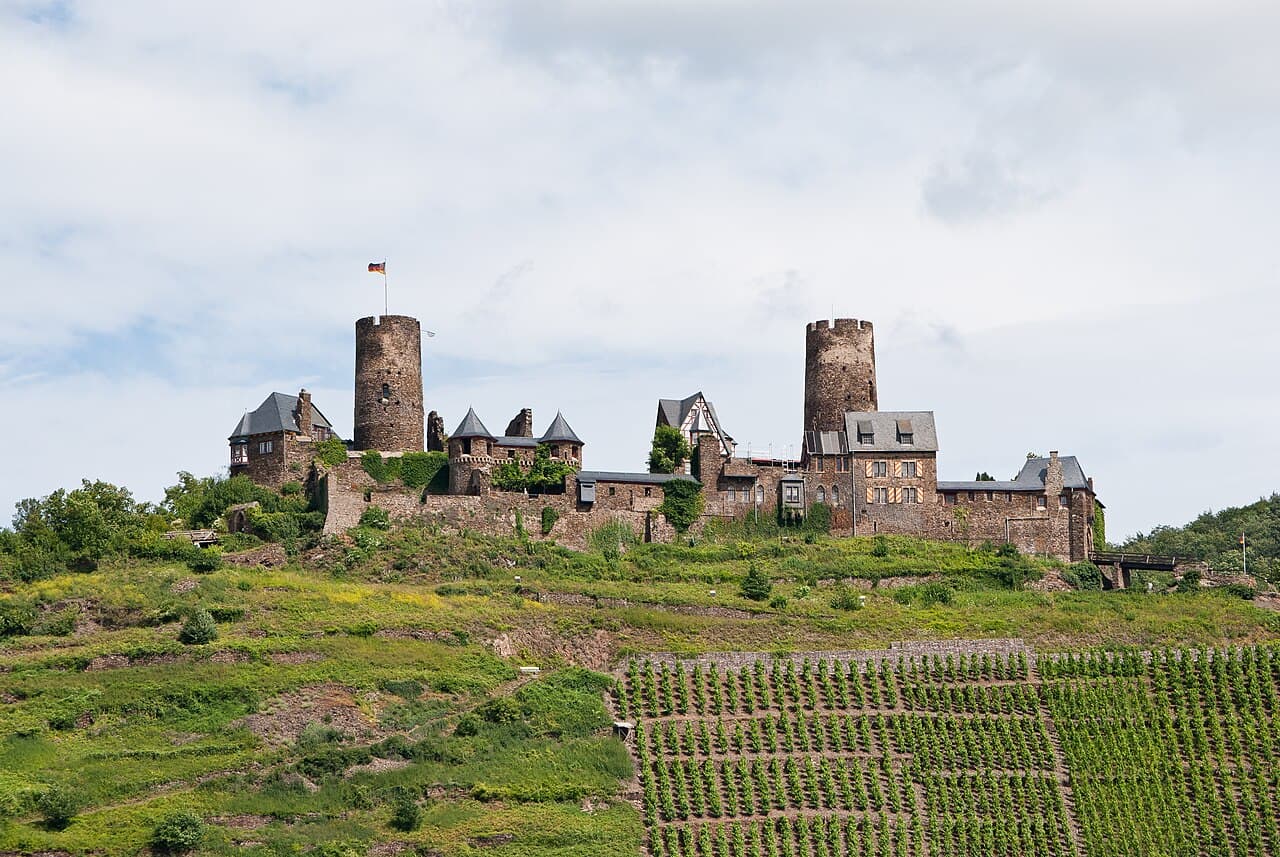
Thurant Castle, perched on a wide slate hill spur above the village of Alken in Germany, commands an impressive view over the Moselle Valley. This high medieval hill castle is renowned for its unique twin fortress design, reflecting the turbulent history of the region during the 13th century. The castle's origins date back to between 1198 and 1206, when Count Palatine Henry I the Tall of the Welf dynasty constructed it to secure his family's interests in the Moselle region and support his brother, Emperor Otto IV.
The name "Thurant" draws inspiration from Toron Castle near Tyros in the Holy Land, a fortress Henry unsuccessfully besieged during the Third Crusade. This naming reflects a medieval tradition of European nobility evoking crusader prestige through castle names. The site itself holds deeper historical significance, with archaeological finds of Roman pottery and coins indicating its strategic importance long before the medieval fortress was built.
Historical background and political significance
After Henry II the Younger died without a male heir in 1214, the castle passed to the Wittelsbach family as a fief from Emperor Frederick II. This transfer marked the beginning of a complex period of contestation for control of the castle between powerful ecclesiastical authorities, primarily the archbishops of Cologne and Trier. In 1216, Engelbert I of Cologne seized the castle by force, maintaining possession despite papal opposition until his death in 1225.
The mid-13th century was marked by intense conflict known as the "Great Feud," culminating in a siege from 1246 to 1248 led by Arnold II of Isenburg and Conrad of Hochstaden. The castle was captured, and a significant treaty in November 1248 formalized its division between the archbishops of Cologne and Trier. This treaty is one of Germany's oldest surviving legal documents and led to the castle's distinctive physical division.
The twin castle structure
Following the division, Thurant Castle was physically split into two independent halves, each governed by one of the archbishoprics. Each half had its own bergfried (keep), residential buildings, domestic structures, and a separate entrance. This rare arrangement made Thurant a unique example of a divided medieval fortress.
Architectural features and castle layout
The castle occupies a roughly triangular plateau fortified by a ring wall and protected on its southern side by a steep valley flank and a neck moat. The two halves are separated by a substantial dividing wall that still stands today.
The trier half
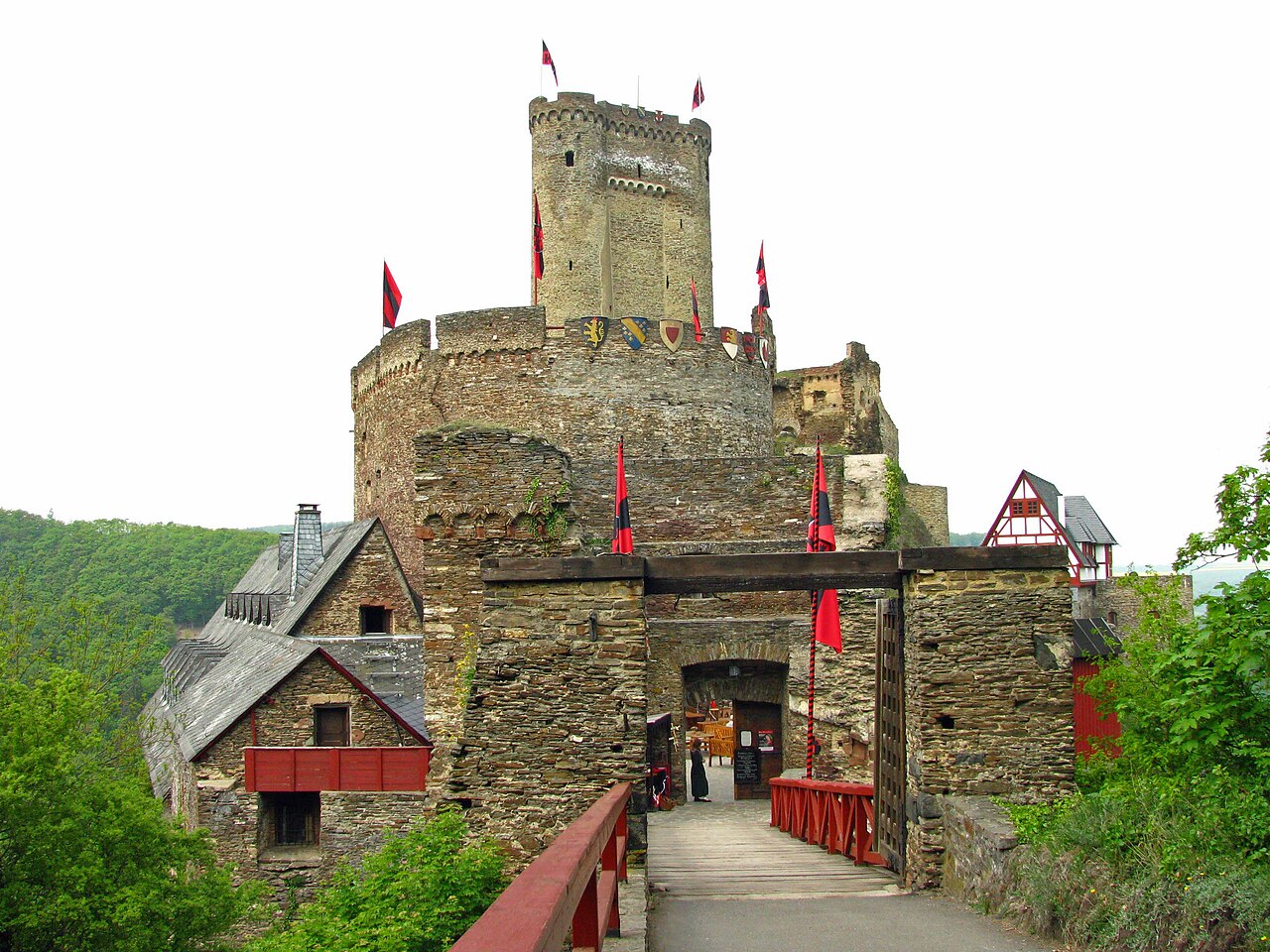
The Trier section is accessed through a gatehouse reached by a wooden bridge spanning the neck moat. This leads into a large inner courtyard that was transformed into a rock garden during 20th-century restorations. Dominating this courtyard is the imposing Trier Tower, a massive 20-meter-high keep with walls up to three meters thick at the base. The tower now functions as a water reservoir and is closed to the public.
On the western edge overlooking the Moselle stands the Herrenhaus, a residential building rebuilt on medieval foundations after destruction in World War II. A battlement walkway extends from the Herrenhaus, crossing the dividing wall into the Cologne half.
Adjacent to the courtyard is the cour d’honneur (Ehrenhof), housing the castle's only surviving cistern, a 20-meter-deep shaft for collecting rainwater. A segment of the original thick enclosing wall remains intact here. The northern corner features a three-story building with a timber-framed upper floor now used as a holiday residence. The ground floor contains the castle chapel, which preserves ancient wall and ceiling frescoes alongside a Baroque altar from 1779 and a baptismal font carved in 1515. Nearby lie the remains of the Trier Palas, the main residential building.
The cologne half
The Cologne section is accessible only via a narrow wooden bridge and the Palatine Gate at the northwest corner. Its courtyard features two circular towers connected by a covered battlement. The southern round tower contains murals depicting coats of arms of former owners and vassals, serving as a heraldic record.
The remains of the Cologne Palas lie to the east, formerly housing the knights' hall. Though heavily damaged by Napoleonic troops in the early 19th century, the cellar and ground floor survive, along with fragments of upper stories and gable walls. Decorative Late Romanesque-style windows were added in the early 20th century but are not original.
At the northern end stands the hunting lodge (Jagdhaus), rebuilt on historic foundations. Its ground floor, lined with dark wood paneling and beamed ceilings, now serves as an exhibition space for hunting trophies, armor, weapons, and archaeological finds. A covered walkway connects the lodge to the Cologne Tower, which formerly housed the dungeon and now displays torture instruments. This tower remains accessible as a lookout, offering panoramic views of the Moselle Valley.
Decline, destruction, and restoration
By the mid-16th century, Thurant Castle had fallen into disrepair. A 1542 description refers to it as dilapidated, with stones quarried for the nearby Wiltburg estate. The castle suffered further damage during the Nine Years' War (War of the Palatine Succession) in 1689 when French troops partially destroyed it, leaving only key towers and a 16th-century residential building intact.
In the 18th century, the castle passed into private hands. Industrialist Robert Allmers acquired the ruins in 1911 and initiated partial restoration between 1915 and 1916. Since 1973, ownership has been shared privately by the Allmers and Wulf families. Today, Thurant Castle is protected under regional heritage laws and internationally recognized as a cultural monument under the Hague Convention.
Visitor information and cultural significance
Although privately owned, Thurant Castle is open to visitors from March to mid-November for a fee. The castle offers a rare glimpse into medieval fortification architecture and the complex political history of the Moselle region. Its chapel, wine cellar, and dungeon with a torture chamber are notable attractions. The castle's elevated position provides stunning views of the Moselle River and surrounding vineyards, enhancing its appeal to tourists and historians alike.
The castle's unique division into two halves governed by rival archbishoprics makes it an exceptional case study in medieval territorial disputes and architectural adaptation. Visitors can explore the extensive ruins, including towers, battlements, courtyards, and restored residential buildings, gaining insight into the life and conflicts of the medieval nobility.
Thurant Castle stands as a testament to the region's layered history, from Roman times through the Middle Ages to modern preservation efforts, embodying the cultural heritage of the Moselle Valley.
Frequently asked questions (FAQ)
- How do I visit Thurant Castle?
- Thurant Castle is open to visitors from March to mid-November. You can explore the castle ruins for an admission fee during these months.
- What is unique about Thurant Castle's architecture?
- Thurant Castle is unique for its division into two halves, each with its own keep, residential buildings, and entrance, reflecting the historical rivalry between the archbishops of Cologne and Trier.
- When was Thurant Castle built?
- The castle was constructed between 1198 and 1206 by Count Palatine Henry I the Tall to secure control over the Moselle region.
- Can I access the towers at Thurant Castle?
- The Trier Tower is currently closed to the public as it functions as a water reservoir, but the Cologne Tower is accessible and offers panoramic views of the Moselle Valley.
- Why is Thurant Castle historically significant?
- Thurant Castle played a key role in medieval power struggles between the archbishops of Cologne and Trier, and its division is documented in one of Germany's oldest surviving legal treaties from 1248.
Photo gallery

Information
Opening hours
March to mid-November, daily
Ticket prices
Admission fee required
Current owner
Private owners (Allmers and Wulf families)
Website
Visit websiteSources & official resources
Verify the information above using these authoritative references.
Loading map...
Visitor reviews
No reviews yet. Been here? Write the first review and help other travelers!
Write the first reviewVisited this castle? Share your experience
Your review helps other travelers and adds first-hand knowledge to our encyclopedia.