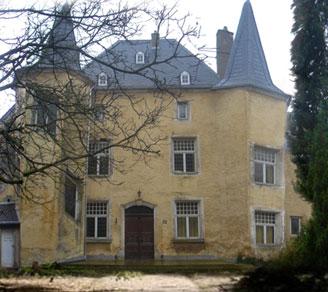
Thorn Castle
Thorn Castle, known locally as Schloss Thorn, is a historic castle turned stately home situated in Germany along the Moselle River. The site has a long history dating back to ancient times, originally marked by a Roman guard tower built to oversee a strategic ford crossing. This early tower, constructed on a prominent rock outcrop, gave the castle its name derived from the Latin word turris, meaning "tower." The medieval castle that followed was likely rectangular in shape and featured round corner towers for defense.
Medieval origins and evolution
The medieval castle served as a fiefdom under the lords of Rollingen, hereditary marshals of Luxembourg, before passing to the lords of Bübingen. By the late 15th century, the castle had fallen into disrepair. In 1536, the castle underwent significant reconstruction under new ownership, preserving only two towers and part of the defensive wall from the medieval structure. This reconstruction marked the transition of the castle into the renaissance architectural period, with the addition of stylistic elements characteristic of that era.
Renaissance rebuilding and later transformations
The 16th-century rebuilding focused on transforming the fortress into a more comfortable residence while maintaining some defensive features. One of the remaining towers was a rectangular gate tower, which was originally inhabitable, while the other was a round tower at the south-eastern corner. Unfortunately, the round tower was destroyed during bombardment in 1945. The castle remained in the hands of the lords of Musiel until the late 19th century.
In 1800, the castle underwent another transformation, this time into a stately home. The defensive structures were repurposed into garden terraces, reflecting changing architectural tastes and the reduced need for fortification. Over the centuries, the castle's appearance evolved to incorporate elements of the Baroque and Empire styles, resulting in a complex architectural layering that showcases styles from the Middle Ages through the Renaissance and into the 19th century.
Architectural features and preservation
Today, Thorn Castle exhibits a mix of architectural influences due to its long history of rebuilding and renovation. The surviving rectangular gate tower stands as a reminder of the castle's medieval defensive origins. The castle's walls, terraces, and residential wings reflect the Renaissance and later Baroque modifications. Although partially altered, the castle retains significant historical fabric, making it a valuable example of evolving castle architecture in the Moselle region.
Vineyards and cultural heritage
Thorn Castle is notable for its surrounding vineyards, which have been family-owned since 1534, making them the oldest castle vineyard on the Moselle. The estate also preserves the only known tree wine press in Europe, an important cultural artifact linked to traditional winemaking practices. The castle remains a private residence of the Barons von Hobe-Gelting, who continue the winemaking tradition, linking the site's historical significance with ongoing agricultural heritage.
Visiting and significance
Although primarily a private residence, Thorn Castle's rich history and architectural diversity make it an important landmark in the Moselle region. Its combination of medieval defensive elements, Renaissance rebuilding, and later stylistic adaptations provide insight into the region's historical development. The castle's vineyards contribute to the local economy and cultural landscape, maintaining a centuries-old tradition of viticulture.
Architectural summary
- Medieval castle origins with round corner towers
- 16th-century Renaissance rebuilding preserving two towers and defensive walls
- 19th-century transformation into a stately home with garden terraces
- Architectural styles include Middle Ages, Renaissance, Baroque, and Empire
- One surviving rectangular gate tower, round tower destroyed in 1945
Historical ownership
- Lords of Rollingen (hereditary marshals of Luxembourg)
- Lords of Bübingen
- Lords of Musiel until the late 19th century
- Barons von Hobe-Gelting current owners and residents
Frequently asked questions (FAQ)
- What is the historical significance of Thorn Castle?
- Thorn Castle dates back to Roman times with a guard tower and evolved through medieval and Renaissance periods, reflecting centuries of architectural and regional history.
- Can visitors tour Thorn Castle?
- Thorn Castle is primarily a private residence, so public access is limited. Visitors can appreciate its exterior and surrounding vineyards but should check for any special events or tours.
- What architectural styles are present at Thorn Castle?
- Thorn Castle features a mix of medieval, Renaissance, Baroque, and Empire architectural elements due to multiple renovations over centuries.
- Is Thorn Castle associated with winemaking?
- Yes, Thorn Castle has the oldest castle vineyard on the Moselle, with family-owned vineyards since 1534 and Europe's only preserved tree wine press.
- What happened to the round tower of Thorn Castle?
- The round tower at the south-eastern corner was destroyed by bombardment in 1945 during World War II.
Information
Sources & official resources
Verify the information above using these authoritative references.
Loading map...
Visitor reviews
No reviews yet. Been here? Write the first review and help other travelers!
Write the first reviewVisited this castle? Share your experience
Your review helps other travelers and adds first-hand knowledge to our encyclopedia.