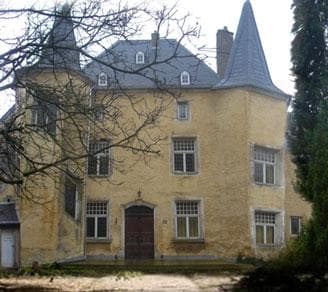
Wintrange Castle
Wintrange Castle, known locally as Schlass Wëntreng in Luxembourgish and Château de Wintrange in French, is a notable example of a Renaissance hill castle situated in the village of Wintrange, near Schengen in south-eastern Luxembourg. Constructed around 1610 by Alexandre de Musset, the Lord of Foetz, the castle reflects the architectural and defensive needs of its era while maintaining the elegance of Renaissance design.
Architectural features and construction
The castle's main structure is distinguished by its four towers, which remain intact and are a defining characteristic of the building. These towers not only provided residential and defensive functions but also contributed to the castle's imposing silhouette on the hill. The Renaissance style is evident in the castle's balanced proportions and the integration of fortifications that blend functionality with aesthetic considerations.
During the Thirty Years' War (1618-1648), additional fortifications were added to the castle, including a gunport to enhance its defensive capabilities against artillery and infantry attacks. This adaptation illustrates the evolving military architecture of the period, where castles had to accommodate the increasing use of gunpowder weapons.
In the 18th century, a barn with a fifth tower was constructed, expanding the estate's utility and architectural complexity. This addition reflects the castle's role not only as a noble residence but also as a center of agricultural management.
Historical context and ownership
Alexandre de Musset, the original builder, was a prominent nobleman whose influence extended through the Moselle valley region. The castle's location on a hill provided strategic oversight of the surrounding landscape, important for both defense and control of local trade routes.
The castle changed hands several times over the centuries, with significant events impacting its condition and use. In 1938, it was acquired by the industrialist Nick Schlesser, marking a new chapter in its history. However, the castle suffered considerable damage during the 1940s when it was occupied first by German troops and later by American forces during the Second World War. This period left the castle in a state of disrepair.
Restoration efforts were undertaken by Nick Schlesser's son, Henri Schlesser, who fully restored the castle to its former condition. The current owner, Philippe Schlesser, continues the restoration and maintenance of the property, preserving its historical and architectural integrity.
Setting and environment
The castle is set within a 1.5-hectare private park, enhancing its stately presence and providing a tranquil environment. Adjacent to the estate lies the Haff Remich bird sanctuary and national park, an area of ecological importance featuring lakes and ponds that extend down to the Moselle River. This natural setting adds to the castle's appeal and situates it within a broader landscape of environmental and cultural significance.
Current use and accessibility
Today, Wintrange Castle remains privately owned and is not open for general tourist visits or guided tours. However, it is available for private rental for events such as weddings, film productions, and photo shoots. Visitors can access the castle only by appointment, ensuring privacy and careful preservation of the site.
Architectural significance and preservation
The castle exemplifies the transition from medieval fortress to Renaissance residence, combining defensive features such as towers and gunports with the stylistic elements of the Renaissance period. Its survival through centuries of conflict, including the Thirty Years' War and World War II, and subsequent restoration efforts, highlight its resilience and cultural value.
Wintrange Castle stands as a testament to the architectural evolution and noble heritage of Luxembourg's Moselle valley, representing a significant chapter in the region's history and built environment.
Frequently asked questions (FAQ)
- How do I visit Wintrange Castle?
- Wintrange Castle is privately owned and not open for general tourism. Visits are allowed only by appointment, typically for private events or special arrangements.
- What is the historical significance of Wintrange Castle?
- Built in 1610 by Alexandre de Musset, Wintrange Castle reflects Renaissance architecture and was fortified during the Thirty Years' War. It also endured damage during World War II and was later restored.
- Can I rent Wintrange Castle for events?
- Yes, the castle is available for private rental for weddings, film productions, photo shoots, and other events, providing a unique historic setting.
- What architectural style is Wintrange Castle?
- Wintrange Castle is built in the Renaissance style, featuring four main towers and later additions including a barn with a fifth tower from the 18th century.
- Is the castle located near any natural attractions?
- Adjacent to the castle is the Haff Remich bird sanctuary and national park, with lakes and ponds extending to the Moselle River, offering a scenic natural environment.
Photo gallery

Photo by Wintrange_chateau_web.jpg: Philippe Schlesser (Flep at en.wikipedia) derivative work: Ipigott (talk)•Public domain
Information
Sources & official resources
Verify the information above using these authoritative references.
Loading map...
Visitor reviews
No reviews yet. Been here? Write the first review and help other travelers!
Write the first reviewVisited this castle? Share your experience
Your review helps other travelers and adds first-hand knowledge to our encyclopedia.



