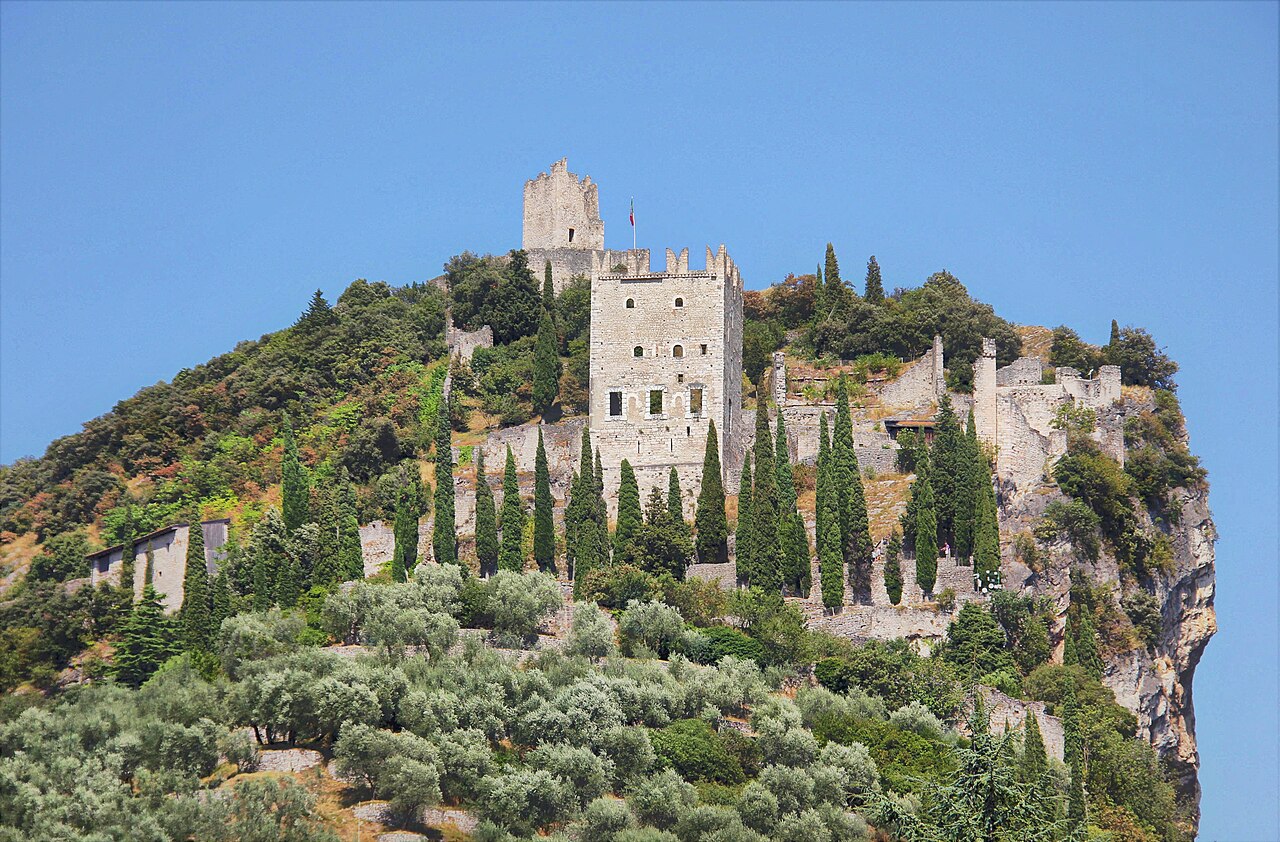
Tenno Castle
Tenno Castle is a remarkable medieval fortress perched on a rocky spur overlooking the alpine routes of the Giudicarie Valleys, just a few kilometers from the stunning Lake Tenno in northern Italy. This hill castle in the Trentino-Alto Adige region offers a fascinating glimpse into the military and social history of the area, embodying centuries of architectural evolution and strategic significance.
Constructed in the 12th century, Tenno Castle originally belonged to the local community before passing through the hands of several noble families, most notably the Counts of Appiano and the Bishop's Principality of Trento. Its position on a prominent rocky promontory provided commanding views over the surrounding landscape, including the nearby Lake Garda, making it an important defensive and administrative center throughout the High Medieval and later periods.
Strategic location and early history
The castle's location was chosen for its natural defensive advantages, situated on a rocky spur that controls access to the alpine passes leading into the Giudicarie Valleys. This position allowed the castle's occupants to monitor and control trade routes and military movements in the region. The nearby village of Frapporta developed in close connection with the castle, its walls and layout reflecting medieval patterns of settlement and defense.
Initially, the castle was under communal ownership, reflecting the medieval practice of local communities building fortifications for mutual protection. By the early 13th century, it came under the control of the Counts of Eppan and their Ulten branch, a powerful noble family in the region. Between 1210 and 1211, the castle was transferred to the Bishop of Trento, Friedrich von Wangen, as part of a strategic land exchange, marking the beginning of ecclesiastical influence over the fortress.
Architectural evolution and ownership changes
Throughout the 13th and 14th centuries, Tenno Castle underwent numerous modifications reflecting the changing needs and styles of its rulers. In 1260, the Counts of Arco were appointed administrators and carried out significant structural enhancements. The castle's architecture became a blend of defensive and residential elements, adapting to advances in siege technology and the lifestyle requirements of its occupants.
Ownership of the castle changed hands multiple times during this period. After coming under the rule of Meinhard II in 1284, it was returned to the bishops of Trento by 1314. The mid-14th century saw the castle sold to the Scaliger family, with Mastino II della Scala expanding its fortifications and granting it as a fief to the Counts of Arco. Following the Scaliger's expulsion in 1387, control alternated among the Visconti, the bishops, and the Venetian Republic.
Notable military events
The castle's strategic importance made it a focal point during regional conflicts. In 1439, it was involved in military confrontations between Visconti troops led by Niccolò Piccinino and Venetian forces commanded by Francesco Sforza. A famous anecdote recounts Piccinino's daring escape from a siege by hiding inside a large sack, highlighting the castle's turbulent history.
In 1460, the castle reverted to the bishops of Trento, who undertook major restorations under Bishop Johannes Hinderbach. These included modernizing defenses with the addition of cannons and rebuilding key residential and functional spaces such as the loggia, kitchen, servants' quarters, and living rooms. An inscription in the courtyard commemorates these works.
The fortress successfully withstood a Venetian siege in 1487 during the Tyrolean-Venetian war, defended by the Counts of Arco. Later, in 1703, it was briefly captured by French forces under General Vendôme during the War of Spanish Succession but suffered limited damage.
Architectural features and surviving elements
Tenno Castle was originally dominated by a massive 48-meter-high square keep or bergfried, which served as a last refuge and lookout point. Unfortunately, this central tower collapsed in 1920, representing a significant loss to the castle's medieval fabric.
The castle's defensive walls are constructed with scarped masonry, characterized by sloping bases designed to better resist siege engines and undermine attempts. The surviving curtain walls and partial fortifications of the adjacent fortified village, or borgo, provide valuable insights into the castle's defensive network and its integration with the surrounding settlement.
The 15th-century restorations led by Bishop Hinderbach introduced Renaissance elements to the castle, including the vaulted loggia and improved residential quarters. These features illustrate the transition from purely military architecture to more comfortable noble residences while maintaining defensive capabilities.
The castle and its surroundings
The castle remains embedded in a picturesque natural setting, with the medieval town of Frapporta nestled against its walls. Visitors reaching the castle's promontory are rewarded with breathtaking views over Lake Garda and the surrounding alpine landscape. Nearby attractions include the Lago di Tenno, a glacial lake renowned for its crystal-clear waters, formed thousands of years ago during the last ice age.
Modern history and restoration efforts
After the Napoleonic era, the castle lost its military relevance and gradually fell into decay. In the early 19th century, it was sold to private owners who undertook restoration efforts, transforming the fortress into a residence. Despite these efforts, the collapse of the main tower in 1920 marked a turning point in the castle's physical condition.
In the late 20th century, the castle changed hands several times, including ownership by two engineers from Belgium and Luxembourg. In 1997, Klaus Zumwinkel acquired the property and invested significantly in restoration, adapting parts of the estate for modern use, including the addition of a swimming pool.
Today, Tenno Castle remains a private residence and is not generally open to the public. However, its historical significance, architectural features, and stunning location continue to attract interest from historians, architects, and visitors exploring the region.
Visiting tenno castle and nearby attractions
While the castle itself is privately owned and closed to public tours, visitors can explore the charming medieval village of Frapporta and enjoy panoramic views from the castle's promontory. The surrounding area offers numerous hiking trails and natural sites, including the famous Lago di Tenno, perfect for nature lovers and history enthusiasts alike.
The castle's rich history, blending High Medieval military architecture with Renaissance adaptations, makes it a noteworthy example of northern Italian fortifications. Its story reflects the complex political and military dynamics of the region over several centuries.
Frequently asked questions (FAQ)
- How do I get to Tenno Castle?
- You can reach Tenno Castle by taking public transport to the nearest town and then a short hike or drive to the castle. The castle is well-signposted and is located in the scenic hills of Tenno, providing beautiful views of the surrounding landscape.
- What is the historical significance of Tenno Castle?
- Tenno Castle dates back to the 12th century and is a prime example of medieval military architecture in Italy. It played a crucial role in the region's defense and has been a witness to many historical events throughout the centuries.
- When was Tenno Castle built?
- Construction of Tenno Castle began in the late 12th century, and it was completed in the early 13th century. The castle has undergone various renovations over the years, maintaining its historical charm while adapting to modern visitor needs.
- Can I take a guided tour of Tenno Castle?
- Yes, guided tours are available at Tenno Castle, offering visitors in-depth insights into its history and architecture. These tours are typically conducted during the peak tourist season, and advance booking is recommended.
- Is it possible to explore Tenno Castle on my own?
- Absolutely! Visitors can explore the castle grounds independently, allowing for a more personal experience. Informational signs are placed throughout the site to help guide you as you discover its fascinating history.
- What are the opening hours for Tenno Castle?
- Tenno Castle is open to visitors from April to October, typically from 10 AM to 6 PM. However, it's advisable to check the official website for any seasonal changes or special events that might affect the hours.
- What is the best time to visit Tenno Castle?
- The best time to visit Tenno Castle is during the spring and early autumn when the weather is mild, and the surrounding scenery is at its most picturesque. Additionally, these seasons tend to have fewer crowds, allowing for a more enjoyable experience.
- Are there any nearby attractions to visit while at Tenno Castle?
- Yes, nearby attractions include the beautiful Lake Tenno and the charming town of Riva del Garda. Both locations offer stunning views and additional opportunities for hiking, dining, and cultural exploration.
- What are the ticket prices for Tenno Castle?
- Ticket prices for Tenno Castle are quite reasonable, typically ranging from €5 to €10 per person, with discounts available for students and seniors. Children under a certain age may enter free, making it an affordable outing for families.
Information
Loading map...
Visitor reviews
No reviews yet. Been here? Write the first review and help other travelers!
Write the first reviewVisited this castle? Share your experience
Your review helps other travelers and adds first-hand knowledge to our encyclopedia.