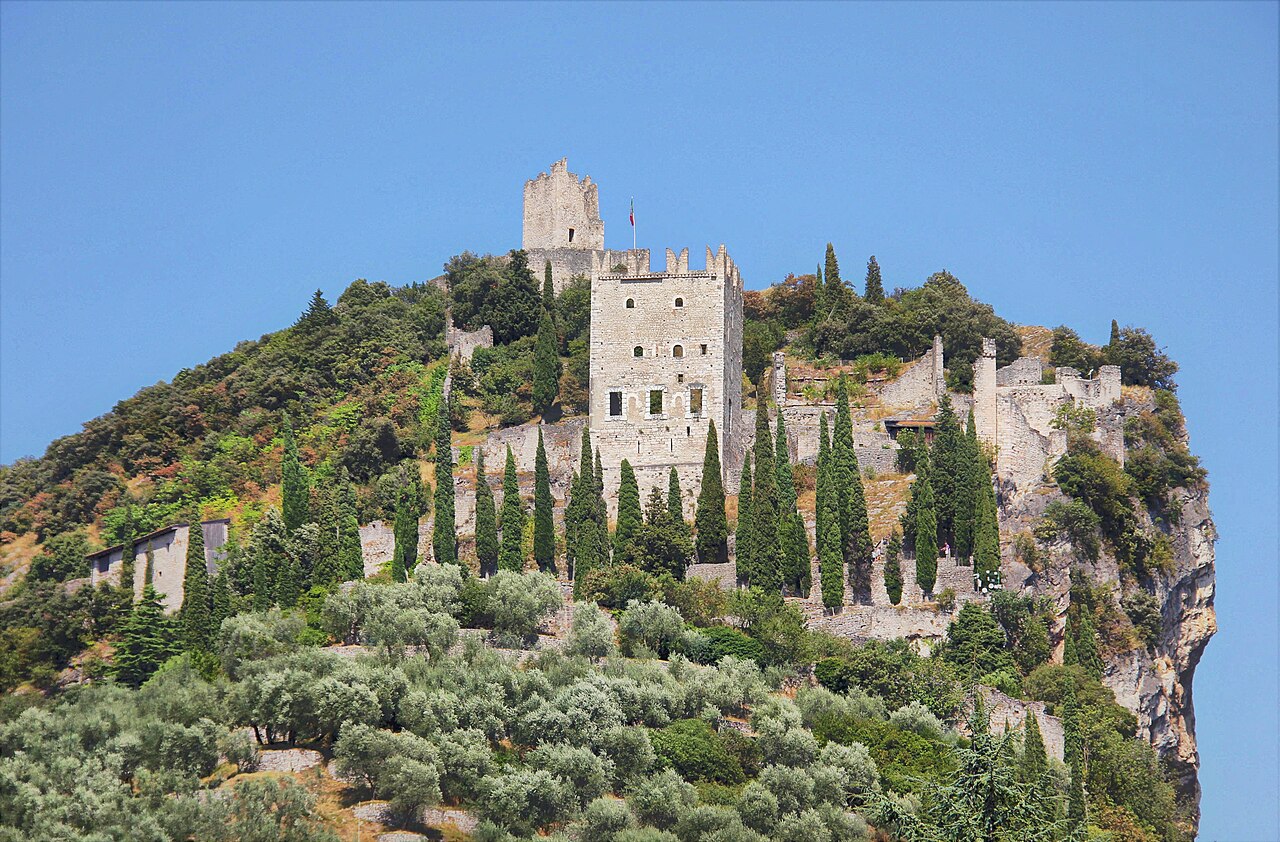
Riva Castle
Riva Castle, also known as Rocca di Riva, is a prominent medieval fortress located in Riva del Garda, within the Trentino-Alto Adige region of northern Italy. This castle stands as a testament to the strategic military architecture of the High Medieval period, guarding the northern shores of Lake Garda. Its unique position on an artificial islet surrounded by water defenses underscores its role in controlling access to the lake and protecting the town's harbor.
The origins of Riva Castle trace back to 1124, when the Bishop of Trento, Altmann, authorized the construction of a fortress to defend the vital trade and transportation routes along Lake Garda. The initial structure was built to secure the southeastern corner of the town's defenses, leveraging the natural rocky terrain and water features for protection. Over the centuries, the castle evolved through numerous expansions and renovations, reflecting the shifting political powers and military technologies of the region.
Medieval origins and early history
The first castle authorized in 1124 was not the current Rocca but an earlier fortification located on a rocky island further west along Lake Garda's shore. The present castle, first documented as Castrum Novum in 1393, meaning "New Castle," was constructed in the late 13th century under the influence of the Counts of Arco and later the Counts of Tyrol. This period marked a significant phase of fortification in the region, as control over Lake Garda was fiercely contested.
The Scaliger family, also known as the Della Scala, a powerful noble dynasty ruling Verona, took possession of Riva Castle in the 14th century. They undertook extensive expansions, transforming it into a moated water fortress with quadrangular bastions, integrating the earlier keep into their defensive scheme. This expansion was part of a broader strategy to dominate the lake's trade routes, alongside their other castles at Sirmione, Lazise, Torri del Benaco, and Malcesine.
Political struggles and changing ownership
Throughout the late medieval period, Riva Castle's ownership oscillated among several powerful entities. After the Scaligers were expelled by the Prince-Bishop of Trent allied with the Visconti Duke of Milan at the end of the 14th century, the castle changed hands multiple times in the early 15th century. The Prince-Bishopric of Trent, the Viscontis, and the Duke of Austria each held sway at various points, reflecting the turbulent political landscape of northern Italy.
In 1440, the Republic of Venice captured the castle after a four-week siege during their conflict with the Viscontis. The Venetians fortified the castle further, adding artillery defenses to adapt to the evolving nature of warfare. Venetian control lasted until 1509, when the Habsburg Emperor Maximilian I took possession following Venice's defeat.
Renaissance and later history
In 1520, Emperor Charles V formally returned Riva Castle to the Prince-Bishopric of Trent, which then used it as a residence and administrative center. Notably, bishops such as Bernhard von Cles and members of the Madruzzo family favored the castle, hosting important receptions during the Council of Trent, highlighting its dual role as a military fortress and a seat of ecclesiastical power.
The castle suffered damage during the War of the Spanish Succession in 1703 when French troops under General Louis Joseph, Duke of Vendôme sacked Riva. Later, under Austrian military administration in the 19th century, the castle was extensively modified and converted into barracks, a change that significantly altered its medieval appearance and gave it much of its current form.
During World War I, the fortress housed a garrison of 600 soldiers and was subjected to bombardment by Italian artillery. After the war, the castle passed into municipal ownership and was restored in the late 20th century. Since 1994, it has functioned as the Museo Alto Garda (MAG), showcasing the cultural and historical heritage of the region.
Architectural features and layout
Riva Castle is distinctive for its water fortress design, occupying an artificial islet of approximately 8,000 square meters. It is surrounded on three sides by a moat fed directly from Lake Garda, integrating natural and man-made defenses. The moat connects to the lake on the east and west sides, enhancing the castle's impregnable character.
The fortress follows an irregular quadrangular plan, anchored by four corner towers. The eastern curtain wall extends about 48 meters, maintaining a straight alignment between the towers. The southern wall, approximately 45 meters long, features a Neo-Renaissance façade dating from the 19th century, marked by an inscription dedicated to Emperor Franz Josef I and the year 1852, commemorating its conversion to barracks under Austrian rule.
The most prominent architectural element is the keep (bergfried) at the northwest corner. This tower stands about 23.5 meters tall with walls roughly 2.5 meters thick and 9.5 meters wide. Its masonry reveals multiple construction phases, including the original 12th-century bossage stonework at its base. However, the tower was partially lowered in 1852, reducing its original height.
Adjacent to the keep is the ravelin, a triangular defensive outwork that houses the main entrance. The original drawbridge here has been replaced by a fixed wooden bridge. Inside, the castle courtyard serves as an open event space and contains a historic well, though extensive modifications have altered its medieval character.
Historically, the castle was surrounded by a zwinger, a lower outer defensive wall that provided an additional layer of protection. This feature likely remained intact until the mid-18th century. The integration of the original 12th-century keep into the larger Scaliger expansion is unique among Trentino fortifications, emphasizing the castle's layered architectural history.
Cultural significance and modern use
Today, Riva Castle stands as a cultural landmark in Riva del Garda. Its commanding position overlooking Lake Garda and its well-preserved defensive structures attract numerous visitors interested in medieval military architecture and regional history. The castle frequently hosts cultural events, especially during the summer months, including exhibitions, concerts, and festivals.
The Museo Alto Garda housed within the castle offers visitors insights into the area's rich history, art, and natural environment. Exhibits include archaeological finds, historical artifacts, and art collections that reflect the diverse heritage of the Garda region.
Nearby, the Bastione di Riva tower complements the castle's defensive network and is another point of interest for visitors exploring the town's fortifications.
Frequently asked questions (FAQ)
- How do I visit Riva Castle and the Museo Alto Garda?
- Riva Castle is open to the public as the Museo Alto Garda. Visitors can explore the museum's exhibits and enjoy cultural events held in the castle. Check the official website or local tourist information for current opening hours and ticket prices.
- What is the historical significance of Riva Castle?
- Riva Castle played a crucial role in controlling access to Lake Garda and was a strategic military fortress during the High Medieval period. It was owned by notable families such as the Scaligers and served as a residence for prince-bishops.
- Can I see the original medieval architecture at Riva Castle?
- Yes, parts of the original 12th-century keep and the Scaliger expansions are still visible. However, the castle underwent significant modifications in the 19th century when it was converted into barracks, which altered its medieval appearance.
- Is Riva Castle accessible for visitors with mobility issues?
- While the castle has some uneven surfaces and historic structures, efforts have been made to improve accessibility. Visitors with mobility concerns should contact the museum in advance to inquire about available accommodations.
- When is the best time to visit Riva Castle?
- The castle and museum are popular during the summer months when cultural events are held. Spring and autumn offer quieter visits with pleasant weather. Winter visits may be limited due to reduced opening hours.
Information
Sources & official resources
Verify the information above using these authoritative references.
Loading map...
Visitor reviews
No reviews yet. Been here? Write the first review and help other travelers!
Write the first reviewVisited this castle? Share your experience
Your review helps other travelers and adds first-hand knowledge to our encyclopedia.