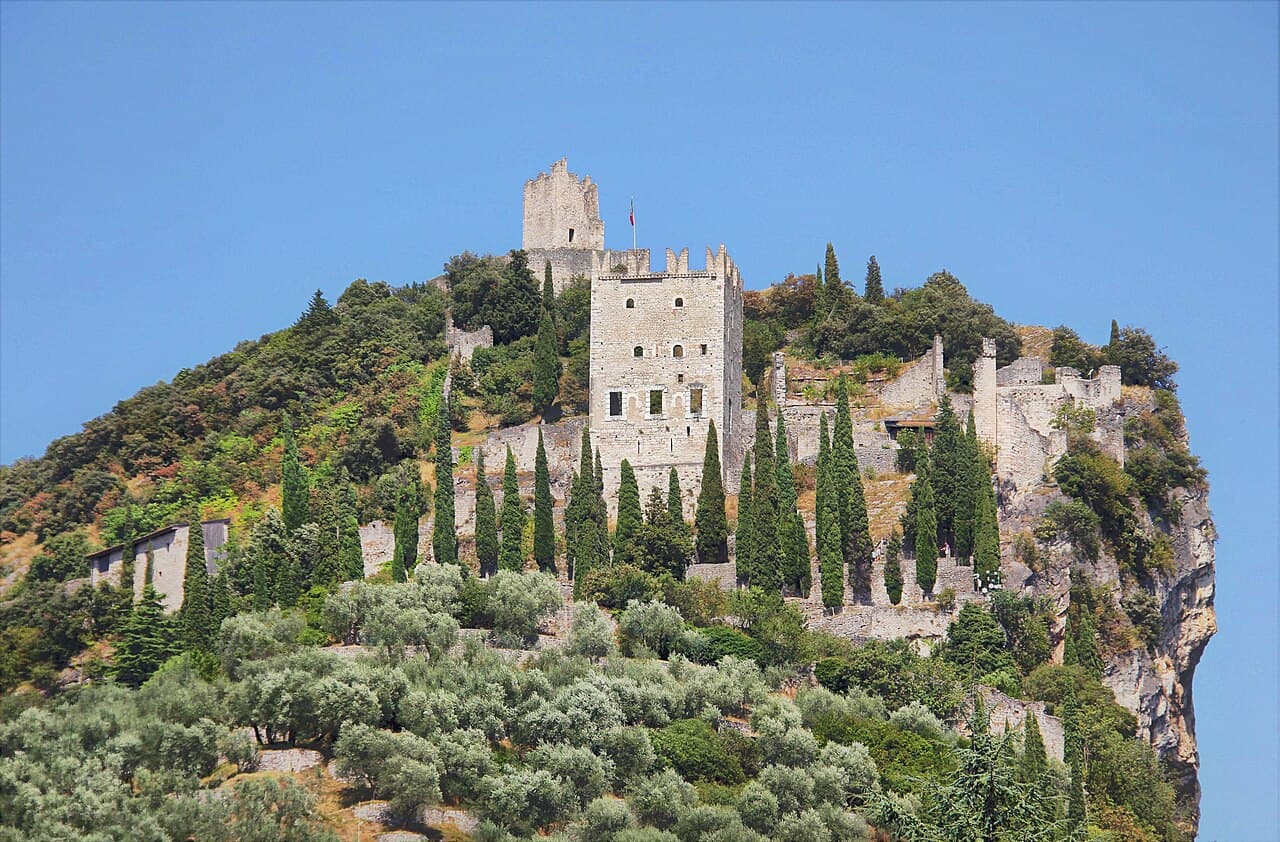
Arco Castle
Arco Castle stands prominently on a rocky spur overlooking the town of Arco and the Sarca Valley in northern Italy's Trentino-Alto Adige region. This hill castle is a defining landmark of the Garda Trentino landscape, commanding views where the Sarca river plain widens near Lake Garda. Its origins trace back to the early medieval period, with the first fortifications likely constructed around the 10th century AD by indigenous free nobles. The castle’s strategic location atop a steep ridge approximately 273 meters above sea level allowed it to control vital routes through the Sarca valley, an important passage to northern Lake Garda.
Medieval origins and early history
The site of Arco Castle was used as a refuge as early as 300 BCE by local tribes, but the castle itself emerged as a fortified residence around the year 1000 AD. Initially, the castle was held as an allodial property by the inhabitants of Arco, a status confirmed in 1196 by Federico d’Arco. Over time, it became the private domain of the noble Counts of Arco, whose influence extended across the Sarca valley. The counts were first mentioned in a deed from 1124 and served as liensmen under the Prince-Bishops of Trent. They were elevated to comital status by Emperor Frederick II in 1221 but later acknowledged the overlordship of the Meinhardiner counts of Tyrol in 1272.
Throughout the Middle Ages, Arco Castle endured numerous sieges by regional powers, including forces from Seiano, Lodron, and Venetian troops, yet it retained a reputation for resilience. In 1349, the Prince-Bishops of Trent expelled the Counts of Arco and granted the castle to the Veronese noble Scaliger family. However, a local uprising restored the counts to power, and in 1413 they secured Imperial immediacy from Emperor Sigismund, strengthening their autonomy. Despite this, the powerful House of Habsburg, rulers of Tyrol since 1363, eventually subdued the counts. The castle was captured by imperial forces in 1579, and the counts submitted to Habsburg rule in 1614. Their estates were seized by Emperor Leopold I in 1680.
Architectural features and defensive structures
Arco Castle occupies a natural crescent-shaped rock formation separated from the nearby Colodri mountain by a deep saddle. The fortress spans over 23,000 square meters, with sheer cliffs protecting the north and northwest faces and defensive walls concentrated on the more accessible south and west sides. The castle’s fortifications include a series of double-layered walls known as the Rivellino, which rise nearly 10 meters high and are up to two meters thick, designed to impede attackers.
The Hauptturm (main tower) is a prominent Romanesque residential tower dating from around 1300. It rises three stories and retains much of its original masonry, featuring battlements typical of northern Italian castles of the period. The oldest tower, the Rengheraturm, functions as a bergfried or keep, positioned at the highest point of the hill. Its entrance is elevated about seven meters above ground level, accessible only by a removable wooden ladder. This tower housed the Renga, a bell used to alert the castle and town of approaching danger.
Additional defensive features include a well-preserved square watchtower facing the settlement of Laghel, which allowed observation of movements in the valley and along the old castle road. Water management was vital during sieges, and the castle contains two large cisterns uncovered during restoration, which collected rainwater to supply the inhabitants. The castle also features a rock-cut dungeon known as the Felsengefängnis, carved from a natural cave and sealed with an artificial barrier. This prison had a small window for light and ventilation and was secured by two doors, including an outer hatch for supplying prisoners without opening the main door.
Historical events and sieges
Arco Castle experienced a turbulent history marked by numerous sieges and changes in ownership. In the mid-13th century, control briefly shifted when the castle was partially entrusted to the Ghibelline leader Ezzelino III da Romano and later handed to the Podestà of Trento. The counts regained possession by 1272 under Tyrolean overlordship. The castle was damaged by a significant fire in 1542, which destroyed many main buildings. In 1579, Archduke Ferdinand II of Tyrol seized the castle with imperial forces, forcing the counts to flee. They returned in 1614 after acknowledging Habsburg authority and undertook rebuilding efforts.
Between 1665 and 1675, the castle underwent extensive restoration and remodeling under the direction of architect Stefano Voltolino. However, the counts lost their estates permanently in 1680 under Emperor Leopold I. During the War of Spanish Succession in 1703, French troops led by General Duke Louis Joseph of Vendôme besieged and bombarded the fortress, compelling its surrender. Following this defeat, the castle was abandoned and fell into ruin, while the noble family relocated to branches in Bavaria and Mantua.
Artistic heritage and frescoes
Archaeological excavations in the 1980s revealed foundations of earlier buildings within the castle complex, highlighting its multiple construction phases. Notably, several 14th-century frescoes have been conserved inside the fortress, depicting scenes of medieval courtly life. These include images of knights and ladies engaged in games such as chess and dice, the legendary slaying of a dragon by Saint George, a knight’s investiture ceremony, and a lady weaving garlands of roses. These frescoes provide valuable insight into the cultural and social milieu of the castle’s medieval inhabitants.
Modern restoration and public access
In the 20th century, the castle grounds were purchased by Countess Giovanna d’Arco, Marchesa Guidi di Bagno, who became the sole owner in 1927. Later, a family foundation inherited the property. The municipality of Arco acquired the ruins in 1982 and established a museum on site. Beginning in 1986, the Provincial Cultural Heritage Service of Trento initiated conservation, restoration, and archaeological research projects to stabilize the remains and enhance understanding of the castle’s history.
Today, visitors can access the castle via three historic paths that wind through olive groves and the surrounding hills. The ascent rises approximately 120 meters from the town, offering panoramic views of the Sarca valley and Lake Garda. The castle’s ruins, including towers, walls, frescoes, and cisterns, remain a testament to its strategic importance and rich medieval heritage. The site’s natural defenses, combined with its architectural features, continue to captivate historians, archaeologists, and tourists alike.
Geographical setting and natural defenses
Arco Castle’s location atop a steep rocky ridge provides a commanding vantage point over the Sarca valley. The site features a vertical drop of more than 100 meters on its southern side, creating a formidable natural defense. The north and northwest faces are protected by sheer cliffs, while the south and west sides have gentler slopes fortified with thick defensive walls. The surrounding terrain includes a small woodland dominated by stone oaks and steep rock faces that were once popular climbing routes but are now closed to preserve the site.
The castle’s strategic position allowed control over the valley approaches and the old castle road connecting Arco to the nearby settlement of Laghel. This road emphasized the fortress’s role in regional defense and trade control during the Middle Ages.
Frequently asked questions (FAQ)
- What is the historical significance of Arco Castle?
- Arco Castle, dating back to the 12th century, is a remarkable example of medieval architecture and served as a strategic fortification overlooking the town of Arco. Its well-preserved ruins tell the story of the region's feudal past and the powerful noble families that once resided there, making it a focal point for understanding local history.
- When is the best time to visit Arco Castle?
- The best time to visit Arco Castle is during the spring and early autumn months, from April to June and September to October. During these times, the weather is generally mild and pleasant, allowing for an enjoyable exploration of the castle grounds and the surrounding landscape.
- Can I access Arco Castle by public transport?
- Yes, Arco Castle can be accessed by public transport. Visitors can take a bus to Arco and then enjoy a short walk to the castle, which is situated on a hilltop offering stunning views of the area.
- What are the opening hours for Arco Castle?
- Arco Castle is typically open to visitors from 9 AM to 6 PM during the summer months, and from 9 AM to 5 PM in the winter. It is advisable to check the official website for any seasonal changes or special closures before planning your visit.
- Is there an entrance fee for visiting Arco Castle?
- Yes, there is a small entrance fee to visit Arco Castle, which helps with the maintenance and preservation of this historic site. Ticket prices are generally affordable, making it accessible for visitors of all ages.
- What architectural features can I expect to see at Arco Castle?
- Arco Castle features impressive medieval architecture, including robust stone walls, ancient towers, and a well-preserved keep. Visitors can explore the castle's ruins and enjoy panoramic views of the surrounding valley, making it a fantastic spot for photography and history enthusiasts.
- Are there nearby attractions to visit along with Arco Castle?
- Absolutely! Nearby attractions include the charming town of Arco, known for its historic center and beautiful gardens, as well as the stunning Lake Garda, which is just a short drive away. Visitors can also enjoy various outdoor activities such as hiking, climbing, and cycling in the picturesque surroundings.
- Is Arco Castle accessible for individuals with mobility issues?
- While Arco Castle is a historic site with some uneven terrain, there are pathways that allow for easier access to certain areas of the castle. It is recommended for visitors with mobility issues to check in advance for any specific accessibility accommodations that may be available.
Photo gallery

Information
Website
Visit websiteSources & official resources
Verify the information above using these authoritative references.
Loading map...
Visitor reviews
No reviews yet. Been here? Write the first review and help other travelers!
Write the first reviewVisited this castle? Share your experience
Your review helps other travelers and adds first-hand knowledge to our encyclopedia.


