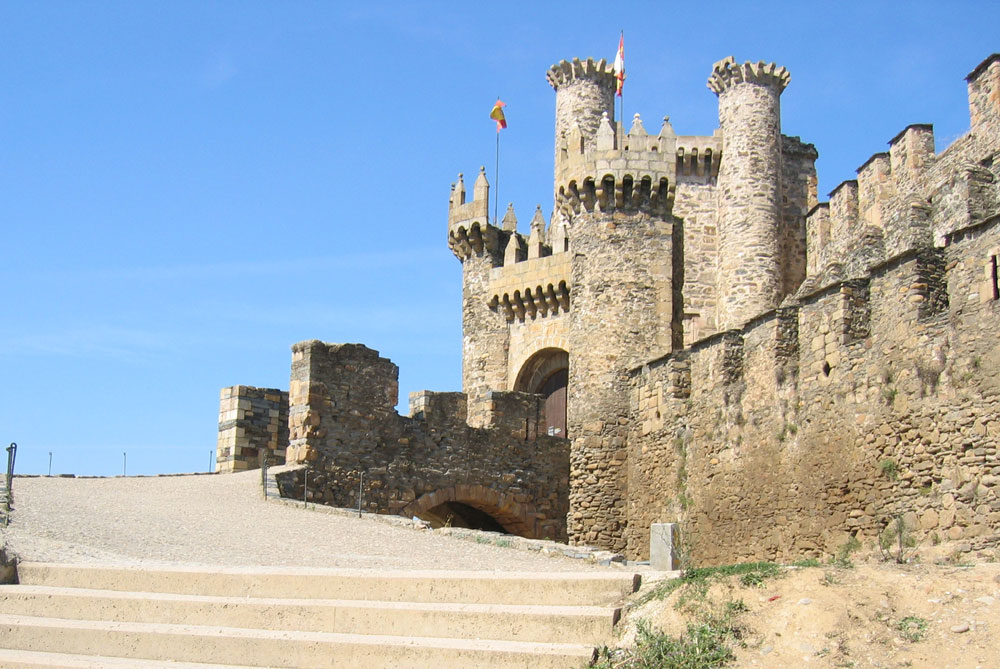
Templar Castle of Ponferrada
The Templar castle of Ponferrada is a remarkable medieval fortress located in the city of Ponferrada, in the province of León, northwest Spain. Strategically perched on a hill at the confluence of the Boeza and Sil rivers, the castle occupies a site with a rich history that spans several civilizations. Originally, this location was home to a Celtic castro, a fortified settlement typical of the Iron Age in the Iberian Peninsula. Subsequently, the Romans and Visigoths established their presence here, leaving behind a fortified structure and a reinforced bridge that gave the town its name: "pons ferrata", meaning "iron bridge".
The castle's historical significance is closely tied to the Knights Templar, who were granted the town and its surrounding lands by King Fernando II of León in 1178. Soon after, the Templars began construction of the fortress, with the earliest documented fortifications dating from around 1187. The initial phase of the castle's construction was completed by 1282, serving as a vital stronghold to protect pilgrims traveling the Camino de Santiago and to control the surrounding region. The Templars maintained ownership until their dissolution in 1311–1312, a consequence of the trials against the Order in France. To avoid confiscation, the Castilian master of the Temple, Rodrigo Yanez, transferred control of Ponferrada to the infant Don Felipe, brother of the king.
Historical development and ownership transitions
Following the dissolution of the Templars, the castle passed into the hands of various noble families. From 1340, it was held by Pedro Fernández de Castro, a prominent nobleman of the period. The 15th century saw significant expansions and renovations under the Osorio family, particularly Pedro Álvarez Osorio, who enhanced the castle's defensive and residential features. The fortress played an active role in regional conflicts, including the 1467 Irmandiña Revolt and a local rebellion between 1485 and 1486. After these uprisings, the Catholic Monarchs assumed control and undertook further fortifications to solidify their authority in the region.
During the Peninsular War in the early 19th century, the castle was briefly occupied by French troops. In 1811, parts of the fortress were deliberately damaged to prevent its use by enemy forces. Subsequently, the castle fell into decline and was repurposed for non-military uses, including functioning as a quarry and even a football field. The designation of the castle as a National Monument in 1924 marked the beginning of restoration efforts that have continued into the present day.
Architectural features and layout
The Templar castle of Ponferrada covers an irregular polygonal area exceeding 8,000 square meters atop its strategic hill. The natural defenses provided by the Boeza and Sil rivers historically acted as a moat on the northwest side, enhancing the fortress's security. The castle comprises two primary sections: a northern part dating to the 12th century, constructed by the Templars, and a larger 15th-century complex that includes the "Castillo Viejo", a walled enclosure with multiple defensive barriers, and a Renaissance palace.
Built predominantly of stone, the fortress features thick defensive walls and numerous towers of varied shapes and functions. Among the most notable are the elliptical tower, the 15th-century Malvecino tower, the hexagonal Monclín tower with its irregular plan, the southern Cabrera tower, and a semicircular tower that historically served as dungeons. The Rastrillo, also known as the Torre de los Caracoles, was constructed between the 14th and 15th centuries and forms a critical part of the castle's defensive system.
The main entrance is situated on the southwest side, marked by a robust masonry gate flanked by two towers. This gate is protected by a moat and an iron grille, emphasizing the fortress's defensive capabilities. Beyond the entrance lies a defensive enclosure that leads to the keep tower, known as the Torre del Homenaje, and the inner courtyard or patio de armas. Within the courtyard are the remains of various buildings, including the Gallery of Tiles, which suffered damage during the 1811 demolition and subsequent quarrying activities in the 19th and early 20th centuries.
A subterranean passage connects the castle to a cistern located in an albarrana tower, a detached defensive tower linked to the main walls. The fortress's walls are supported by four principal towers: Malvecino, Monclín, Malpica, and Cabrera. These towers provided strategic vantage points and reinforced the castle's defenses.
Restoration and current use
Restoration efforts initiated in the 20th century have focused on stabilizing the structure, repairing roofs, and recovering wooden galleries and walkways that reflect the castle's historical architecture. Today, the Templar castle of Ponferrada functions as a cultural and historical center, housing a museum that showcases its rich past. It also contains conference rooms, a library, and visitor facilities that enhance the educational experience for tourists and scholars alike.
The castle's location along the Camino de Santiago pilgrimage route adds to its cultural significance, attracting visitors interested in medieval history, architecture, and religious heritage. Its well-preserved defensive features and complex architectural evolution make it a prime example of high medieval military architecture in Spain.
Frequently asked questions (FAQ)
- What is the historical significance of the Templar Castle of Ponferrada?
- The Templar Castle of Ponferrada is a key historical site that dates back to the 12th century, originally built by the Knights Templar to protect the pilgrimage route to Santiago de Compostela. It symbolizes the power and influence of the Templars in medieval Spain and showcases their architectural ingenuity.
- When was the Templar Castle of Ponferrada constructed?
- Construction of the Templar Castle began in the 12th century and continued over several centuries, with significant enhancements made in the 15th and 16th centuries. Its development reflects the evolving defensive needs and architectural styles of the time.
- What are the opening hours for visiting the castle?
- The Templar Castle of Ponferrada is typically open to visitors from 10 AM to 7 PM during the summer months and from 10 AM to 6 PM in the winter. It's advisable to check the official website for any updates on seasonal hours or special closures.
- Is it possible to purchase tickets in advance?
- Yes, tickets for the Templar Castle can be purchased in advance through the official website or at the entrance. Buying tickets ahead of time can help you avoid long lines and ensure a smooth visit, especially during peak tourist seasons.
- Can I access the castle with mobility issues?
- The Templar Castle of Ponferrada has made efforts to improve accessibility, including ramps and designated paths for visitors with mobility challenges. However, due to its historical structure, some areas may still present difficulties, so it's best to inquire at the visitor center for specific assistance.
- When is the best time to visit the Templar Castle?
- The best time to visit the Templar Castle of Ponferrada is during the spring and fall when the weather is mild, and the tourist crowds are smaller. Visiting during these seasons allows you to enjoy the scenic surroundings and the castle’s exterior in a more comfortable atmosphere.
- What nearby attractions should I consider visiting?
- In addition to the Templar Castle, visitors can explore the nearby historic town of Ponferrada, the Basilica de la Encina, and the beautiful landscapes of the Bierzo region. These attractions complement your visit and provide a fuller experience of the area's rich culture and history.
- What are the ticket prices for the castle?
- The ticket prices for the Templar Castle of Ponferrada are generally affordable, with discounts available for students, seniors, and groups. Children under a certain age may enter for free, making it accessible for families looking to explore this historic site.
Information
Website
Visit websiteSources & official resources
Verify the information above using these authoritative references.
Loading map...
Visitor reviews
No reviews yet. Been here? Write the first review and help other travelers!
Write the first reviewVisited this castle? Share your experience
Your review helps other travelers and adds first-hand knowledge to our encyclopedia.