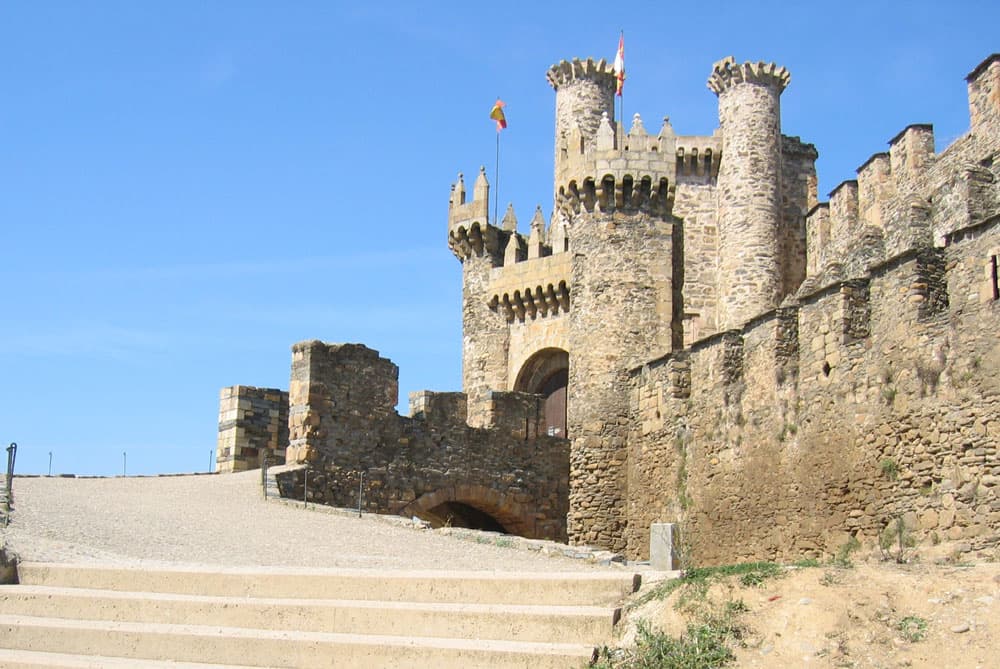
Ponferrada Castle
Ponferrada Castle stands as a monumental example of medieval military architecture in Castile and León, Spain. Perched strategically next to a steep slope overlooking the Sil River, the castle's location provided a formidable natural defense that was further enhanced by a deep moat protecting the side facing the town. This hill castle occupies a vast polygonal enclosure exceeding 8,000 square meters, showcasing multiple layers of fortifications including double and triple defensive walls, barbacans, numerous towers, and an expansive courtyard.
Architectural features and defenses
Access to the castle is gained by crossing a fixed stone bridge over the moat, a modern replacement of the original drawbridge. Visitors enter through a semicircular arch entrance flanked by two cylindrical turrets topped with battlements and protective copings. The castle's defensive design reflects its evolution over several centuries, with fortifications adapted to meet changing military needs and architectural styles.
The castle's walls incorporate an array of towers named after noble families and historic figures, including the towers of Homage, Old Homage, and the Catholic Kings. These towers served both as lookout points and strongholds within the fortress. The large inner courtyard is surrounded by the so-called Palacio or Casa Grande, which housed essential facilities such as outbuildings, cellars, an armory, stables, and gazebos, indicating the castle's role not only as a military bastion but also as a residential and administrative center.
Historical development and templar legacy
The origins of Ponferrada Castle trace back to a fortified hill and possibly a Roman citadel, underscoring its long-standing strategic importance. The first significant fortifications date to the 12th century, during a period of territorial conflict between the kingdoms of Castile and León. In 1196, after Alfonso VIII of Castile attacked the Bierzo region, Alfonso IX of León initiated the establishment of the town's defenses, including the castle's early walls.
In 1178, Ferdinand II of León granted the city of Ponferrada to the Order of the Temple (the Templars) to protect pilgrims traveling the Way of St. James (Camino de Santiago). The Templars fortified and expanded the castle, transforming it into a habitable palace and a military stronghold to safeguard the pilgrimage route. By 1226, the Templars had completed significant fortifications around the town and castle.
Despite their efforts, the Templars controlled Ponferrada for only about two decades before the order was disbanded in 1312. After the dissolution, ownership passed to King Ferdinand IV, who granted the castle to his butler, Pedro Fernández de Castro. This marked the beginning of the Castillo Viejo construction, which displays architectural features typical of the 14th century.
Expansion and modifications through the centuries
Subsequent noble families, notably the Osorio-Castro lineage, undertook extensive renovations and expansions to adapt the fortress to evolving defensive needs and contemporary tastes. Pedro Álvarez Osorio led significant reforms that included the construction of new towers such as Monclín, Cabrera, and Malpica, the installation of a drawbridge, and enhancements to the palatial quarters. These developments elevated Ponferrada Castle to one of the largest and most formidable fortresses in northwestern Spain during the late medieval period.
Throughout its history, the castle underwent continuous repairs and additions. In 1848, stables were added, reflecting the castle's ongoing use and adaptation. Modern restoration efforts have aimed to preserve its architectural integrity and highlight its historical significance.
Architectural style and cultural significance
Ponferrada Castle exhibits characteristics of high medieval military architecture with Gothic influences visible in its pointed arches and doorways. Its irregular square plan is punctuated by twelve original towers, which are famously said to represent the shapes of constellations, a unique feature that adds to its mystique.
The castle's role in protecting the pilgrims on the Way of Santiago underscores its cultural and religious importance. As a Templar fortress, it embodies the martial and spiritual zeal of the order, while its later incorporation into the Crown of Castile under the Catholic Monarchs in 1486 marks its integration into the broader political landscape of Spain.
Today, Ponferrada Castle remains a significant historical monument and tourist attraction. Although classified as ruins, its well-preserved walls, towers, and courtyards offer valuable insights into medieval fortification techniques and the turbulent history of the region.
Visiting ponferrada castle
Visitors to Ponferrada Castle can explore its vast grounds, including the moat, entrance bridge, defensive towers, and the inner courtyard with the Palacio. The site provides a tangible connection to the Templar knights and the medieval history of Spain. Interpretive signage and guided tours often highlight the castle's architectural evolution and its strategic role along the pilgrimage route.
Frequently asked questions (FAQ)
- What is the historical significance of Ponferrada Castle?
- Ponferrada Castle, built in the 12th century, served as a strategic fortress along the Camino de Santiago pilgrimage route. Its impressive architecture reflects the military importance it held during the Middle Ages, particularly in defending the region from invasions and controlling trade routes.
- When was Ponferrada Castle constructed?
- The construction of Ponferrada Castle began in the late 11th century, with significant expansions and renovations occurring throughout the 12th and 13th centuries. Its design showcases various architectural styles, primarily Romanesque and Gothic, reflecting the evolving needs of its time.
- Can I visit Ponferrada Castle during the winter months?
- Yes, Ponferrada Castle is open to visitors year-round, including during the winter months. However, it is advisable to check the specific opening hours as they may vary seasonally.
- What are the opening hours for Ponferrada Castle?
- Ponferrada Castle typically opens at 10 AM and closes at 8 PM during the summer months, and at 6 PM during the winter. It's recommended to verify the hours on the official website before your visit to avoid any changes.
- Is it possible to take guided tours of Ponferrada Castle?
- Yes, guided tours are available for visitors interested in learning more about the castle's rich history and architecture. These tours often provide in-depth insights and are a great way to enhance your experience while exploring the castle.
- What are the ticket prices for Ponferrada Castle?
- The ticket prices for Ponferrada Castle are generally affordable, with discounts available for students and seniors. Children under a certain age may enter for free, making it an accessible destination for families.
- When is the best time to visit Ponferrada Castle?
- The best time to visit Ponferrada Castle is during the spring and fall when the weather is mild and crowds are smaller. These seasons also allow visitors to enjoy the beautiful surrounding landscapes and nearby attractions at a comfortable pace.
- Are there any nearby attractions to visit along with Ponferrada Castle?
- Yes, nearby attractions include the historic town of Ponferrada itself, the Basilica de la Virgen de la Encina, and the picturesque landscapes of the Bierzo region. These sites complement your visit to the castle and provide a deeper understanding of the area's cultural heritage.
- How do I get to Ponferrada Castle?
- Ponferrada Castle is easily accessible by public transport, with regular bus services connecting it to major cities in the region. If you are driving, there is parking available nearby, making it convenient for visitors traveling by car.
Photo gallery

Photo by No machine-readable author provided. Bolado~commonswiki assumed (based on copyright claims).•CC BY-SA 2.5
Information
Loading map...
Visitor reviews
No reviews yet. Been here? Write the first review and help other travelers!
Write the first reviewVisited this castle? Share your experience
Your review helps other travelers and adds first-hand knowledge to our encyclopedia.



