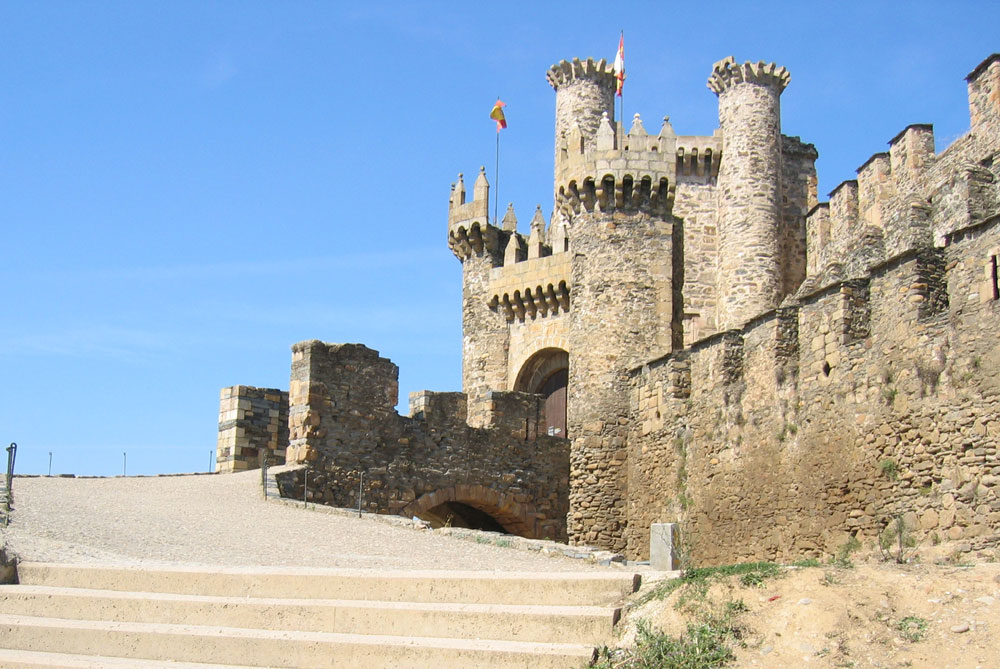
Cornatel Castle
Cornatel Castle stands as a commanding hill castle perched atop a rocky promontory in Priaranza del Bierzo, Spain. Its origins trace back to the 9th century AD, though the site itself reveals a much older legacy, built upon the remains of a significant Roman temple complex. This remarkable layering of history illustrates the strategic and cultural importance of the location across centuries, from classical antiquity through the medieval period and beyond.
Ancient origins and roman foundations
The earliest known construction at the site of Cornatel Castle dates to the Roman era, when a religious complex featuring terraced stone structures and a colonnaded façade was established. Archaeological evidence reveals that these terraces formed the podium of a temple, enclosed by thick limestone walls on three sides. The use of durable local limestone in the Roman construction provided a robust foundation that later medieval builders incorporated into the castle's fortifications. This continuity of occupation from Roman times through the medieval period is a testament to the site's enduring strategic and symbolic value.
Early medieval fortress and strategic significance
The castle's medieval history begins in the early medieval period, with records linking it to the Castle of Ulver, a fortress referenced in early medieval chronicles. The fortress gained prominence during the reign of King Bermudo II of León in the late 10th century, who recognized its strategic importance in controlling the surrounding territory. Throughout the 11th century, the castle was managed by castellans or tenentes, including notable figures such as Rapinato Ectaz and Pedro Velazquez. From 1093 to 1108, Jimena Muñiz governed the castle, maintaining close ties with King Alfonso VI of León and Castile, underscoring the castle's role in regional power dynamics.
Templar control and noble ownership
In the early 13th century, the castle entered a new phase under the control of the Knights Templar. In 1211, King Alfonso IX of León granted the nearby city of Ponferrada to the Templars, who took possession of Cornatel Castle by 1228. The Templars reinforced the castle's defenses, adapting it to the military needs of the time. Their tenure ended with the dissolution of the order in 1312, after which the castle passed through the hands of prominent noble families, including Álvar Núñez Osorio and Pedro Fernández de Castro. By the late 14th century, the castle was firmly in the possession of the Osorio family, with Pedro Álvarez de Osorio securing royal approval for his lordship.
Marriage alliances and regional influence
The union of Pedro Álvarez Osorio and Beatriz de Castro through marriage combined significant noble titles and expanded their influence in the region. This alliance exemplifies the castle's role not only as a military stronghold but also as a center of aristocratic power and territorial control during the late medieval period.
Conflicts and restoration in the 15th century
The castle's strategic importance made it a target during the turbulent second Irmandiña Revolt of 1467, when insurgent forces seized and heavily damaged the fortress. Following this, the owner undertook repairs in 1469 to restore the castle's defensive capabilities. After the death of Pedro Álvarez Osorio in 1483, a bitter family dispute erupted involving his widow María de Bazán and daughter Juana Osorio against claimant Rodrigo Enríquez Osorio. This conflict led to sieges of Cornatel Castle itself and lasted for two years, illustrating the castle's central role in local noble power struggles.
Intervention by the catholic monarchs
The Catholic Monarchs intervened in 1486, establishing the Marquisate of Villafranca for Juana Osorio and her husband Luis Pimentel, compelling Rodrigo Enríquez Osorio to relinquish control over Ponferrada. Despite this, Rodrigo reignited conflict in 1507, recapturing Ponferrada and laying siege to Cornatel and other fortresses, underscoring ongoing regional instability.
Later history and cultural significance
Following these conflicts, Cornatel Castle remained part of the Marquisate of Villafranca until the abolition of feudal lordships. In the 19th century, ownership transferred to the municipality of Ponferrada. The castle also inspired literary works, most notably serving as the setting for El Señor de Bembibre, a historical novel by Enrique Gil y Carrasco published in 1843, which helped cement its place in Spanish cultural heritage.
Architectural features and current condition
Cornatel Castle is characterized by its adaptation to the rugged rocky promontory on which it stands. The eastern and northern sides present steep drops exceeding 180 meters, providing natural defense. The castle's defensive system includes a single perimeter wall protecting the more accessible western and southern sides, topped with crenellated battlements and an adarve—a battlemented walkway allowing defenders to patrol the walls.
Roman remains integrated into medieval fortifications
Archaeological excavations have revealed the integration of Roman-era terraced stone structures into the castle's western section. These terraces, originally part of a temple podium, highlight the transformation of a classical religious site into a medieval fortress. The use of local limestone in both Roman and medieval construction demonstrates continuity in building materials and techniques.
Restoration and preservation efforts
After centuries of neglect and damage, particularly following the 15th-century conflicts and use as livestock shelter in the 19th and early 20th centuries, restoration efforts began in the early 2000s. These initiatives have stabilized vulnerable sections and improved visitor safety, although some internal galleries remain closed to the public. Today, the ruins clearly outline the castle's former scale and strategic design, inviting exploration and study.
Natural environment and unique botanical interest
The limestone cliffs supporting Cornatel Castle host a rare plant species, Petrocoptis viscosa, found only in this and adjacent cliff areas. This botanical rarity reflects the unique microclimate created by the castle's elevation and geographic setting, adding ecological significance to the site.
Visitor experience and museum exhibitions
Within the castle grounds, a museum presents permanent exhibitions that detail the fortress's historical phases and architectural evolution. The museum also showcases a collection of medieval pole weapons assembled by a local historical association, providing insight into the martial history of the site. Periodic exhibitions and cultural events further enrich the visitor experience, highlighting Cornatel Castle's layered history from ancient times through the medieval era.
Frequently asked questions (FAQ)
- How do I get to Cornatel Castle?
- Cornatel Castle is located near Priaranza del Bierzo in the León region of Spain. Visitors typically reach it by car, with parking available nearby. The castle is accessible via a path that borders the western section of the walls, leading up to the entrance at the foot of the cliff.
- What is the historical significance of Cornatel Castle?
- Cornatel Castle has a rich history dating back to the 9th century, built on Roman remains and later controlled by the Knights Templar and noble families. It played a strategic role in regional conflicts and noble power struggles during the medieval period.
- Can I visit the interior of Cornatel Castle?
- Visitors can explore the castle ruins and the museum within the grounds, which features exhibitions on the castle's history and medieval weaponry. Some internal galleries are closed for safety reasons, but the main areas and battlements are accessible.
- When is the best time to visit Cornatel Castle?
- The castle is best visited during spring and autumn when the weather is mild, making the climb and exploration more comfortable. Summer can be hot, and winter conditions may make access more challenging.
- Are there guided tours available at Cornatel Castle?
- Guided tours are sometimes offered during special events or peak tourist seasons. Visitors should check local tourism offices or the castle's official website for current information on tours and events.
- What architectural styles are evident at Cornatel Castle?
- Cornatel Castle exhibits a blend of <strong>early medieval fortress architecture</strong> with integrated <strong>Roman structural elements</strong>. Its defensive walls, battlements, and adarve reflect typical medieval military design adapted to the natural terrain.
Information
Sources & official resources
Verify the information above using these authoritative references.
Loading map...
Visitor reviews
No reviews yet. Been here? Write the first review and help other travelers!
Write the first reviewVisited this castle? Share your experience
Your review helps other travelers and adds first-hand knowledge to our encyclopedia.