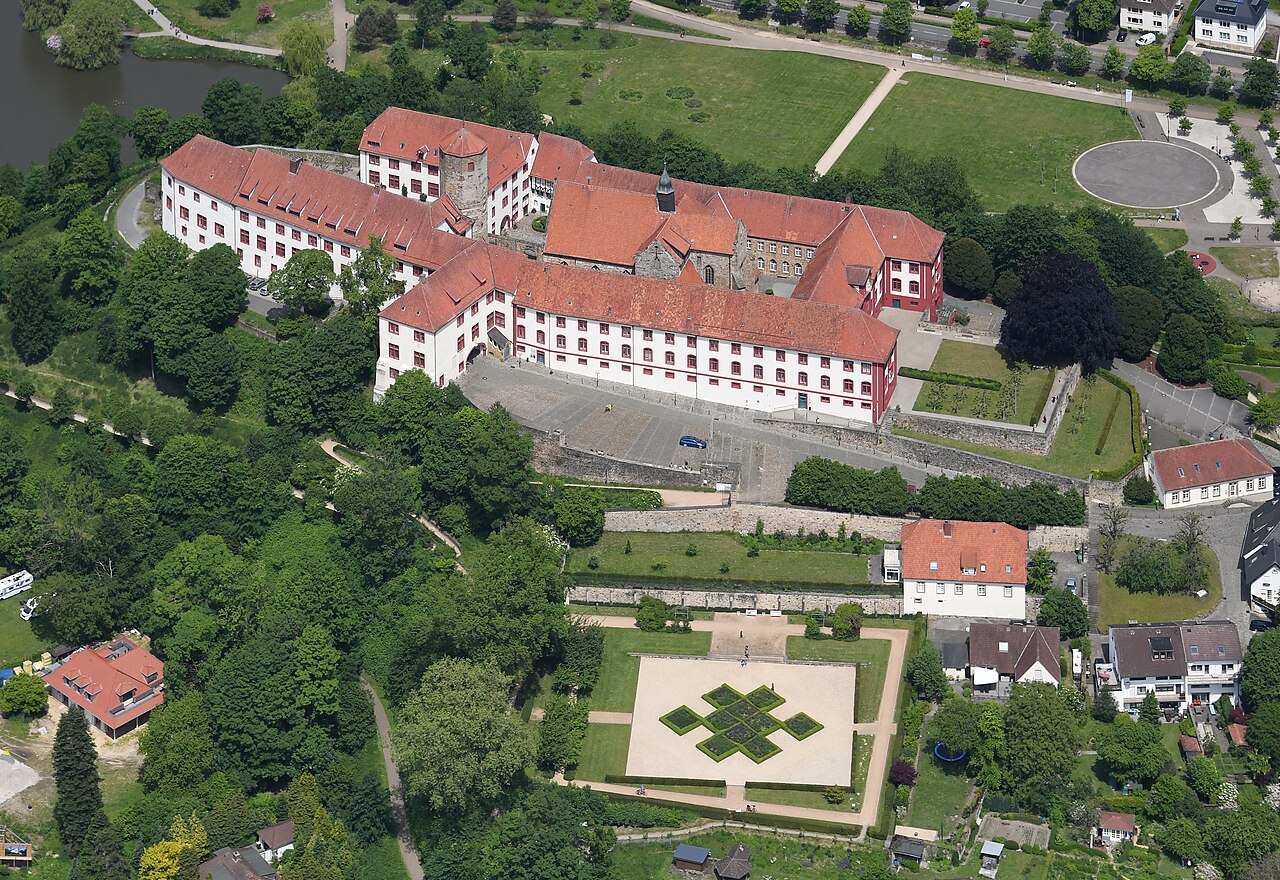
Tecklenburg Castle
Tecklenburg Castle stands as a prominent hilltop fortress in the town of Tecklenburg, Germany, renowned for its rich medieval heritage and its unique role as a cultural venue today. Originally constructed around 1100 by the Dutch Count of Zutphen, the castle was strategically positioned to oversee and protect a vital trade route connecting Lübeck, Bremen, Münster, and Cologne. Its elevated location on the Burgberg hill within the Teutoburg Forest provided commanding views and defensive advantages, making it a significant stronghold in northern Germany during the High Medieval period.
The castle's importance is underscored by its early mention in an 1184 document, which described it as the largest and most powerful hilltop castle in the region. Throughout its history, Tecklenburg Castle served as the seat of the rulers of the County of Tecklenburg, witnessing numerous political and military changes. It played a crucial role in regional power struggles involving the Archbishopric of Cologne, the Bishopric of Osnabrück, and other noble families, reflecting the complex feudal landscape of medieval Germany.
Historical evolution and political significance
The castle's origins trace back to the early 12th century, built by the Count of Zutphen to control trade and assert territorial authority. Between 1168 and 1190, the surrounding county came under the influence of Archbishop Philip of Cologne, although the castle itself remained under the control of local counts through feudal arrangements. A pivotal moment occurred in 1226 when the castle was placed under papal ban for harboring Frederick of Isenberg, accused of murdering Archbishop Engelbert of Cologne. Subsequently, the castle was confiscated by the Cologne church and later transferred to the Bishop of Osnabrück by 1282.
Following the extinction of the original counts in 1262, ownership passed to the Counts of Bentheim and then the Counts of Schwerin, who held the castle until 1562. During this era, the castle's northern territories were lost to the Bishopric of Münster in 1400, diminishing its strategic importance as trade routes shifted toward Osnabrück.
Religious and military transformations in the 16th century
The 16th century marked a significant religious shift under Count Conrad, who led Tecklenburg to become the first territory in Westphalia to adopt the Protestant Reformation in 1527. The county joined the Schmalkaldic League in 1538, aligning itself with Protestant states. This period saw important military upgrades, including the construction of a bastion in the northeastern corner to strengthen defenses amid religious conflicts.
Countess Anna, Conrad's daughter, later enhanced the castle's residential comfort by enlarging windows and creating a new entrance from the northeast via Schlossstraße. These modifications partially concealed the earlier bastion and reflected a transition from purely military functions to a more stately residence. The 17th century brought further architectural developments, including the construction of the Mauritz Gate, whose richly decorated façade still partially survives today.
Architectural features and remaining structures
Tecklenburg Castle is characterized by its dual-courtyard layout comprising an outer ward and an inner ward, separated by a defensive moat and embankment. Portions of these fortifications remain visible, offering insight into the castle's original defensive design.
One of the castle's most notable features was the Hakenturm or Schiffsturm, a pentagonal tower that crowned the embankment and was the tallest structure in the complex. Today, only its foundation survives at the embankment's height, but archaeological studies provide clues about its former prominence.
The Mauritz Gate serves as the main entrance from the northeast and dates to the 17th century. Its lower floor and parts of the upper floor remain intact, displaying ornate stonework and a frieze adorned with coats of arms. This gate marks the castle's later phase when aesthetic and residential considerations became important.
Within the inner courtyard, buildings once enclosed the space on three sides, though only foundation remnants remain today. Among these ruins is the Krönchen, a large room traditionally believed to have housed the castle chapel, though no conclusive archaeological evidence confirms this. Given the castle's significance, the presence of a chapel is plausible.
The northeastern bastion, constructed in the 16th century, was largely buried during later modifications but was rediscovered in 1944 during air raid shelter construction. Its vaulted stone structure exemplifies military architectural techniques of the period.
Reuse of castle materials and local influence
After the castle's decline, many stones were repurposed in local buildings, including a Renaissance fireplace in the Drei Kronen hotel, decorative bridge piers at Haus Marck, and parts of the town's former prison and courthouse. These elements testify to the castle's lasting architectural influence on Tecklenburg.
Modern cultural significance and preservation efforts
Following its sale to the Kingdom of Prussia in 1707, Tecklenburg Castle lost its independence and was gradually dismantled for building materials. By 1744, it was largely in ruins, with preservation efforts only beginning in the late 19th century.
A notable addition is the Wierturm, a round brick observation tower built in 1884 as a memorial to Johann Weyer, a court physician. This tower remains a popular vantage point, offering sweeping views of the town and surrounding countryside. Visitors can access it by obtaining a key from the local tourist office.
Since 1927, the castle's outer courtyard has been used as an open-air theatre venue. The Tecklenburg Open-Air Theatre, established in 1949, accommodates approximately 2,300 spectators and features professional stage technology, making it a significant cultural landmark in the region.
Today, Tecklenburg Castle is a well-preserved ruin that offers valuable insights into medieval military architecture and the socio-political history of Westphalia. Its combination of historic significance and ongoing cultural use ensures its place as a cherished heritage site in Germany.
Frequently asked questions (FAQ)
- How do I visit Tecklenburg Castle and the open-air theatre?
- Tecklenburg Castle is open to visitors year-round, with the open-air theatre hosting performances primarily from late spring to early autumn. Tickets for theatre events can be purchased online or at the venue, while the castle grounds are accessible for self-guided tours during daylight hours.
- What is the historical significance of Tecklenburg Castle?
- Tecklenburg Castle was a major medieval hilltop fortress controlling key trade routes and serving as the seat of the County of Tecklenburg. It played a vital role in regional power struggles and was the first territory in Westphalia to adopt the Protestant Reformation.
- Can I access the Wierturm observation tower?
- Yes, visitors can access the Wierturm, a brick observation tower on the castle grounds, by obtaining a key from the local tourist office in Tecklenburg. The tower offers panoramic views of the town and surrounding landscape.
- When was Tecklenburg Castle built and by whom?
- Tecklenburg Castle was built around 1100 by the Dutch Count of Zutphen to protect an important trade route connecting Lübeck, Bremen, Münster, and Cologne.
- Why did Tecklenburg Castle lose its strategic importance?
- The castle lost strategic importance after 1400 due to territorial losses to the Bishopric of Münster and the rerouting of trade roads through Osnabrück, combined with changes in military technology that rendered its defenses outdated.
Information
Sources & official resources
Verify the information above using these authoritative references.
Loading map...
Visitor reviews
No reviews yet. Been here? Write the first review and help other travelers!
Write the first reviewVisited this castle? Share your experience
Your review helps other travelers and adds first-hand knowledge to our encyclopedia.