
Iburg Castle
Iburg Castle stands as a remarkable example of a hill castle with a rich history intertwined with religious, military, and political significance in the region of Bad Iburg, Germany. Originally established in the 11th century, this castle served as the residence of the bishops of Osnabrück for over five centuries, from around 1100 until 1673. Its strategic location on a natural hill ridge near the Teutoburg Forest allowed it to function as a fortified stronghold, a religious center, and later as a palace complex, reflecting the evolving architectural and cultural landscape of medieval and early modern Germany.
The castle's origins trace back to a wooden fortress founded around 1070, with archaeological evidence suggesting earlier fortifications dating to the 9th or 10th century. This early fortification was enhanced with the establishment of a Benedictine monastery by Bishop Benno II of Osnabrück in 1080, who brought twelve monks from Mainz to settle there. The castle's initial purpose was both military and religious, with a chapel dedicated to St. Peter built within its confines, symbolizing the fusion of spiritual and defensive functions.
Historical significance and development
Throughout its history, Iburg Castle played a central role in the religious and political affairs of the Osnabrück diocese. It was the seat of the Prince-Bishopric of Osnabrück and witnessed numerous historical events, including military conflicts, religious reforms, and administrative changes. Notably, the castle was the birthplace of Sophia Charlotte of Hanover in 1668, who later became the Queen consort of Prussia, linking the site to significant European dynastic history.
The castle endured several sieges and occupations, including during the Thirty Years’ War, when it suffered damage and was occupied by Swedish forces. The presence of the octagonal Bennoturm, built between 1492 and 1508, is a testament to the castle's defensive capabilities. This tower served as a prison, famously holding Anabaptist prisoners from Münster in the 16th century, including Heinrich Graes, who acted as an informant.
Architectural features and renovations
The castle complex is notable for its diverse architectural elements that reflect its long history. The oldest surviving structure is an 11th-century residential tower, nearly square in shape, which was later enclosed by a ring wall. The addition of a flank tower in the early 12th century enhanced its defensive strength. The Bennoturm remains a prominent feature, symbolizing the castle’s role in regional justice and imprisonment.
In the early 17th century, under the direction of Prince-Bishop Philipp Sigismund of Brunswick-Wolfenbüttel, the castle and monastery were transformed into an elaborate palace complex. The Rittersaal or Knights’ Hall, measuring 12 by 15 meters, originally served as a hunting and dining hall. It was redecorated between 1650 and 1661 by architect Johannes Crafft after damage sustained during the Thirty Years’ War. The hall’s ceiling features a rare Baroque trompe-l’œil fresco by Andrea Alovisii, depicting Zeus and the labors of Heracles, unique north of the Alps for its intact preservation. The walls display 73 portraits of Osnabrück bishops and regional rulers, and the floor is paved with diamond-shaped tiles representing the Bavarian coat of arms of Bishop Franz Wilhelm von Wartenberg, restored in 1997.
Religious buildings within the castle
The castle grounds include two churches: the Catholic St. Clemens Church and the Evangelical Lutheran Schlosskirche. St. Clemens Church dates to the 13th century and is characterized by a three-aisled hall with a transept and rectangular choir. Its interior contains Baroque elements by Johann Conrad Schlaun and a medieval hagioscope, an opening historically used to allow lepers to observe services. After the monastery’s dissolution, the church was repurposed as a powder magazine before returning to religious use.
The Schlosskirche was built in 1664 as a court chapel accessible only through the prince-bishop’s wing. It retains much of its original Baroque furnishings and received a neo-Renaissance stairway addition in 1913, donated by Berta von Bardeleben, whose coat of arms is featured in the stained glass windows.
Monastic and ancillary buildings
The Benedictine convent buildings largely date from a mid-18th-century Baroque reconstruction around 1750, designed by Johann Conrad Schlaun. These structures are notable for their stucco decorations depicting biblical scenes, allegories, emblems, and motifs of plants and animals, showcasing the artistic craftsmanship of the period.
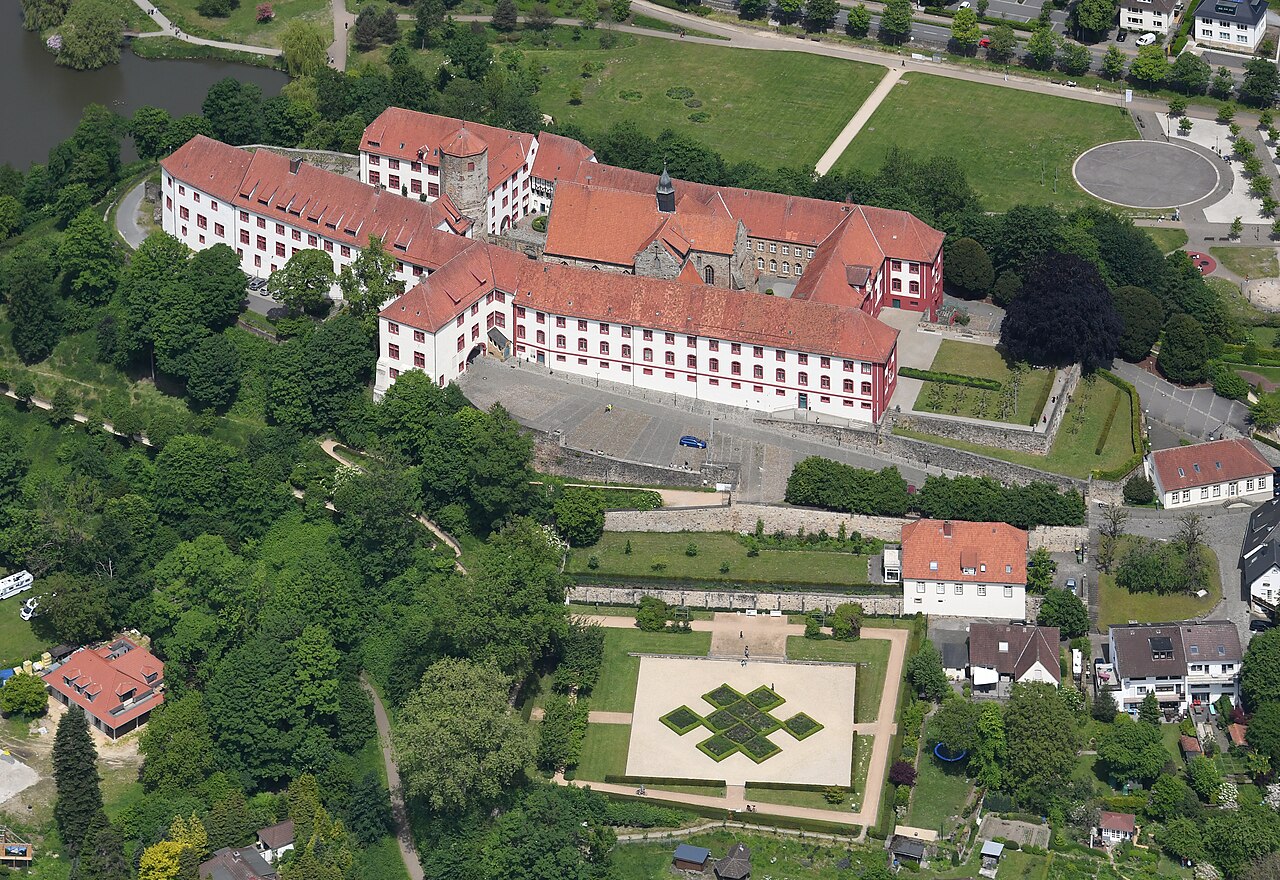
Photo by Carsten Steger • CC BY-SA 4.0
Preservation and current use
Following the secularization of the Benedictine monastery in 1803, the monastic community was dissolved, and much of the monastery’s inventory was sold, except for church furnishings and a significant library. Unfortunately, the library was largely destroyed in a bombing raid in 1944. The castle has since served various administrative and institutional functions, including district administration, Nazi-era schools, a police academy, and currently houses the Bad Iburg district court and offices of the State Building Management Region North-West.
Archaeological efforts beginning in 1900 have uncovered important artifacts such as a Thebal ring, abbatial staffs, medieval crossbow parts, writing styli, floor tiles, and ceramic containers, which are displayed in the castle museum. The grounds feature a reconstructed 16th-century knot garden spanning 3,500 square meters, complete with boxwood hedges, sandstone walls, benches, and a rose-bower promenade leading to the castle mill, enhancing the visitor experience.
Notable architectural elements
The main entrance gate, forged in 1781 by Johann Georg Reinhard and designed by Franz Schädler, remains a striking feature. The former court apothecary building, dating from around 1600, connects the castle and monastery areas and includes original elements such as a stone fireplace bearing the initials of Prince-Bishop Philipp Sigismund and the date 1600.
Overall, Iburg Castle is a well-preserved historical monument that offers insight into the architectural, religious, and political history of Westphalia. Its combination of medieval fortifications, Baroque artistic achievements, and adaptive reuse over centuries makes it a significant cultural heritage site and a popular destination for visitors interested in German history and castle architecture.
Frequently asked questions (FAQ)
- What are the opening hours of Iburg Castle?
- Iburg Castle is open to visitors from 10 AM to 6 PM daily during the summer months, and from 10 AM to 4 PM in the winter. It's advisable to check the castle's official website for any seasonal changes and special holiday hours.
- How do I get to Iburg Castle?
- Iburg Castle is located in Bad Iburg, Germany, and can be accessed by car, bus, or on foot. The nearest train station is in Osnabrück, from where you can take a local bus or taxi to reach the castle.
- What is the historical significance of Iburg Castle?
- Iburg Castle dates back to the 11th century and played a significant role in the region's history as a defensive stronghold. It has witnessed numerous historical events and changes in ownership, reflecting the architectural and cultural evolution over the centuries.
- Can I explore the castle grounds freely?
- Yes, visitors can freely explore the castle grounds and enjoy the beautiful views of the surrounding area. However, guided tours may be available to provide more in-depth information about the castle's history and architecture.
- Is Iburg Castle accessible for people with disabilities?
- Iburg Castle has made efforts to enhance accessibility for visitors with disabilities. While some areas may have limited access due to the castle's historic structure, there are pathways and facilities designed to accommodate various needs.
- When is the best time to visit Iburg Castle?
- The best time to visit Iburg Castle is during the late spring and summer months when the weather is pleasant and the gardens are in full bloom. This is also when most events and guided tours take place, providing a richer experience.
- What are the ticket prices for Iburg Castle?
- Admission to Iburg Castle typically costs around 5 Euros for adults, with discounts available for students and children. Special events may have different pricing, so it’s best to check the official website for the most current information.
- Are there any nearby attractions to visit while at Iburg Castle?
- Yes, in addition to Iburg Castle, visitors can explore the beautiful surrounding landscape, including the Teutoburg Forest, which offers hiking trails and scenic views. The nearby town of Bad Iburg also features charming cafes and shops for visitors to enjoy.
Photo gallery

Information
Website
Visit websiteSources & official resources
Verify the information above using these authoritative references.
Loading map...
Visitor reviews
No reviews yet. Been here? Write the first review and help other travelers!
Write the first reviewVisited this castle? Share your experience
Your review helps other travelers and adds first-hand knowledge to our encyclopedia.