Tatsuoka Castle
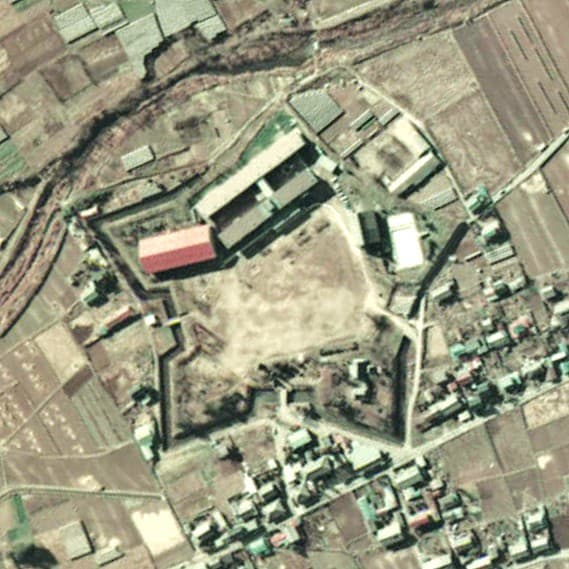
Tatsuoka Castle (Tatsuoka-jō) is a distinctive example of a Bakumatsu period fortress, notable for its rare pentagonal star fort design. Constructed in the 19th century during Japan's late feudal era, it served as the primary stronghold for the Tatsuoka Domain, governed by the Ogyū-Matsudaira clan. Located in what is now the city of Saku in Nagano prefecture, this castle exemplifies the adaptation of Western military architectural concepts in Japan during a time of significant political and social change.
Alongside the Goryōkaku fortress in Hakodate, Hokkaidō, Tatsuoka Castle is one of only two known star forts in Japan, making it an architectural rarity and a valuable cultural heritage site. Its pentagonal layout was inspired by European star fort designs, which were developed to withstand artillery attacks more effectively than traditional Japanese castles.
Historical context and construction
The castle was built in the late Edo period, specifically during the Bakumatsu era, a time when Japan was opening up to Western influences after centuries of isolation. The Ogyū-Matsudaira clan, who ruled the Tatsuoka Domain, commissioned the fortress as a modern defensive structure reflecting new military technologies and strategies.
The construction of Tatsuoka Castle marked a significant departure from the conventional Japanese castle design, which typically featured irregular shapes and multiple baileys. Instead, the star-shaped plan allowed for better defensive coverage and reduced blind spots, a feature critical for withstanding cannon fire and musket attacks.
Architectural features and layout
The castle's most striking feature is its pentagonal star shape, characterized by five bastions projecting outward, which provided overlapping fields of fire to defenders. This design minimized dead zones around the walls and allowed defenders to cover each other effectively.
The walls were constructed using traditional Japanese stone masonry techniques, but the overall layout was heavily influenced by European fortification principles. The castle grounds included moats and earthen ramparts that complemented the star-shaped walls, enhancing its defensive capabilities.
Unlike many Japanese castles that emphasize tall keeps or donjons, Tatsuoka Castle's design focused on low, thick walls and bastions, reflecting the shift towards artillery warfare. The interior structures were modest, primarily serving administrative and residential purposes for the ruling clan and their retainers.
Decline and current state
Following the Meiji Restoration and the abolition of the feudal domain system, Tatsuoka Castle lost its military significance. Over time, the castle fell into disrepair and much of its original structures were dismantled or eroded.
Today, Tatsuoka Castle remains as archaeological ruins, with its distinctive star-shaped earthworks and stone foundations still visible. The site has been protected as a National Historic Site since 1934, ensuring its preservation and recognition as an important cultural landmark.
Visiting Tatsuoka Castle
The castle ruins are accessible to the public and provide a unique glimpse into Japan's adaptation of Western military architecture. Visitors can explore the remains of the star-shaped fortifications and learn about the Bakumatsu period through onsite information panels and local museums.
The site is particularly popular among history enthusiasts and those interested in military architecture, offering a rare opportunity to see a star fort in an East Asian context. Seasonal events and guided tours occasionally take place, enhancing the educational experience.
Frequently asked questions (FAQ)
- What is the historical significance of Tatsuoka Castle?
- Tatsuoka Castle, built in the late 16th century, played a crucial role in the region's defense during Japan's feudal era. It served as a strategic stronghold for various samurai clans and is a testament to Japan’s rich history of castle architecture and warfare.
- When was Tatsuoka Castle constructed?
- Tatsuoka Castle was constructed in 1583 by the Takeda clan. It underwent various renovations and modifications throughout the Edo period, reflecting the architectural styles of different eras.
- What are the opening hours for Tatsuoka Castle?
- Tatsuoka Castle is typically open to visitors from 9 AM to 5 PM. However, it's advisable to check for seasonal variations or special events that may affect opening hours.
- Can I access Tatsuoka Castle with public transportation?
- Yes, Tatsuoka Castle is accessible via public transportation. Visitors can take a train to Saku City and then a short bus ride or taxi to the castle grounds.
- Is it possible to explore the interior of Tatsuoka Castle?
- Currently, Tatsuoka Castle is primarily an outdoor attraction, and the interior is not fully accessible for exploration. However, visitors can enjoy scenic views and explore the surrounding park area.
- When is the best time to visit Tatsuoka Castle?
- The best time to visit Tatsuoka Castle is during the spring (March to May) and autumn (September to November) when the weather is pleasant and the cherry blossoms or autumn foliage provide stunning backdrops. Summer can be hot, while winter may bring snow.
- What are the ticket prices for Tatsuoka Castle?
- Admission to Tatsuoka Castle is generally free, allowing visitors to enjoy the grounds without any charge. Special events or guided tours may have associated fees, so it's best to check in advance.
- Are there any nearby attractions to see after visiting Tatsuoka Castle?
- Yes, nearby attractions include the Saku City Museum and the scenic Lake Daisan. Visitors can also explore the beautiful landscapes of the surrounding Nagano Prefecture.
- How do I get more information about events at Tatsuoka Castle?
- For the latest information on events and activities at Tatsuoka Castle, you can visit the official website or contact the local tourism office in Saku. They provide updates on festivals, guided tours, and other special programs.
Photo gallery

Photo by retouch: Qurren (talk).•Attribution
Information
Loading map...
Visitor reviews
No reviews yet. Been here? Write the first review and help other travelers!
Write the first reviewVisited this castle? Share your experience
Your review helps other travelers and adds first-hand knowledge to our encyclopedia.